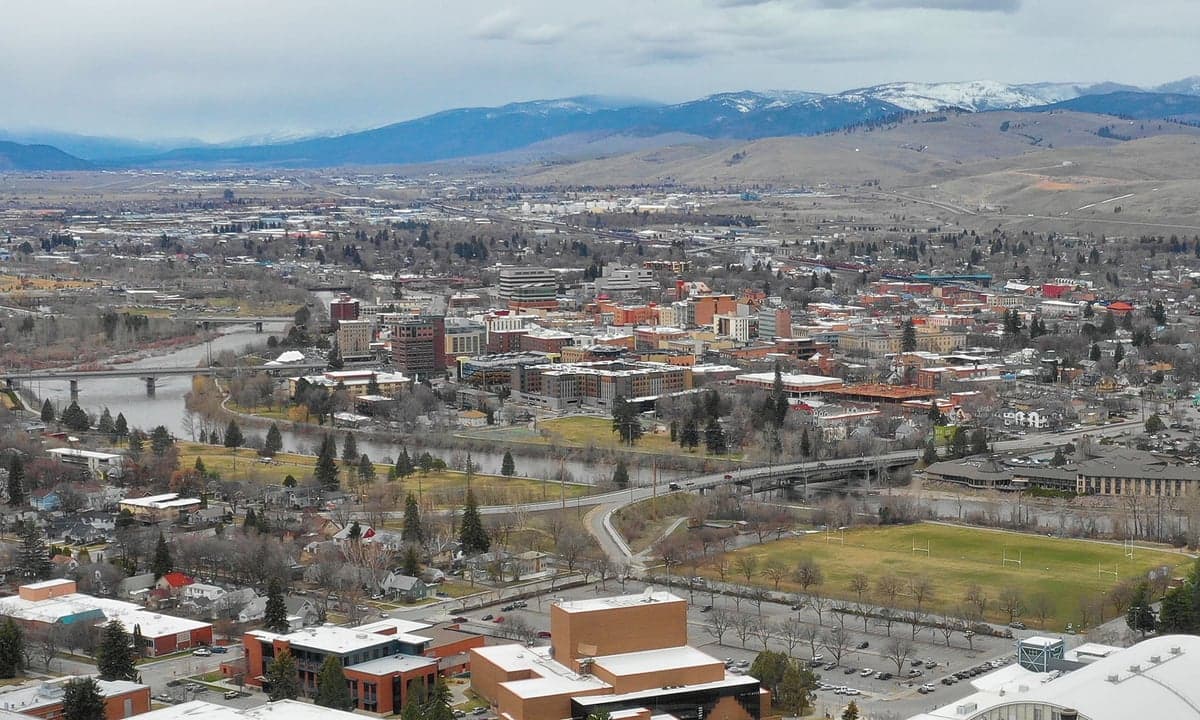
Photo: Wikipedia
Personal Sovereignty in Missoula, MT
Viable for self-reliance. Generally workable, though some barriers may limit total independence.
What does Personal Sovereignty tell us?
Personal Sovereignty measures your capacity for self-reliance and independence with minimal government friction. Higher scores mean fewer barriers between you and the way you want to live... but it assumes you have the space you need and good neighbors.
What does this tell us?
Personal Sovereignty measures your capacity for self-reliance and independence with minimal government friction. Higher scores mean fewer barriers between you and the way you want to live... but it assumes you have the space you need and good neighbors.
State Policy
Energy independence: Net exporter (120% of energy produced in-state)
Personal Liberty
Homesteading

Personal Liberty Analysis
Missoula, Montana, presents a deeply conflicted picture for those prioritizing personal sovereignty. While the state’s constitutional and cultural DNA strongly favors individual liberty, the city itself has become a flashpoint for progressive governance that can feel at odds with a survivalist or prepper mindset. For the conservative-leaning individual or family weighing relocation, the key question isn’t whether Montana is free—it’s whether Missoula’s local policies will let you exercise that freedom without constant friction. The answer requires a hard look at taxes, guns, land use, and the everyday reality of living under a city council that often views personal autonomy as negotiable.
Tax burden and regulatory posture in Missoula County
Montana’s state-level tax climate is a genuine advantage. There is no state sales tax, which means your purchasing power isn’t eroded every time you stock up on supplies. Property taxes in Missoula County, however, are a different story. The county’s average effective property tax rate hovers around 0.83% of assessed home value—higher than the national average and notably steeper than in rural eastern Montana counties. Recent reappraisals have sent tax bills soaring for long-time residents, and new arrivals should budget for a significant annual cost. Income tax is a flat 6.75% on all taxable income over a modest threshold, which is moderate but not negligible. The regulatory posture in Missoula itself leans interventionist. The city has adopted strict short-term rental ordinances, aggressive rental inspection programs, and a building code that can make even simple outbuilding construction a permitting headache. For someone wanting to quietly improve their property without government oversight, Missoula’s bureaucracy is a persistent irritant rather than a partner.
Self-defense and gun law specifics in Montana’s liberal hub
Montana’s state preemption law is a powerful shield. The state explicitly prohibits local governments from enacting their own firearm ordinances, which means Missoula cannot ban concealed carry or restrict magazine capacities on its own. Montana is a constitutional carry state—no permit is required to carry a concealed firearm for anyone legally able to possess one. This is non-negotiable state law, and Missoula must comply. However, the cultural friction is real. The city council has passed symbolic resolutions supporting “red flag” laws and universal background checks, and local law enforcement’s posture toward gun owners can feel less supportive than in neighboring counties like Ravalli or Granite. For the prepper, the practical takeaway is that your legal right to keep and bear arms is solid, but you will be living in a community where a significant portion of your neighbors and local officials view that right with suspicion. Range access is good—the Deer Creek Shooting Range is a well-maintained public facility just south of town—but expect to drive 20-30 minutes to use it without city noise complaints.
Self-reliance and homesteading viability: lot sizes, zoning, and off-grid feasibility
This is where Missoula’s appeal to the self-reliant individual hits a wall. Within city limits, standard residential lots are typically 5,000 to 7,000 square feet—enough for a garden and a chicken coop, but not for serious homesteading. Zoning is restrictive: raising livestock beyond a few hens is prohibited in most residential zones, and accessory dwelling units (ADUs) require a lengthy conditional use permit process. Off-grid living is effectively illegal inside city limits. The city requires connection to municipal water and sewer, and building codes mandate grid-tied electrical systems for new construction. For true self-reliance, you must look outside the urban growth boundary. Rural Missoula County parcels of 5 to 20 acres are available in areas like Frenchtown, Lolo, and the Bitterroot Valley corridor, but prices have skyrocketed—expect $100,000–$200,000 per acre for raw land with water rights. The county’s health department enforces strict septic and well regulations, and the fire department imposes defensible space requirements that can limit tree cover. Homesteading is possible, but it requires significant capital and a willingness to navigate a permitting process that feels designed for suburban compliance, not frontier independence.
Personal liberties: parental rights, medical autonomy, speech, and property
Parental rights in Montana are relatively strong by national standards. The state’s constitution explicitly recognizes the “right, duty, and responsibility” of parents to care for their children. Missoula County Public Schools, however, have adopted policies that can alarm conservative parents. The district’s “safe schools” policy includes gender identity and sexual orientation as protected categories, and curriculum materials have been a source of ongoing controversy. Opt-out procedures exist but are not always straightforward. Medical autonomy is a mixed bag. Montana has no state-level vaccine mandate for adults, and the 2023 passage of SB 154 prohibits discrimination based on vaccine status for public services. However, Missoula’s private healthcare systems—primarily Providence St. Patrick Hospital and Community Medical Center—have their own policies, and some patients report difficulty finding providers willing to honor conscientious objections to standard protocols. Free speech is protected by the Montana Constitution, which explicitly guarantees the right to “speak, write, and publish freely.” The University of Montana campus has seen its share of speech controversies, but off-campus, the legal framework is robust. Property rights are where the tension is most acute. Missoula’s growth policy and zoning code heavily regulate land use, and the city has aggressively pursued code enforcement against properties deemed “nuisances”—including those with visible storage of materials, unregistered vehicles, or unpermitted structures. For the prepper who values privacy and the right to use their land as they see fit, Missoula’s code enforcement culture is a constant source of low-grade conflict.
Overall, Missoula offers a paradox: a city in a free state where local governance often works against the very autonomy that draws people to Montana. For the single individual or family with a survivalist mindset, the calculus is clear. The state-level protections—constitutional carry, no sales tax, parental rights language, and strong free speech guarantees—provide a solid foundation. But the day-to-day experience in Missoula involves navigating a city government that views personal sovereignty as something to be managed, not celebrated. Compared to liberal strongholds like Portland or Seattle, Missoula is significantly freer—you can carry a firearm without a permit, you won’t pay sales tax, and your property rights are stronger. Compared to rural Montana counties like Sanders or Mineral, however, Missoula feels like a different country. For those willing to live on the outskirts—in the county, outside the urban growth boundary—the balance tips back toward freedom. But for anyone expecting to move into Missoula proper and live unbothered, the reality is that you will be trading some autonomy for access to the amenities and community that a small city provides. The strategic move is to buy land in the county, commute for work, and treat Missoula as a resource hub rather than a home base. That’s the path that preserves the most sovereignty while still benefiting from what the area offers.

* Values derived from national, state, county, city and local statistics and may differ in a specific area. Last updated: 2026-04-23T04:42:42.000Z
Narrative content on this page is AI-generated and may contain mistakes. Verify any details that matter before acting on them.
ReloMaps may earn a commission from affiliate links at no extra cost to you.

