
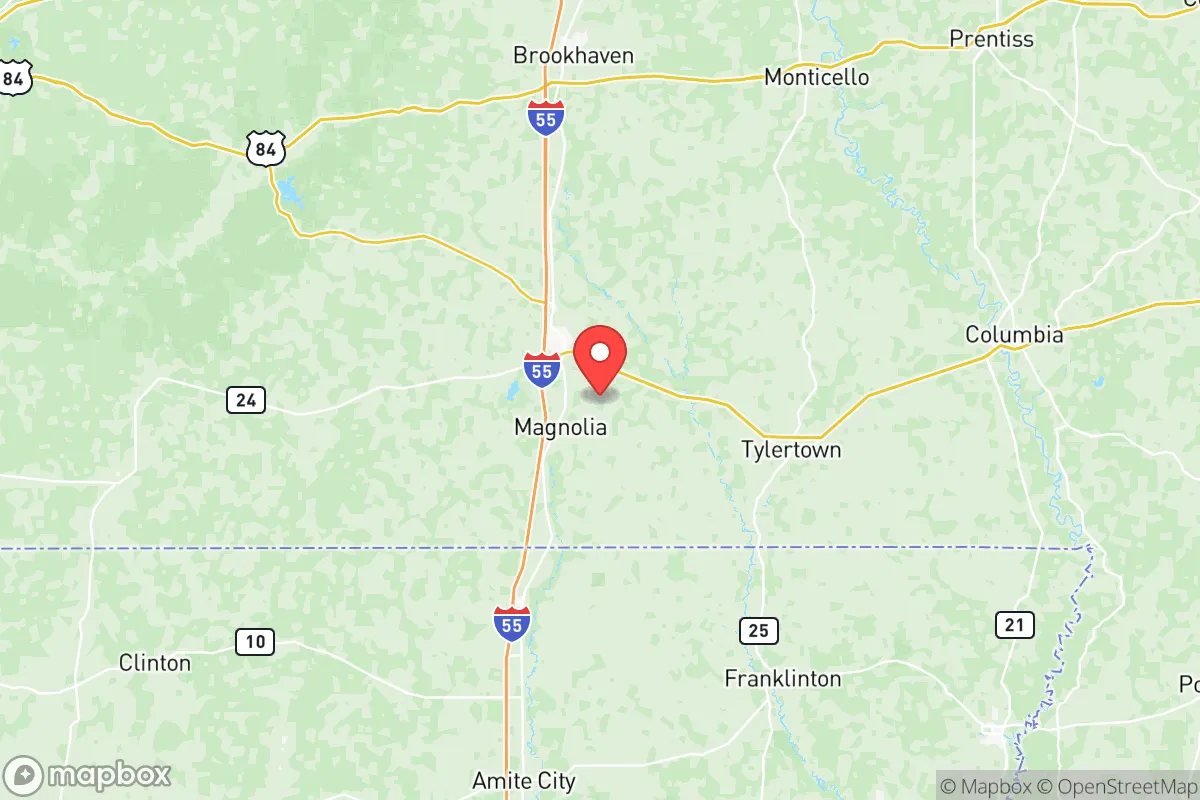
Photo: Wikipedia
Political ClimatePolitical Climate in Pike County
Showing district-level results — no local-only data available.
Local Political AnalysisPolitical Analysis of Pike County
Pike County, Mississippi, leans solidly Republican with a Cook Partisan Voting Index (PVI) of R+14, making it notably more conservative than the state of Mississippi as a whole, which sits at R+11. This isn't a recent shift—the county has been trending red for decades, driven largely by the rural and small-town electorate outside of the city of McComb. While the county as a whole reliably votes GOP in statewide and federal races, there are real pockets of blue, particularly in McComb itself and the historically Black communities around Magnolia and Summit, which often vote Democratic by wide margins. The swing precincts tend to be the more suburban edges of McComb and the Osyka area, where ticket-splitting is more common, especially in local sheriff and supervisor races.
How it compares
Compared to Mississippi's statewide R+11, Pike County's R+14 means it is about three points more conservative than the average Mississippi county. That gap is significant because it places Pike in the same league as the reliably red counties of the Pine Belt, like Lamar and Forrest, rather than the more competitive Delta counties. In practice, this means that while Mississippi as a whole occasionally flirts with competitive Senate races (like the 2018 special election), Pike County almost never does—Republican candidates routinely win here by double digits. The Democratic stronghold of McComb, which makes up roughly a third of the county's population, is simply outvoted by the surrounding rural precincts. That said, the county's political geography is more nuanced than the PVI suggests: local elections often hinge on personality and race, not just party label, and it's not uncommon to see a Democrat win a county supervisor seat in a precinct that voted for Trump by 20 points.
What this means for residents
For conservative residents, Pike County feels like a comfortable place to live politically. Republican candidates are almost always a safe bet, and conservative values are reflected in local policy, from school board decisions to zoning debates. For liberal residents, the reality is more mixed. While McComb provides a reliable Democratic base and a more progressive social atmosphere—especially among younger residents and at the local university—the countywide tilt means that progressive policy priorities rarely gain traction at the county level. That said, the political divide is not as sharp as in some parts of the country. People here tend to know their neighbors across party lines, and local issues like road maintenance, hospital access, and the health of the railroad economy often transcend partisan bickering. The biggest cultural distinction is the urban-rural split: McComb feels like a small city with a diverse, working-class identity, while the outlying towns like Magnolia, Summit, and Osyka are deeply rural and traditionally conservative.
One notable policy distinction that sets Pike County apart from the rest of Mississippi is its relatively higher reliance on the railroad and manufacturing economy, which has created a more pragmatic, union-friendly strain of conservatism in some precincts. You don't hear as much anti-union rhetoric here as you do in the more agricultural Delta or the coastal counties. The county also has a higher percentage of Black residents than the state average, which shapes the local political conversation in ways that are often more direct and less coded than in whiter parts of the state. Looking ahead, the trajectory is likely to continue its slow march rightward, driven by the same rural-to-suburban migration patterns affecting much of the South, but the Democratic base in McComb is resilient enough to keep local races competitive for the foreseeable future.

State Political ClimatePolitical Climate in Mississippi
State Political AnalysisPolitical Environment in the State
Mississippi is one of the most reliably Republican states in the nation, with a Cook Partisan Voting Index of R+11, meaning it votes about 11 points more Republican than the country as a whole. The state hasn't voted for a Democratic presidential candidate since Jimmy Carter in 1976, and every statewide elected official is currently a Republican. Over the past 10-20 years, the shift has been dramatic — Mississippi was already conservative, but the realignment of white voters, particularly in rural areas and the Gulf Coast, has turned what was once a competitive state for Democrats into a GOP stronghold where the primary election is often the only contest that matters.
Urban vs. rural divide
The political map of Mississippi breaks down along familiar lines: the state's few urban centers lean Democratic, while the vast rural and suburban areas are deeply Republican. Jackson, the capital and largest city, is a Democratic stronghold — Hinds County went 78% for Joe Biden in 2020 — but it's surrounded by heavily Republican suburbs like Madison and Ridgeland, where GOP margins often exceed 70%. The Mississippi Delta, including towns like Greenville and Clarksdale, is predominantly Black and reliably Democratic, but these areas have shrinking populations. The Gulf Coast, anchored by Biloxi and Gulfport, has trended hard right over the past two decades, driven by military retirees, casino workers, and a growing evangelical presence. DeSoto County, just south of Memphis, is the state's fastest-growing area and one of its most Republican — it voted 72% for Donald Trump in 2020. The only real outlier is Oxford, home to the University of Mississippi, which has become a blue dot in a red sea as the student population and faculty have pulled Lafayette County toward the center.
Policy environment
Mississippi's policy environment is among the most conservative in the country. The state has no income tax on Social Security benefits and has been phasing out its personal income tax entirely — the rate dropped to 4.0% in 2024 and is scheduled to reach 0% by 2032. Sales tax is 7% on most goods, with local add-ons pushing it higher in some cities. The state is a right-to-work state with some of the weakest labor protections in the nation. Education policy is dominated by school choice: Mississippi has a robust charter school law, a growing Education Scholarship Account program for students with disabilities, and open enrollment in many districts. Healthcare is a different story — the state has not expanded Medicaid under the Affordable Care Act, leaving roughly 75,000 residents in the coverage gap, and rural hospital closures have been a persistent problem. Election laws are restrictive by national standards: voter ID is required, early voting is limited to in-person absentee voting with an excuse, and same-day registration is not allowed. The state also has a lifetime ban on voting for people with certain felony convictions, though a 2023 law restored voting rights to some nonviolent offenders after they complete their sentences.
Recent policy direction
The last few years have seen Mississippi double down on cultural conservatism while also pursuing economic reforms. In 2023, the legislature passed a near-total abortion ban with no exceptions for rape or incest, triggered by the Dobbs decision. Gun laws are among the most permissive in the country: permitless carry was enacted in 2016, and the state has strong Stand Your Ground and Castle Doctrine protections. On education, the 2022 "Parents' Bill of Rights" law requires schools to notify parents of any changes to a student's mental or physical health, effectively restricting discussions of gender identity in classrooms. Property rights are strongly protected — Mississippi is a non-disclosure state for real estate transactions, meaning sale prices aren't public record, and there's no statewide property tax reassessment cycle, which keeps tax bills predictable. On privacy and surveillance, the state has no comprehensive data privacy law, but it did pass a 2023 law restricting TikTok on government devices. Voting access has been a flashpoint: the 2023 law restoring voting rights to some felons was a rare bipartisan compromise, but efforts to expand early voting or no-excuse absentee voting have repeatedly failed. The overall direction is clear: Mississippi is moving further right on social issues while slowly liberalizing its tax code.
Civil unrest & political movements
Mississippi doesn't see the kind of large-scale protests common in other states, but there have been notable flashpoints. The 2020 racial justice protests in Jackson and Oxford were relatively small compared to national trends, but they did draw attention to the state's Confederate monuments and the ongoing debate over the state flag — which was changed in 2020 to remove the Confederate battle emblem. The flag change was a genuinely bipartisan effort, passed by a Republican supermajority legislature and signed by a Republican governor. Immigration politics are less visible here than in border states, but there's a small but vocal movement pushing for stricter enforcement, particularly around the growing Latino population in the poultry processing plants of Morton and Forest. Election integrity controversies have been muted compared to states like Georgia or Arizona, though the 2020 election did see some local Republican officials question the security of mail-in voting. There's also a persistent undercurrent of secessionist rhetoric in some rural counties, but it's more of a cultural expression than a serious political movement. What a new resident would notice most is the absence of visible political conflict in daily life — outside of Jackson and Oxford, politics is not a frequent topic of public conversation.
Projection
Over the next 5-10 years, Mississippi is likely to become even more Republican, but the nature of that conservatism may shift. The state's population is aging and slowly declining, with the biggest losses in the Democratic-leaning Delta and the biggest gains in the Republican suburbs of DeSoto County and the Gulf Coast. The income tax phase-out will make the state more attractive to retirees and remote workers, but it also puts pressure on funding for schools and infrastructure. The biggest wild card is the growth of Madison and Ridgeland — these suburbs are attracting younger, more educated families who are conservative on economics but less dogmatic on social issues. If that trend continues, Mississippi could see a shift toward a more Chamber of Commerce-style Republicanism, with less emphasis on culture war battles and more on economic development. The Democratic Party will remain competitive only in majority-Black areas and a few college towns, and statewide elections will continue to be noncompetitive. For someone moving in now, the state in a decade will likely look much like it does today: deeply red, low-tax, culturally traditional, and politically stable, with the main changes being continued suburban growth and a slow-motion fiscal realignment as the income tax disappears.
For a new resident, the bottom line is straightforward. If you're conservative, you'll find a state where your values are reflected in law and where the political environment is stable and predictable. If you're liberal, you'll be in a distinct minority outside of Jackson and Oxford, but you won't face hostility in daily life — Mississippi politics is more about policy than personal confrontation. The practical takeaway is that the state's political climate is consistent and unlikely to surprise you, for better or worse. What you see is what you get.
* Values derived from national, state, county, city and local statistics and may differ in a specific area. Last updated: 2026-07-03T14:35:58.000Z
Narrative content on this page is AI-generated and may contain mistakes. Verify any details that matter before acting on them.
ReloMaps may earn a commission from affiliate links at no extra cost to you.

