Photo: Wikipedia
Demographics of Pike County
Affluence Level in Pike County
A below-average socioeconomic profile. Incomes, home values, and educational attainment trail the U.S., with higher poverty and unemployment.
People of Pike County
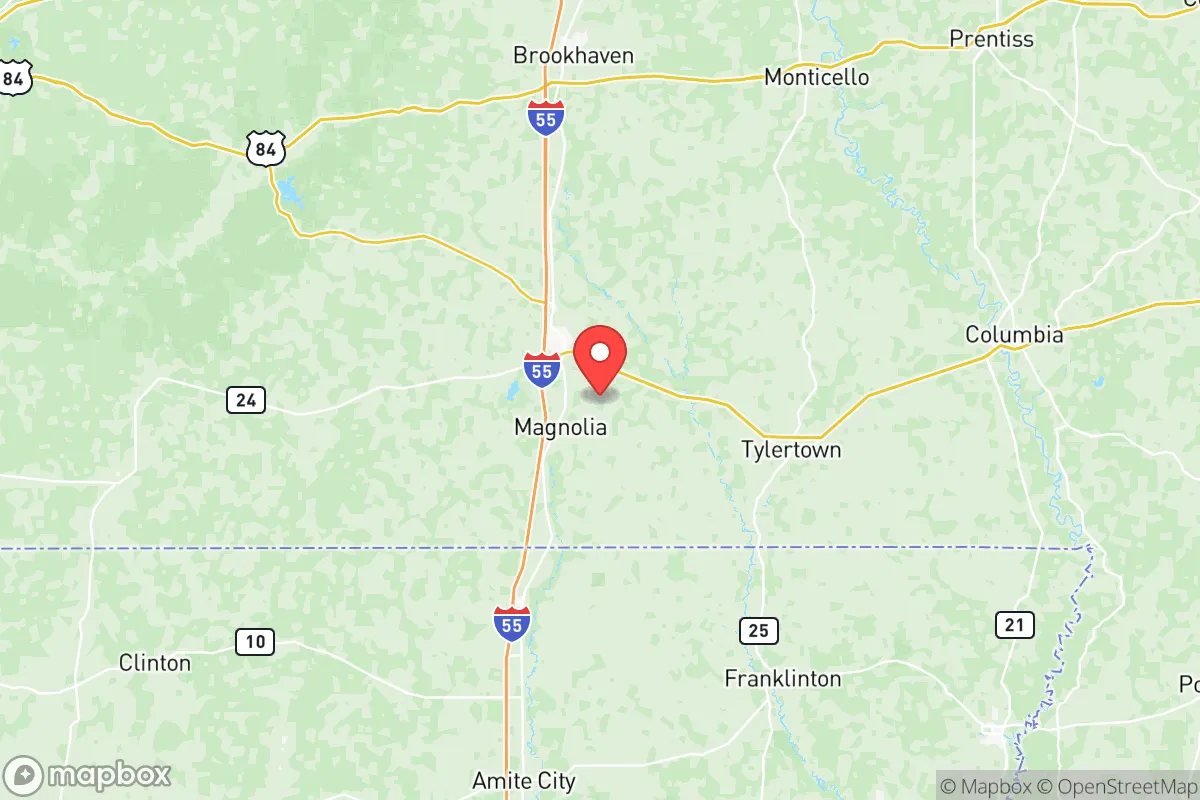
Pike County, Mississippi, today is a predominantly African American community (54.1% of the population) with a significant white minority (41.7%), a very small Hispanic presence (1.6%), and a foreign-born population of just 0.3% — one of the lowest in the state. The county’s 39,930 residents are concentrated in the twin hubs of McComb and Magnolia, with smaller populations in Summit, Osyka, and the unincorporated community of Chatawa. The area retains a distinctly rural, Deep South character, with a strong sense of local history, a modestly educated workforce (15.9% hold a bachelor’s degree or higher), and a cultural identity shaped by agriculture, railroads, and the legacy of segregation and civil rights activism.
Settlement & growth (pre-1960)
Before European settlement, the area now known as Pike County was part of the ancestral homeland of the Choctaw people, who occupied much of present-day Mississippi. The Choctaw were forcibly removed through a series of treaties and the Indian Removal Act of 1830, with most relocated to Oklahoma along the Trail of Tears. Pike County was formally established in 1815, carved from Marion County, and named after explorer Zebulon Pike. The earliest white settlers were primarily Scots-Irish and English migrants moving south and west from the Carolinas, Virginia, and Georgia, drawn by the promise of fertile, inexpensive land for cotton cultivation. These families established small farms and plantations, and by the 1830s, the county’s economy was firmly rooted in cotton, worked by an enslaved African American population that grew rapidly alongside the white planter class.
The arrival of the New Orleans, Jackson and Great Northern Railroad in the 1850s transformed the county. The railroad spurred the founding of McComb in 1872 as a major repair and maintenance hub, attracting a wave of laborers, mechanics, and tradesmen — both white and Black. McComb quickly became the county’s largest city and a magnet for African Americans seeking work in the railroad industry, a pattern that continued through the early 20th century. The town of Magnolia, the county seat, developed as a commercial and governmental center, while smaller communities like Summit and Osyka grew as agricultural service towns. The post-Civil War era saw the rise of sharecropping and tenant farming, which kept much of the Black population tied to the land in a system of economic dependency that persisted well into the 20th century.
The early 1900s brought a modest influx of Italian immigrants, who settled primarily in the McComb area and worked as laborers on the railroad and in the growing timber industry. This wave was small but culturally distinct, leaving a lasting mark on local cuisine and Catholic parish life. The Great Migration (roughly 1916–1970) saw tens of thousands of African Americans leave Mississippi for northern industrial cities, but Pike County’s Black population remained relatively stable, as the railroad and timber industries provided steady employment that anchored many families in place. The county’s white population, meanwhile, was supplemented by a trickle of migrants from other parts of the South, but the overall demographic structure — a Black majority and a white minority — was firmly established by 1950 and has persisted to the present day.
Modern era (post-1965)
The 1965 Hart-Cellar Act, which abolished national-origin quotas, had almost no impact on Pike County. The foreign-born population remains negligible at 0.3%, and there is no significant immigrant community from any region. The county’s demographic story in the modern era is not one of new arrivals but of internal dynamics: the slow, ongoing outmigration of younger, educated residents to larger cities, and the gradual aging of the population that remains. The Hispanic population, while growing slightly, is still tiny at 1.6%, and East/Southeast Asian residents make up just 0.5% of the county. The Indian subcontinent population is 0.1%.
The most significant demographic shift since 1965 has been the decline of the white population as a share of the total. In 1970, Pike County was roughly 55% white and 44% Black; by 2020, those figures had inverted to 41.7% white and 54.1% Black. This change is driven primarily by white outmigration to suburban and exurban areas in other parts of Mississippi and the South, as well as a lower birth rate among white families. The Black population, by contrast, has been more rooted, with strong family and church ties keeping many in the county even as economic opportunities have dwindled. The closure of the Illinois Central Railroad’s McComb shops in the 1980s was a major blow, eliminating hundreds of well-paying jobs and accelerating population loss. The county’s population peaked at roughly 46,000 in 1960 and has declined steadily since, dropping to 39,930 by 2020.
Suburbanization within the county has been limited. McComb remains the economic and cultural center, but its population has fallen from a peak of about 13,000 in 1970 to roughly 10,000 today. Magnolia has held steady at around 2,000 residents. The unincorporated areas, particularly around the rural communities of Chatawa and Fernwood, have seen modest growth as some residents seek lower taxes and more land, but this is not a large-scale trend. The county’s housing stock is aging, and new construction is minimal. The lack of significant in-migration means that the county’s demographic future is largely a function of its existing population’s birth and death rates, with little infusion of new ethnic or cultural diversity.
The future
Pike County is projected to continue its slow population decline over the next 10–20 years, barring a major economic development that attracts new residents. The county’s age structure is older than the state average, and the outmigration of young adults — particularly those with college degrees — will likely continue, as local job opportunities in manufacturing, healthcare, and education are limited. The racial composition is expected to become slightly more Black, as the white population continues to age and decline, while the Black population remains more stable. The Hispanic and Asian populations may grow incrementally, but from such a small base that they will remain demographically insignificant for the foreseeable future.
Culturally, Pike County is likely to remain a conservative, religious, and deeply rooted community, with a strong African American political and civic presence in McComb and Magnolia. The county’s identity is shaped by its history — the railroad, the civil rights movement (McComb was a key battleground in the 1960s), and the enduring legacy of rural Southern life. New residents, whether from elsewhere in Mississippi or from out of state, will find a place where community ties are strong, the pace of life is slow, and the demographic and cultural landscape is largely stable. There is no sign of the rapid diversification or suburban boom seen in parts of the Sun Belt; Pike County is, and will likely remain, a quiet, predominantly Black and white Southern county with a small-town feel and a strong sense of its own past.
For someone moving in now, Pike County offers affordability, a low cost of living, and a close-knit community atmosphere, but also limited economic opportunity, a shrinking population, and minimal ethnic or cultural diversity. It is a place for those seeking a slower, more traditional way of life, not for those looking for rapid growth or a cosmopolitan environment. The county’s future is one of gentle decline and continuity, shaped more by who stays than by who arrives.

* Values derived from national, state, county, city and local statistics and may differ in a specific area. Last updated: 2026-07-03T14:35:58.000Z
Narrative content on this page is AI-generated and may contain mistakes. Verify any details that matter before acting on them.
ReloMaps may earn a commission from affiliate links at no extra cost to you.

