
Photo: Wikipedia
Political ClimatePolitical Climate in Panola County
Showing district-level results — no local-only data available.
Local Political AnalysisPolitical Analysis of Panola County
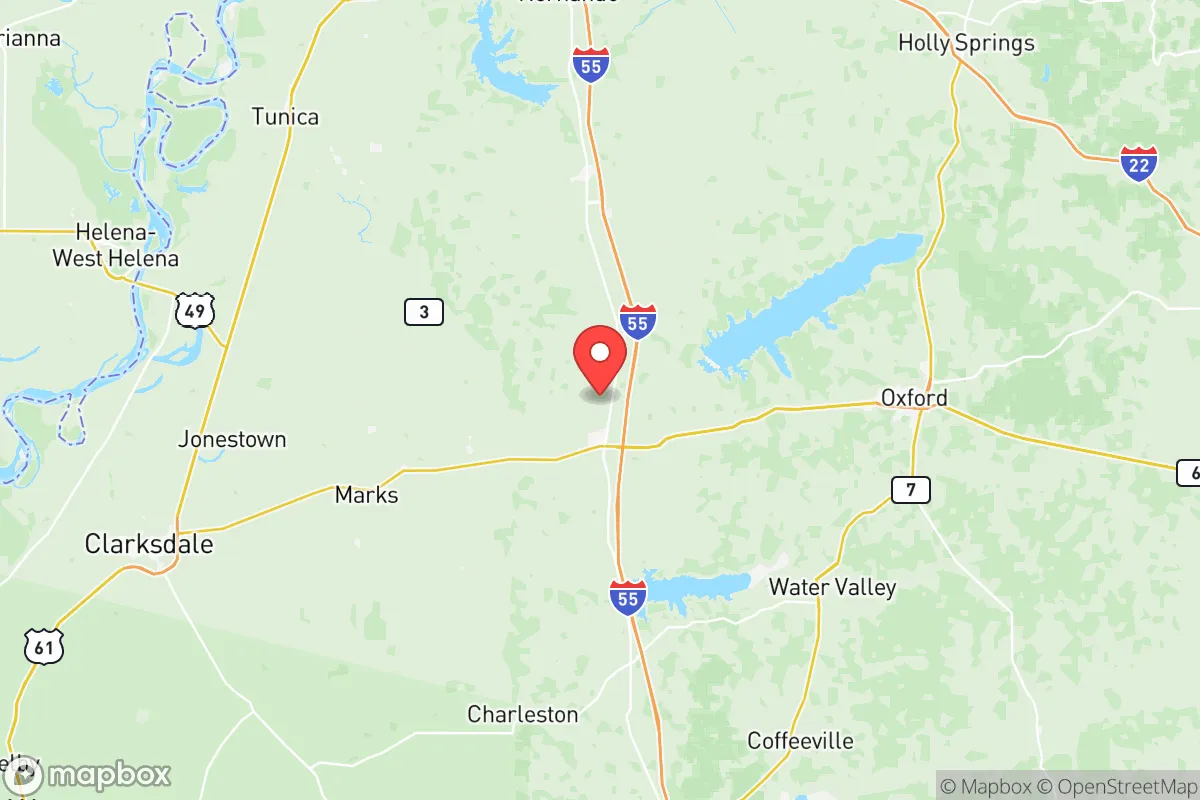
Panola County, Mississippi, is a genuine political outlier in the Deep South, carrying a Cook Partisan Voting Index of D+11 — meaning it votes about 11 points more Democratic than the national average. That stands in stark contrast to the state of Mississippi as a whole, which sits at R+11. This isn't a recent fluke; the county has a long tradition of split-ticket voting and local Democratic strength, though the margins have tightened in presidential races. The real story is how the county's two main towns — the county seat of Batesville and the smaller, more rural Sardis — create a political tug-of-war that defines the area's unique character.
How it compares
Mississippi's R+11 rating reflects a state where Republicans dominate statewide races, often winning by double digits. Panola County's D+11 is a 22-point swing in the opposite direction, making it one of the most Democratic-leaning counties in a deeply red state. The key driver is Batesville, home to a large African American population and a strong Democratic base that reliably turns out. Precincts in Batesville proper — like the ones around the courthouse square and the industrial corridor along I-55 — routinely deliver 70-80% of the vote for Democratic candidates. Meanwhile, Sardis and the rural western precincts lean more conservative, often splitting tickets in local races. The swing precincts are in the unincorporated areas between the two towns, where independent and moderate voters decide close elections. In 2024, for example, Panola County still backed the Democratic presidential candidate by a narrow margin, while the rest of Mississippi went red by double digits. That kind of split is rare and shows the county's stubborn independence.
What this means for residents
For conservative residents, living in a D+11 county means their votes in local races often don't carry the day, but they still have strong representation in state and federal offices that lean Republican. For liberal residents, the county provides a rare safe space in Mississippi where Democratic candidates can win local offices — like the chancery clerk or sheriff — without needing to run as a Republican. In practice, this creates a more pragmatic political culture. You'll see Democrats and Republicans working together on issues like infrastructure and economic development, especially around the Panola Partnership's efforts to recruit manufacturing jobs. The downside? National polarization has crept in. Local elections are still relatively civil, but presidential politics can get heated, especially on social media. The county's Democratic lean also means it gets less attention from state-level Republican leaders, which can affect funding for roads and schools.
Culturally, Panola County feels more like a traditional Southern community than a partisan battleground. Church attendance is high across both parties, and the annual Sardis Lake fishing tournaments and the Batesville Watermelon Festival draw everyone together regardless of politics. One notable policy distinction: the county has a higher minimum wage than the state's $7.25, thanks to local pressure from the Batesville NAACP and labor advocates. That's a concrete example of how the D+11 lean translates into real-world differences. Looking ahead, the county's political trajectory is uncertain. In-migration from Memphis and Oxford is slowly diversifying the population, but the rural precincts are aging and trending redder. The next decade will likely see the D+11 margin shrink, but Panola County will probably remain a blue dot in a red state for the foreseeable future.

State Political ClimatePolitical Climate in Mississippi
State Political AnalysisPolitical Environment in the State
Mississippi is one of the most reliably Republican states in the country, with a Cook Partisan Voting Index of R+11, meaning it votes about 11 points more Republican than the national average in presidential elections. The state hasn't voted for a Democratic presidential candidate since Jimmy Carter in 1976, and the GOP now holds every statewide office, both U.S. Senate seats, and supermajorities in the state legislature. Over the past 20 years, the shift has been dramatic — as late as the 1990s, Democrats still controlled the legislature and many local offices, but the realignment of white conservative voters, particularly in the Delta and Pine Belt regions, has made Mississippi a solidly red state with a political culture that prizes limited government, gun rights, and traditional social values.
Urban vs. rural divide
The political map of Mississippi breaks down along stark urban-rural lines. The state's only reliably blue stronghold is the Jackson metro area (Hinds County), which delivered about 80% of its vote to Joe Biden in 2020. Jackson itself is a majority-Black city with a strong Democratic machine, but the surrounding suburbs — Madison and Ridgeland in Madison County — are among the most Republican areas in the state, routinely voting 70-80% GOP. The Gulf Coast, anchored by Biloxi and Gulfport, leans Republican but with a moderate streak, thanks to a mix of military retirees, casino workers, and seafood industry families. The northeastern corner, around Tupelo and Oxford, is reliably red but with a libertarian bent — Oxford, home to the University of Mississippi, is the only college town in the state that occasionally flips to Democrats in local races. The Delta region, stretching from Greenville to Clarksdale, is heavily Black and Democratic, but its population has been declining for decades, reducing its electoral clout. The Pine Belt around Hattiesburg and the southwestern corner near Natchez are more competitive, with Hattiesburg's university population adding a small but growing liberal presence.
Policy environment
Mississippi's policy environment is defined by low taxes and limited government services. The state has a flat income tax rate of 4.7% (set to phase down to 4% by 2026), a 7% sales tax on most goods, and some of the lowest property taxes in the country — the average effective property tax rate is about 0.65%, roughly half the national average. There is no estate tax or inheritance tax. Regulatory burdens are light, with no state-level minimum wage above the federal $7.25, no paid family leave mandate, and a right-to-work law that keeps union influence minimal. Education policy is dominated by school choice: Mississippi has a robust charter school law, a voucher-like Education Scholarship Account program for students with disabilities, and a new universal school choice program passed in 2024 that allows any family to use state funds for private school tuition or homeschooling expenses. Healthcare is a mixed bag — the state has not expanded Medicaid under the Affordable Care Act, leaving roughly 75,000 low-income adults in a coverage gap, but it has one of the lowest per-capita healthcare costs in the nation. Election laws are restrictive by national standards: voter ID is required, early voting is limited to in-person absentee voting with an excuse, and same-day registration is not allowed. The state also has a strict felony disenfranchisement law that permanently bars anyone convicted of certain crimes from voting unless the legislature restores their rights individually.
Recent policy direction
Over the past five years, Mississippi has moved decisively to the right on nearly every policy front. In 2023, the legislature passed a permitless carry law, allowing any adult who can legally possess a firearm to carry a concealed handgun without a license — this was a top priority for the NRA and local gun rights groups. On education, the 2024 universal school choice law (HB 1230) is the most expansive in the South, allowing families to use up to $7,000 per child for private school tuition, tutoring, or homeschooling materials. The state also passed a "Parents' Bill of Rights" in 2022, requiring schools to notify parents of any changes to a student's mental, emotional, or physical health — a direct response to debates over transgender students' access to bathrooms and pronouns. On abortion, Mississippi was the state that brought the Dobbs case to the Supreme Court, and its trigger law banning nearly all abortions (with exceptions only for rape, incest, and life of the mother) took effect immediately after Roe fell in 2022. Medical marijuana was legalized in 2022 after a ballot initiative, but the program is tightly regulated — only licensed dispensaries can sell, and possession limits are low. On property rights, the state has strong eminent domain protections and no statewide rent control. On voting, the legislature has tightened absentee ballot rules and banned ballot drop boxes, though no major election integrity controversies have erupted. The overall direction is clear: Mississippi is doubling down on conservative governance, with a focus on parental rights, gun access, school choice, and limited taxation.
Civil unrest & political movements
Mississippi has a quieter political landscape than many states, but there are visible flashpoints. The Jackson water crisis in 2022-2023 — where the capital city's water system failed, leaving residents without safe drinking water for weeks — became a national story and a rallying point for civil rights activists, who argued it was a result of decades of state neglect of a majority-Black city. Protests in Jackson were frequent but largely peaceful, with groups like the NAACP and local faith leaders demanding state intervention. On the right, the "Mississippi Freedom Caucus" in the legislature, a group of hardline conservatives, has pushed for further restrictions on transgender rights, immigration enforcement, and election integrity. Immigration politics are less heated than in border states, but the legislature passed a law in 2024 requiring local law enforcement to cooperate with ICE detainers. There is no sanctuary city movement — every county in Mississippi complies with federal immigration requests. Secession and nullification rhetoric is rare but not absent; a few local GOP officials have floated "constitutional carry" resolutions asserting state supremacy over federal gun laws, but these have no legal force. Election integrity controversies have been minimal — the 2020 and 2022 elections ran smoothly, with no major fraud allegations or recounts. The most visible political movement is the growing school choice advocacy, which has united suburban conservatives and some Black parents in Jackson who want alternatives to failing public schools.
Projection
Over the next 5-10 years, Mississippi is likely to remain solidly Republican, but the margins may narrow slightly as the Jackson metro area continues to grow and attract younger, more diverse residents. The Delta's population decline will continue to reduce Democratic turnout, while the Gulf Coast and northeastern suburbs will see modest growth from retirees and remote workers drawn by low taxes and warm weather. The biggest wild card is the state's demographic shift: Mississippi is already 38% Black, and Black voters remain overwhelmingly Democratic, but turnout among Black Mississippians has been declining, particularly in rural areas. If the state's economy diversifies — particularly with the growth of the aerospace industry in the Golden Triangle (Columbus, Starkville, West Point) and the expansion of the Port of Gulfport — it could attract new residents from other states who may not share the state's conservative cultural values. However, the political infrastructure is deeply entrenched: the GOP has a supermajority in both chambers, the governor's office is safe, and the state's media ecosystem is dominated by conservative outlets. A new resident moving in today should expect to find a state where conservative policies are the norm, where taxes are low and government services are limited, and where the political debate is dominated by education, gun rights, and social issues rather than economic populism or environmental concerns.
For a new resident, the bottom line is straightforward: Mississippi offers a low-tax, low-regulation environment with strong protections for gun owners, school choice advocates, and traditional family structures. Liberal residents will find little political representation outside of Jackson and a few college towns, and will need to accept that state policy will consistently lean conservative on issues from abortion to education to voting. Conservative residents will find a state that largely aligns with their values, but should be aware that the state's low tax base means public services — roads, schools, healthcare — are often underfunded compared to national averages. The political climate is stable, predictable, and unlikely to shift dramatically in the next decade, making Mississippi a safe bet for anyone seeking a reliably conservative state with a slow pace of life and a strong sense of local community.
* Values derived from national, state, county, city and local statistics and may differ in a specific area. Last updated: 2026-08-19T12:42:23.000Z
Narrative content on this page is AI-generated and may contain mistakes. Verify any details that matter before acting on them.
ReloMaps may earn a commission from affiliate links at no extra cost to you.

