
Photo: Wikipedia
Demographics of Panola County
Affluence Level in Panola County
A low-income area with significant economic hardship. Household wealth and educational attainment are well below national averages.
People of Panola County
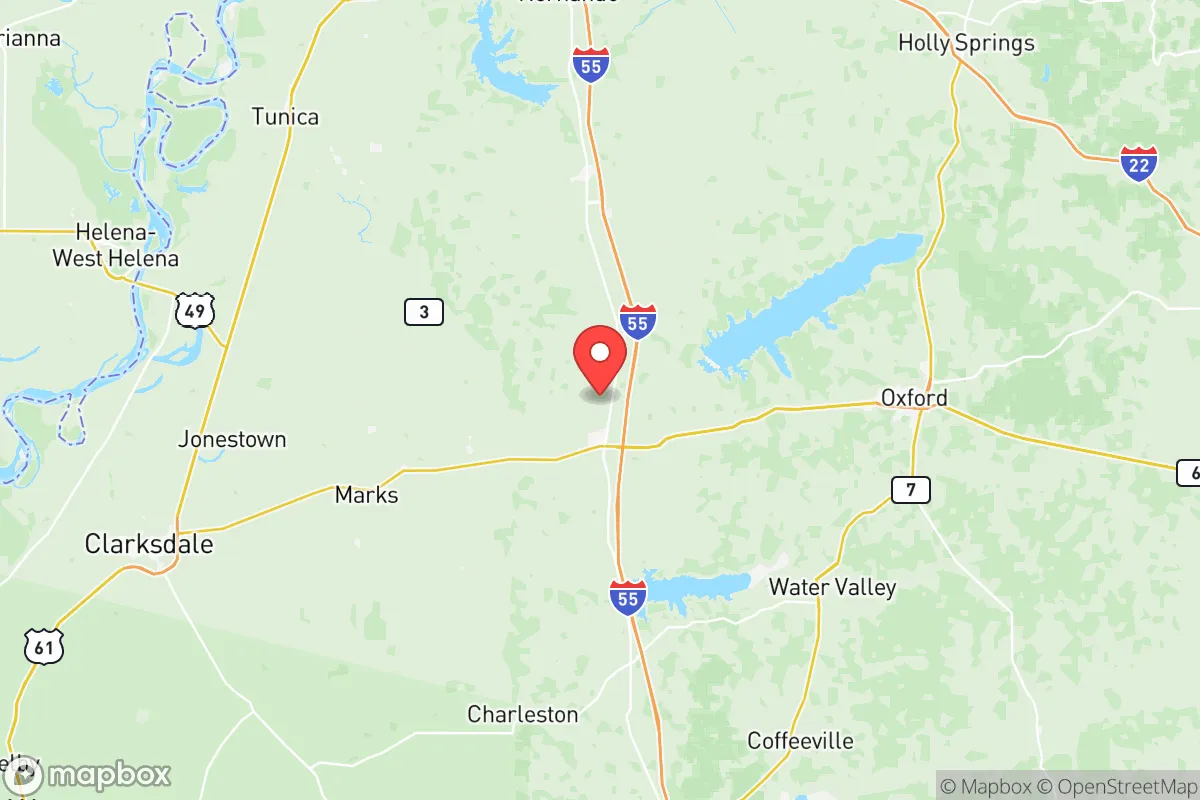
Panola County, Mississippi, is a nearly evenly split Black and white county of 32,965 residents, a demographic rarity in the modern South that reflects its deep plantation history and the enduring presence of descendants of enslaved people. With a foreign-born population of just 0.3% and a college attainment rate of 15.5%, this is a deeply rooted, native-born community where family lineages trace back generations. The county’s identity is defined by the twin towns of Batesville and Sardis, which anchor a rural, agricultural economy that has changed less in the last century than almost anywhere else in the state.
Settlement & growth (pre-1960)
The land that became Panola County was originally home to the Chickasaw people, who ceded the territory to the United States in the 1832 Treaty of Pontotoc. The county was formally established in 1836, carved from the Chickasaw cession, and opened to white settlement almost immediately. The first wave of settlers were Scots-Irish and English yeoman farmers moving south from Tennessee and Kentucky, drawn by cheap, fertile land in the Yalobusha River valley. They established small subsistence farms and the earliest communities, including Sardis, which became the county seat in 1836, and Panola, a now-vanished river town that gave the county its name.
The character of the county changed dramatically with the cotton boom of the 1840s and 1850s. Wealthier planters from the Atlantic seaboard—primarily from Virginia and the Carolinas—purchased vast tracts of the rich, dark soil along the Tallahatchie River and converted the county to large-scale cotton production. This shift brought a massive forced migration of enslaved Black people, who were sold south from the Upper South to work the new plantations. By 1860, enslaved people made up a majority of Panola County’s population, a ratio that has persisted, with only minor fluctuations, to the present day. The plantation economy centered on the river bottoms near Como and Crenshaw, where cotton gins and river landings dotted the landscape.
After the Civil War and emancipation, the county’s Black population remained in place as sharecroppers and tenant farmers, while white landowners retained control of the cotton economy. The late 19th century saw the arrival of the railroad, which created new towns like Batesville, which soon eclipsed Sardis as the county’s commercial center. The railroad also brought a small influx of Lebanese and Syrian merchants, who established dry goods stores in Batesville and Courtland—a rare non-Black, non-white presence that remains a distinct family legacy in the county today. The early 20th century saw the boll weevil devastate cotton, but the county’s population remained stable and overwhelmingly rural. The Great Migration, which drained Black populations from most of the Deep South between 1910 and 1970, had a comparatively muted effect here; Panola County’s Black population declined but did not collapse, as many families stayed tied to the land.
Modern era (post-1965)
The 1965 Hart-Cellar Act, which transformed U.S. immigration, had virtually no effect on Panola County. With a foreign-born population of just 0.3%—roughly 100 people out of nearly 33,000—the county has been almost entirely untouched by the waves of immigration that reshaped urban and suburban America. The Hispanic population, at 2.0%, is the only immigrant-adjacent group of any size, and these residents are largely concentrated in and around Batesville, where they work in the poultry processing industry. East and Southeast Asian residents make up just 0.3% of the population, and there is no measurable Indian-subcontinent community at all.
The more significant demographic shift of the modern era has been domestic. The mechanization of cotton farming in the 1960s and 1970s eliminated the sharecropping system, pushing Black residents off the land and into the county’s towns or out of the county entirely. Batesville absorbed much of this displaced population, while Sardis and Como saw their Black populations stabilize at lower levels. The white population, meanwhile, has slowly declined in absolute numbers as younger residents leave for college and jobs in Memphis, just 50 miles north, or in the growing suburbs of North Mississippi. The county’s population peaked at roughly 34,000 in 1980 and has hovered near 33,000 ever since, a stability that masks a significant churn: out-migration of young adults is offset by a modest but steady birth rate.
The economic anchor of the modern era has been the arrival of the poultry industry. Tyson Foods operates a major processing plant in Batesville, which has become the county’s largest employer and the primary draw for the small Hispanic population that has arrived since the 1990s. This industrial base has kept Batesville relatively prosperous compared to the county’s rural hinterlands, where poverty rates remain high and the population continues to thin out. The county’s Black population, at 48.0%, is now nearly identical to its white share of 46.7%, a near-perfect parity that is almost unique among Mississippi counties and reflects the fact that neither group has dominated the other demographically through migration or differential birth rates.
The future
Panola County is likely to remain one of the most demographically stable places in America over the next two decades. The foreign-born population is so small that even a doubling would barely register, and the county lacks the economic magnets—major universities, tech hubs, or metropolitan job centers—that attract international migration. The Hispanic population, concentrated in Batesville’s poultry industry, is the only segment likely to grow, but it will remain a small minority. The county’s Black and white populations are aging in place, with younger residents continuing to leave for Memphis, Jackson, or the broader Sun Belt, a pattern that suggests gradual population decline unless new industry arrives.
The most likely scenario is a slow, gentle shrinking of the county’s population, with Batesville absorbing a larger share of the total as rural communities like Pope, Shuford, and Eureka continue to depopulate. The county’s cultural identity—rooted in Southern evangelical Christianity, hunting and fishing culture, and a shared history of cotton and civil rights—is likely to persist, as the people who remain are those most committed to that way of life. The near-total absence of immigration means the county will not become more diverse in the way that most of America is diversifying; instead, its diversity will remain the binary Black-white split that has defined it for 180 years.
For someone moving to Panola County today, the bottom line is this: you are joining a community that is deeply rooted, racially balanced, and culturally traditional, but also one that is slowly contracting. The schools, churches, and civic institutions in Batesville and Sardis remain the social anchors, and the low cost of living and strong sense of place are genuine assets. But the county offers little in the way of demographic dynamism or new-economy opportunity. It is a place for those seeking stability, community, and a direct connection to Southern history—not for those seeking rapid growth or cultural change.

* Values derived from national, state, county, city and local statistics and may differ in a specific area. Last updated: 2026-08-19T12:42:23.000Z
Narrative content on this page is AI-generated and may contain mistakes. Verify any details that matter before acting on them.
ReloMaps may earn a commission from affiliate links at no extra cost to you.

