
Photo: Wikipedia
Demographics of Madison County
Affluence Level in Madison County
A middle-class area roughly in line with national averages across income, home values, education, and employment.
People of Madison County
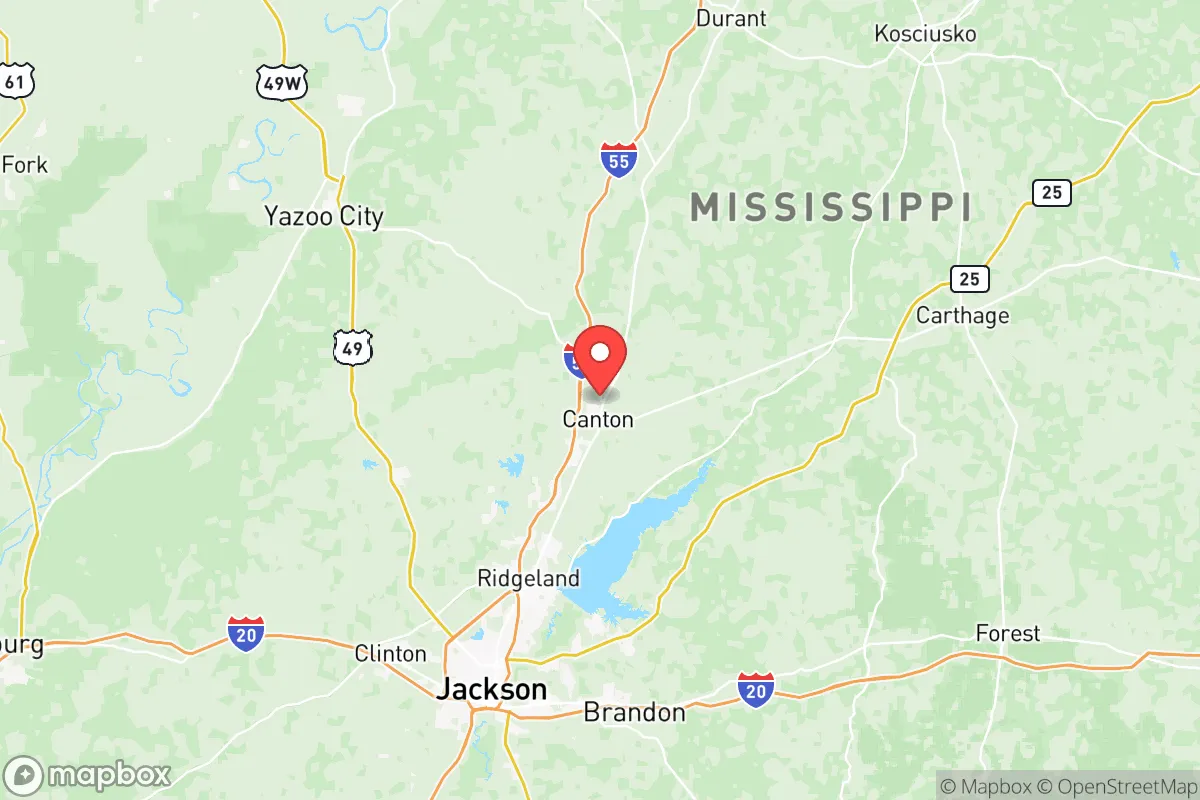
Madison County, Mississippi, today is a predominantly white-collar, family-oriented suburban powerhouse anchored by the city of Madison and extending through Ridgeland, Canton, and Flora. With a population of 110,303, the county is characterized by a high concentration of college-educated residents (48.9%), a significant Black minority (37.3%), and a notably small foreign-born population (2.5%). Its identity is shaped by a blend of historic Deep South roots, rapid Sun Belt suburbanization, and a strong local economy driven by healthcare, education, and the proximity to Jackson's state government and medical centers.
Settlement & growth (pre-1960)
Before American settlement, the area that is now Madison County was part of the ancestral homeland of the Choctaw people, who occupied much of central Mississippi. The county was formed in 1828 from Yazoo County, named after President James Madison, and was opened to European-American settlers following the Treaty of Dancing Rabbit Creek in 1830, which forcibly removed the Choctaw to Oklahoma. The first wave of settlers were primarily Scots-Irish and English yeoman farmers from the Upper South—Virginia, the Carolinas, and Tennessee—who arrived in the 1830s and 1840s, drawn by fertile black prairie soil for cotton cultivation. They established small communities like Flora (founded 1830s) and Canton (incorporated 1836), which quickly became the county seat and a regional cotton-trading center.
By the 1850s, the plantation economy was fully entrenched, and enslaved African Americans made up a majority of the county's population. After the Civil War and emancipation, many freedmen remained in the area as sharecroppers and tenant farmers, forming the foundation of the county's Black communities, particularly in the rural areas around Canton and Flora. The late 19th and early 20th centuries saw little new immigration; the county remained overwhelmingly native-born, with a small number of Lebanese and Syrian peddlers settling in Canton around 1900. The Great Migration (1910–1970) saw tens of thousands of Black Mississippians leave for Northern industrial cities, but Madison County's Black population remained substantial, anchored by agricultural work and later by emerging service industries in Jackson. The post-World War II era brought the first hints of suburbanization, as white families began moving east from Jackson into the unincorporated areas that would later become the city of Madison, incorporated in 1944. By 1960, the county's population was roughly 30,000, still majority rural and agricultural, with Canton as the dominant commercial hub.
Modern era (post-1965)
The 1965 Hart-Cellar Act had a minimal direct impact on Madison County, as the foreign-born population remains just 2.5% today—far below the national average. Instead, the county's modern demographic story is one of domestic migration and suburbanization. The key turning point was the completion of Interstate 55 in the 1970s, which connected Madison and Ridgeland directly to Jackson. This triggered a wave of white flight from the capital city, as middle- and upper-class families sought newer housing, better schools, and lower crime rates. The city of Madison became the epicenter of this growth, transforming from a small town of 2,000 in 1970 to a planned suburb of over 25,000 by 2020. Ridgeland, incorporated in 1970, grew even faster, attracting both white and Black professionals with its retail corridors and the upscale Renaissance at Colony Park development.
The county's Black population, while shrinking as a percentage from a historic majority to 37.3% today, remains concentrated in Canton (which is over 70% Black) and the older neighborhoods of Ridgeland. The Asian population, at 1.7% East/Southeast Asian and 1.1% Indian, is a recent phenomenon, driven by medical professionals and tech workers attracted to the University of Mississippi Medical Center and the region's growing healthcare sector. These families are overwhelmingly concentrated in Madison and the newer subdivisions of Ridgeland. The Hispanic population, at 3.7%, is small but growing, primarily in construction and service industries, with a visible presence in Canton and Flora. The county's overall growth has been steady: from 74,000 in 2000 to 110,303 today, driven almost entirely by domestic in-migration from other parts of Mississippi and, increasingly, from other Southern states and the Rust Belt.
The future
Madison County is likely to continue its trajectory as one of Mississippi's fastest-growing and most affluent counties, but the pace of demographic change will remain moderate. The foreign-born population, while low, is expected to slowly increase as the healthcare and technology sectors expand, drawing more Indian and East/Southeast Asian professionals to Madison and Ridgeland. The Hispanic population will likely grow steadily, though not explosively, as construction and service jobs attract workers from other parts of the South. The Black population share is projected to stabilize or decline slightly, as white in-migration from other states continues and as younger Black families move to newer suburbs in neighboring Rankin County. The county is not tribalizing into distinct ethnic enclaves; rather, it is homogenizing into a broad, car-dependent suburban landscape where income and school district boundaries matter more than ethnicity. The cultural identity of the county is being reshaped by newcomers from outside the Deep South, who bring different political and social expectations, but the conservative, family-oriented character remains dominant. For someone moving in now, Madison County offers a stable, low-crime, high-amenity environment with excellent schools, but with limited ethnic diversity and a culture that remains deeply rooted in Southern Protestant traditions.
Madison County is becoming a classic Sun Belt success story: a place where domestic migration, not international immigration, drives growth, and where the population is becoming more educated, more affluent, and more suburban, while retaining a strong sense of local identity rooted in its historic towns of Canton, Flora, and Madison.

* Values derived from national, state, county, city and local statistics and may differ in a specific area. Last updated: 2026-05-12T12:07:51.000Z
Narrative content on this page is AI-generated and may contain mistakes. Verify any details that matter before acting on them.
ReloMaps may earn a commission from affiliate links at no extra cost to you.

