
Photo: Wikipedia
Political ClimatePolitical Climate in Lincoln County
Showing district-level results — no local-only data available.
Local Political AnalysisPolitical Analysis of Lincoln County
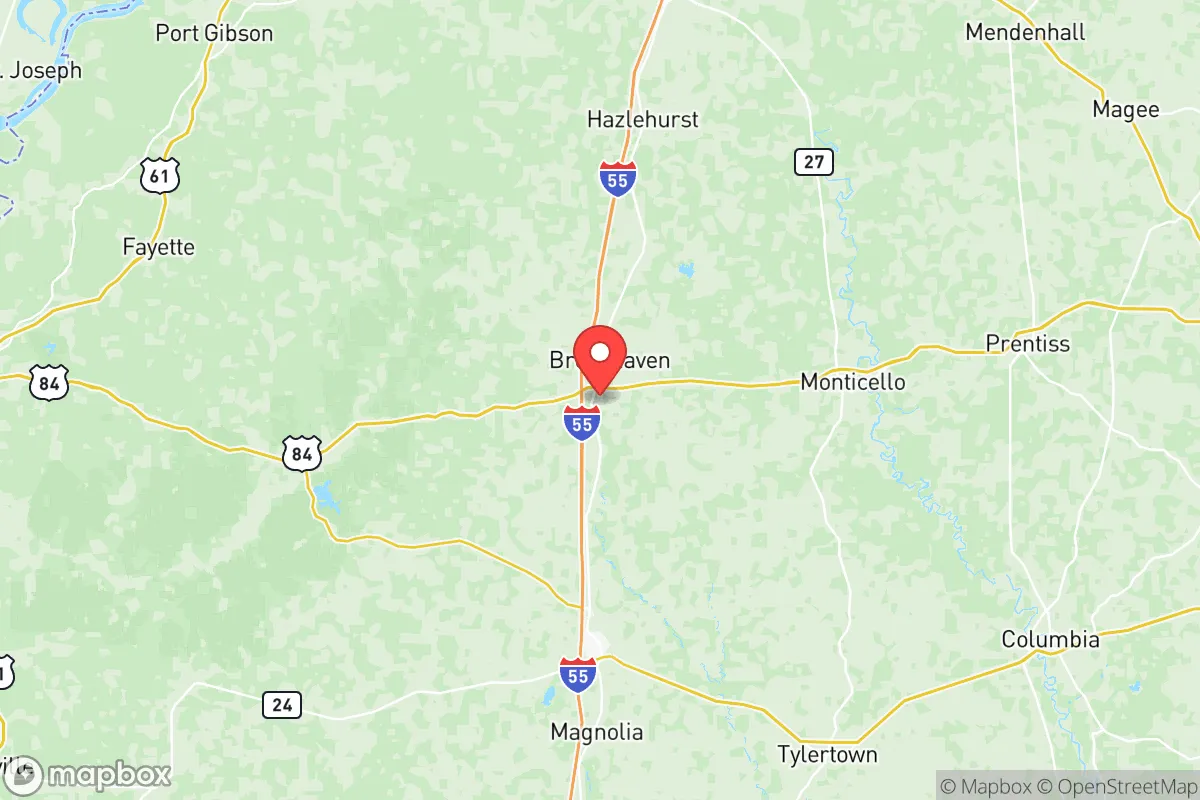
Lincoln County, Mississippi, is a reliably Republican stronghold with a Cook PVI of R+14, making it noticeably more conservative than the state of Mississippi as a whole, which sits at R+11. This isn't a new development; the county has been trending red for decades, but the shift has accelerated since the early 2000s. The county seat, Brookhaven, is the political and population center, and while it's still solidly Republican, it shows more variation than the rural outlying areas. For instance, precincts in the more suburban parts of Brookhaven, like those around the industrial park and newer subdivisions, often vote 70-75% Republican, while the older, more established neighborhoods near downtown Brookhaven can swing closer to 60-65% Republican. In contrast, the smaller communities like Ruth, Norfield, and Caseyville are deeply conservative, routinely delivering 80%+ margins for GOP candidates. There are no precincts in Lincoln County that lean blue, but the Brookhaven city precincts are the closest thing to swing territory, occasionally breaking 40% for Democrats in competitive races.
How it compares
Compared to the state of Mississippi, Lincoln County is about 3 points more Republican on the Cook PVI scale, which is a meaningful gap. This means that while Mississippi is already a deep red state, Lincoln County is one of its redder corners. The state's R+11 rating reflects a mix of the reliably red northern and central counties, the deeply conservative Gulf Coast, and the heavily Democratic Delta region. Lincoln County, sitting in the southwest part of the state, lacks the Delta's Democratic influence entirely. Its politics are more akin to neighboring Copiah County (R+13) or Lawrence County (R+16) than to the state's more competitive areas. The county's trajectory is also slightly more conservative than the state's; while Mississippi has seen a slow, steady rightward drift, Lincoln County's shift has been a bit sharper, driven by the out-migration of younger, more moderate residents to larger cities and the in-migration of retirees from other parts of the state who are often more conservative.
What this means for residents
For conservative residents, Lincoln County is a comfortable environment where their views are the clear majority. Local elections are often decided in the Republican primary, and the general election is usually a formality. This means conservative policy priorities—like lower taxes, Second Amendment rights, and limited government—are generally reflected in county and city government decisions. For liberal residents, the reality is different. They are a distinct minority, and their political influence is largely confined to the Brookhaven city limits, where a more moderate, sometimes even slightly progressive, voice can occasionally be heard on issues like downtown development or public school funding. However, even in Brookhaven, liberal candidates rarely win countywide office. The practical effect is that liberal residents often find their political energy channeled into local civic organizations, non-profits, or the local Democratic Party chapter, which is small but active. They can still participate fully in community life, but they should expect to be in the political minority in most settings.
One cultural distinction that sets Lincoln County apart from some other parts of Mississippi is its strong, independent-minded streak. There's a palpable sense of "we take care of our own" that transcends party lines. This manifests in robust local support for the Brookhaven School District, the county's volunteer fire departments, and the annual Brookhaven Christmas Parade, which draws people from all political backgrounds. The county also has a notable history of being a bit more moderate on economic development than some of its neighbors, with a pragmatic approach to attracting industry that sometimes puts it at odds with the more ideologically rigid parts of the state. Looking ahead, the county's political lean is likely to remain solidly Republican, but the internal dynamics—especially the growing divide between the more moderate Brookhaven precincts and the deeply conservative rural areas—will continue to shape local debates, particularly around land use, school funding, and infrastructure. It's a place where the political reality is clear, but the community's character is more nuanced than the voting numbers alone suggest.

State Political ClimatePolitical Climate in Mississippi
State Political AnalysisPolitical Environment in the State
Mississippi is one of the most reliably Republican states in the country, with a Cook Partisan Voting Index of R+11, meaning it votes about 11 points more Republican than the national average. The state hasn’t voted for a Democratic presidential candidate since Jimmy Carter in 1976, and every statewide elected office is held by a Republican. Over the last 20 years, the GOP’s dominance has only deepened as the rural white electorate consolidated around the party, while the state’s large Black population (about 38% of residents) remains overwhelmingly Democratic, creating a stark racial and geographic partisan split. For a relocator, this means you’re moving into a place where conservative values shape nearly every level of government, but where local political culture varies dramatically depending on where you land.
Urban vs. rural divide
The political map of Mississippi is a textbook study in urban-rural polarization. The only reliably Democratic strongholds are the majority-Black Delta counties and the urban core of Jackson, the state capital, which consistently votes 80-90% Democratic. Hinds County (Jackson) is the Democratic anchor, but its influence is diluted by the surrounding suburban and exurban counties. The Gulf Coast metros of Biloxi and Gulfport lean Republican but are more moderate, often electing pragmatic conservatives who focus on tourism and military issues (Keesler Air Force Base is a major employer). The northeastern corner, anchored by Tupelo (Elvis’s birthplace), is deeply conservative and reliably red. The fastest-growing Republican areas are the suburban rings around Jackson—Madison and Rankin counties—which have flipped from competitive to solidly red over the past decade. Meanwhile, the Mississippi Delta, including towns like Greenville and Clarksdale, remains Democratic but is losing population, further entrenching the GOP’s statewide advantage. The only real political battlegrounds are a handful of state legislative districts in the Jackson suburbs and along the Coast, but at the presidential and gubernatorial level, the outcome is rarely in doubt.
Policy environment
Mississippi’s policy environment is among the most conservative in the nation. The state has no personal income tax on wages (it was phased out between 2022 and 2026), relying instead on a 7% sales tax and relatively low property taxes. Regulatory burdens are light, especially for small businesses and agriculture. On education, the state has a robust school choice program, including charter schools and the Education Scholarship Account (ESA) program, which allows parents to use public funds for private school tuition. Healthcare policy is notably restrictive: Mississippi has not expanded Medicaid under the Affordable Care Act, leaving roughly 75,000 low-income adults in a coverage gap. The state also has some of the strictest abortion laws in the country, with a near-total ban in effect since the Dobbs decision. Election laws are straightforward: voter ID is required, absentee voting is limited to specific excuses, and early voting was only introduced in 2024 (with no-excuse early voting beginning in 2025). For a conservative relocator, the low taxes and light regulation are major draws; for a liberal one, the limited healthcare access and restrictive social policies will be significant drawbacks.
Recent policy direction
The last five years have seen Mississippi accelerate its conservative policy agenda. In 2022, the legislature passed a comprehensive tax reform package that eliminated the income tax entirely by 2026, making Mississippi one of only a handful of states with no wage tax. On gun rights, the state already had permitless carry (passed in 2016) and a strong “stand your ground” law; in 2023, it added a law prohibiting local governments from enforcing federal gun regulations, a direct challenge to federal authority. Parental rights in education were strengthened with the 2022 “Parents’ Bill of Rights,” which requires schools to notify parents of any changes to a child’s services or monitoring related to mental, emotional, or physical health. On medical freedom, Mississippi banned gender-affirming care for minors in 2023 and passed a law requiring public schools to obtain parental consent before teaching about sexual orientation or gender identity. Property rights were bolstered by a 2024 law limiting the use of eminent domain for private economic development. Voting access tightened slightly with a 2023 law that shortened the absentee ballot application window and added stricter signature verification. The overall direction is clear: Mississippi is moving toward a model of low taxes, strong gun rights, parental control in education, and limited government intervention in private life, while maintaining a restrictive stance on abortion and transgender issues.
Civil unrest & political movements
Mississippi has a quieter political landscape than many states, but it’s not without flashpoints. The most visible organized movements are on the right: the Mississippi Republican Party is dominated by the conservative grassroots, and groups like the Mississippi Tea Party have influence in local primaries. On the left, the NAACP Mississippi State Conference and the Mississippi Poor People’s Campaign are active, particularly around voting rights and Medicaid expansion. Immigration politics are less heated here than in border states—Mississippi’s foreign-born population is only about 2.5%—but there have been local controversies over a 2023 law requiring law enforcement to cooperate with federal immigration authorities. The most notable recent unrest was the 2020 Jackson water crisis, which sparked protests over infrastructure neglect and racial inequality, though these were localized and did not escalate into sustained civil disorder. Election integrity has been a recurring theme: in 2022, the state’s Republican secretary of state launched a controversial purge of voter rolls, which was challenged in court but largely upheld. Secessionist or nullification rhetoric is rare but not absent—a 2021 bill proposing a “constitutional convention of the states” passed the legislature, and some local GOP officials have floated nullification of federal gun laws. For a new resident, the political climate is generally stable and low-key, but the racial and economic divides that underpin the state’s politics can surface in local elections and community debates.
Projection
Over the next 5-10 years, Mississippi is likely to become even more Republican, but the nature of that conservatism may shift. The state’s population is aging and slowly declining, with growth concentrated in the suburban counties around Jackson (Madison, Rankin) and along the Gulf Coast. These areas are attracting retirees and remote workers from other states, many of whom are drawn by the low taxes and conservative culture. This in-migration will likely reinforce the GOP’s dominance, but it could also introduce a more libertarian, less socially conservative strain of politics—newcomers from places like Texas or Florida may be less focused on culture war issues and more on economic freedom. The Delta will continue to lose population, further reducing the Democratic vote share. The biggest wild card is the state’s Medicaid expansion debate: if Mississippi eventually expands coverage (as some business groups and hospital associations are pushing), it could soften the state’s hardline image and make it more attractive to moderate relocators. But don’t expect any major leftward shift—the state’s political trajectory is firmly rightward, and anyone moving here should expect that to continue.
For a new resident, the bottom line is that Mississippi offers a deeply conservative political environment with low taxes, strong gun rights, and a government that prioritizes parental control and limited regulation. If you align with those values, you’ll find a state where your vote counts heavily in primaries and local races, and where policy is moving in your direction. If you’re more liberal, you’ll face a state where your political voice is largely confined to Jackson and the Delta, and where social policies will feel restrictive. Either way, the political reality is stable, predictable, and unlikely to surprise you—Mississippi is what it is, and it’s not changing course anytime soon.
* Values derived from national, state, county, city and local statistics and may differ in a specific area. Last updated: 2026-07-15T10:55:48.000Z
Narrative content on this page is AI-generated and may contain mistakes. Verify any details that matter before acting on them.
ReloMaps may earn a commission from affiliate links at no extra cost to you.

