Photo: Wikipedia
Demographics of Lincoln County
Affluence Level in Lincoln County
A below-average socioeconomic profile. Incomes, home values, and educational attainment trail the U.S., with higher poverty and unemployment.
People of Lincoln County
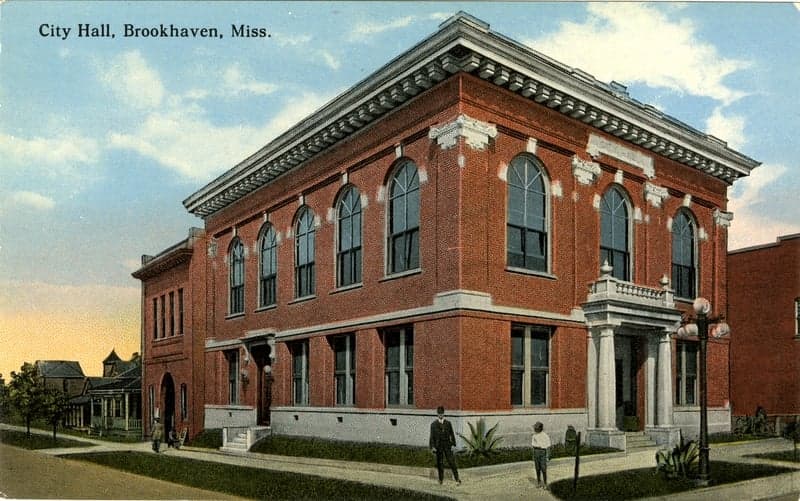
The people of Lincoln County, Mississippi, today number 34,830, forming a community defined by its deep Southern roots, a strong Black-white demographic divide, and a remarkably low foreign-born presence of just 0.4%. The county is 67.1% white and 30.2% Black, with negligible Hispanic (1.3%), East/Southeast Asian (0.2%), and Indian subcontinent (0.4%) populations, creating a cultural landscape that remains overwhelmingly native-born and shaped by the legacies of the 19th and 20th centuries. With only 18.4% of adults holding a college degree, the population leans toward blue-collar and agricultural traditions, centered on the county seat of Brookhaven, which serves as the commercial and social hub for smaller communities like Ruth, Norfield, and East Lincoln.
Settlement & growth (pre-1960)
Long before European settlement, the area that is now Lincoln County was part of the ancestral homeland of the Choctaw Nation. The Choctaw lived in dispersed villages along the Pearl River and its tributaries, practicing agriculture and trade. After the Treaty of Dancing Rabbit Creek in 1830, the Choctaw were forcibly removed to Oklahoma, opening the land to white settlers. Lincoln County itself was formed in 1870 from parts of Franklin, Lawrence, and Copiah counties, but the foundational population waves arrived earlier, in the 1810s through 1850s.
The first major wave was of Scots-Irish and English settlers from the Upper South—Virginia, the Carolinas, and Tennessee—who came over the Natchez Trace and down the Pearl River valley. They were drawn by cheap, fertile land for cotton and corn farming, establishing small farms and plantations. These early settlers concentrated around what would become Brookhaven, as well as in the rural communities of Bogue Chitto and Norfield. By the 1840s, the county's economy was firmly tied to cotton, and enslaved Black people made up a significant portion of the population—a pattern that would define the region for generations.
After the Civil War and Reconstruction, the Black population remained in the area as sharecroppers and tenant farmers, while white landowners consolidated control. The arrival of the Illinois Central Railroad in the 1880s spurred a second wave of growth, bringing a small number of German and Irish laborers to work on the rail lines and in the new timber industry. These immigrants settled primarily in Brookhaven and the mill town of Ruth, but their numbers were small and they largely assimilated into the white population within a generation. The early 20th century saw little new immigration; instead, the Great Migration (1910–1970) saw tens of thousands of Black residents leave Lincoln County for industrial jobs in Chicago, Detroit, and St. Louis, dramatically reducing the county's Black share from a post-Reconstruction high of roughly 55% to under 35% by 1960.
World War II and the post-war boom brought modest growth, as returning soldiers and their families settled in Brookhaven and the newly incorporated town of Wesson (home to Copiah-Lincoln Community College). The county's population peaked at around 28,000 in 1950, but the mechanization of agriculture and the decline of cotton farming pushed many rural residents—both Black and white—to seek work in larger Southern cities like Jackson and Baton Rouge.
Modern era (post-1965)
The 1965 Hart-Cellar Act had almost no direct impact on Lincoln County. Unlike metropolitan areas that saw surges of Asian, Hispanic, and Indian immigration, Lincoln County's foreign-born population remains at 0.4%—one of the lowest rates in Mississippi. The county's modern demographic story is instead one of domestic migration and suburbanization. Since the 1970s, the white population has remained stable, while the Black population has slowly rebounded from its Great Migration low, rising to 30.2% by 2020 as some Black families returned from Northern cities and others moved in from nearby rural counties.
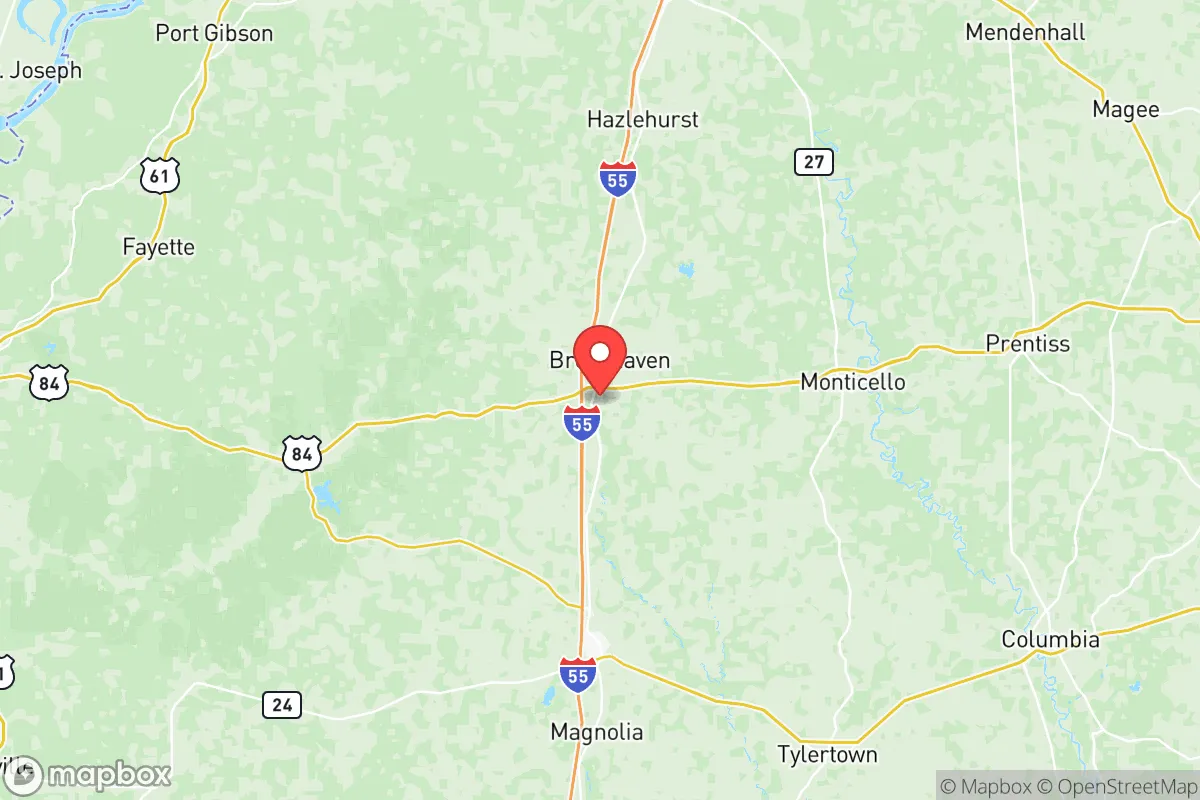
The most significant post-1965 shift has been the growth of Brookhaven as a regional retail and healthcare hub. The construction of Interstate 55 in the 1960s bypassed the county to the east, but U.S. Highway 51 and the railroad kept Brookhaven connected. New subdivisions like East Lincoln and Brookhaven Estates attracted white families moving out of older neighborhoods, while Black families concentrated in the historic South Brookhaven and Northside areas. The Hispanic population, though still tiny at 1.3%, began to appear in the 1990s, drawn by poultry processing plants in nearby McComb and agricultural work in the county's soybean and timber operations. These Hispanic residents settled mainly in Brookhaven and the unincorporated community of Caseyville, but they remain a small and dispersed group.
The Indian subcontinent population (0.4%) is almost entirely composed of professionals—doctors, engineers, and motel owners—who arrived after 2000, settling in Brookhaven near King's Daughters Medical Center. East/Southeast Asian residents (0.2%) are similarly few, mostly Vietnamese and Filipino families who came as healthcare workers or through family reunification. Neither group has formed a visible ethnic enclave.
The future
Lincoln County's population is projected to remain flat or decline slightly over the next 20 years, mirroring the broader trend of rural Mississippi. The county's low birth rate and outmigration of young adults—especially those with college degrees—will likely keep the population near its current 34,830. The white share is expected to shrink modestly as older residents pass away, while the Black share may rise to 33–35% as Black families continue to return from urban areas and as the county's small Hispanic population grows slowly through natural increase and limited new immigration.
Diversity will increase, but from a very low base. The Hispanic and Asian populations may double or triple in absolute numbers, but they will still represent less than 5% of the total. The county's cultural identity will remain deeply Southern and Christian, with the Black-white dynamic continuing to shape local politics, schools, and social life. New residential development will concentrate in Brookhaven's expanding suburbs, particularly along the Highway 51 corridor toward Norfield and Ruth, while rural areas like Bogue Chitto and Caseyville will see continued population loss.
For someone moving in now, Lincoln County offers a stable, low-cost, and culturally traditional environment—but one with limited diversity and economic opportunity. The county's future is one of slow, incremental change, not transformation. The people who thrive here are those who value community rootedness, outdoor life, and a pace of life that resists the pressures of metropolitan growth.

* Values derived from national, state, county, city and local statistics and may differ in a specific area. Last updated: 2026-07-15T10:55:48.000Z
Narrative content on this page is AI-generated and may contain mistakes. Verify any details that matter before acting on them.
ReloMaps may earn a commission from affiliate links at no extra cost to you.

