
Photo: Wikipedia
Political ClimatePolitical Climate in Greene County
Showing district-level results — no local-only data available.
Local Political AnalysisPolitical Analysis of Greene County
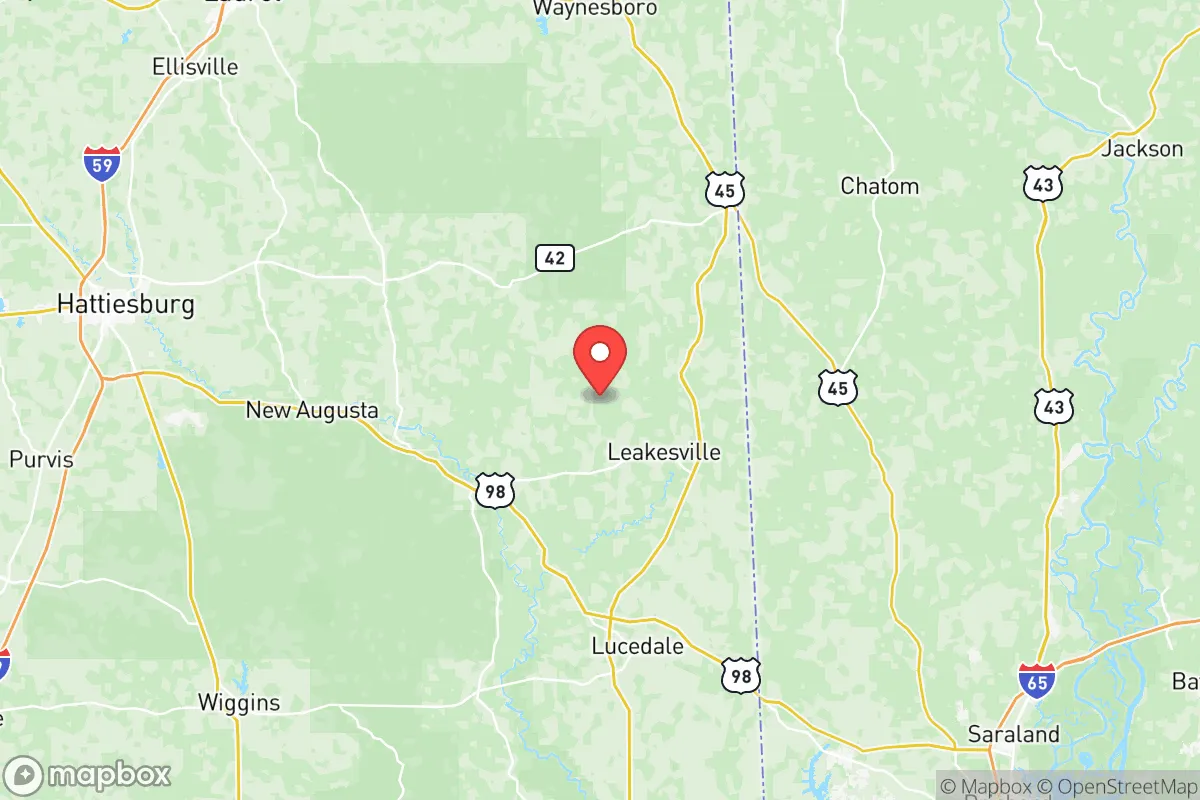
Greene County, Mississippi, is a deeply conservative area that leans heavily Republican, with a Cook PVI of R+21, making it significantly more Republican than the state of Mississippi as a whole, which sits at R+11. This isn't a recent shift; the county has been a reliable GOP stronghold for decades, and the trend is only solidifying. The rural, timber-and-agriculture economy, combined with strong evangelical Christian traditions, creates a political culture where conservative values are the default. While there's no real blue-leaning town to speak of, the small unincorporated communities like Leakesville (the county seat) and McLain are overwhelmingly red, with precincts routinely delivering 75-80% of the vote to Republican candidates. The only slight variation you might see is in the more remote, sparsely populated precincts near the Pascagoula River, where turnout is low and the vote is still overwhelmingly Republican, just with a slightly higher share of Democratic votes from a handful of old-line Democratic families who haven't shifted with the times.
How it compares
To understand Greene County's politics, you have to compare it to the state as a whole. Mississippi is already a solidly red state, but Greene County is a full ten points more conservative on the Cook PVI scale. That's a massive gap. For context, while Mississippi's R+11 rating means it's reliably Republican in presidential elections, Greene County's R+21 puts it in the same league as the deepest red counties in the country, like those in the Texas Panhandle or rural Alabama. The difference is stark when you look at local elections: in Greene County, a Democrat running for county supervisor or sheriff is almost unheard of, and if one does run, they face an uphill battle. In contrast, in the rest of Mississippi, particularly in the Delta or around Jackson, Democrats still hold local offices and can be competitive in state legislative races. The county's political trajectory is also distinct: while Mississippi as a whole has seen a slow but steady drift rightward since the 1990s, Greene County has been there the whole time, and its Republican margins have only grown as national politics have polarized further.
What this means for residents
For conservative residents, Greene County is a comfortable place to live politically. Their values are reflected in local policy, from the county's stance on gun rights to its approach to economic development, which prioritizes low taxes and minimal regulation. There's no real political friction in daily life; most people agree on the basics. For liberal residents, the reality is different. They are a distinct minority, and while they aren't actively persecuted, they often keep their political views private to avoid social friction or professional repercussions. There's no organized progressive community, and local Democratic Party activity is virtually nonexistent. The practical effect is that liberal residents either adapt to the conservative consensus or find their political expression limited to national issues, where they might vote for a Democratic presidential candidate but have no real local outlet for their views. The county's trajectory suggests this dynamic will persist, as younger residents who leave for college or jobs in cities like Mobile or Hattiesburg often don't return, reinforcing the area's conservative character.
Culturally, Greene County is distinct from the rest of Mississippi in its deep connection to the timber industry and its relative isolation from the state's major population centers. There's no college town, no major highway, and no urban influence to speak of. This insularity reinforces the political homogeneity. Policy-wise, the county is a stronghold for Second Amendment rights, with a permissive approach to concealed carry and no local gun control ordinances. It's also a place where religious conservatism shapes public life more than in the state's more diverse regions; for example, the county's schools and local government are openly Christian in their culture, with prayer at public meetings and a curriculum that reflects local values. For anyone moving here, the key takeaway is that Greene County is not just a red county in a red state—it's a place where the political and cultural consensus is deeper and more uniform than almost anywhere else in Mississippi.

State Political ClimatePolitical Climate in Mississippi
State Political AnalysisPolitical Environment in the State
Mississippi is one of the most reliably Republican states in the country, with a Cook Partisan Voting Index of R+11, meaning it votes about 11 points more Republican than the national average. The state hasn't voted for a Democratic presidential candidate since 1976, and the GOP holds every statewide office and supermajorities in both legislative chambers. Over the last 20 years, the shift has been dramatic — as late as the 1990s, Democrats still held the governorship and many local offices, but the realignment of white conservative voters, especially in the suburbs and rural areas, has made Mississippi a deep-red stronghold. The Democratic coalition is now largely confined to the Mississippi Delta, a handful of majority-Black urban precincts, and a few college towns.
Urban vs. rural divide
The political map of Mississippi is starkly divided along urban, suburban, and rural lines. The state's largest metro area, Jackson (Hinds County), is a Democratic stronghold — Hinds County voted over 80% for Joe Biden in 2020 — but it is surrounded by rapidly growing, heavily Republican suburbs like Madison and Rankin counties, which are among the most conservative in the nation. The Gulf Coast cities of Biloxi, Gulfport, and Pascagoula lean Republican but are more competitive, with pockets of Democratic support among unionized shipyard workers and the Black community. The Mississippi Delta, including towns like Greenville, Clarksdale, and Cleveland, is overwhelmingly Democratic and majority-Black, but these areas have lost population for decades. Meanwhile, the northeastern corner of the state, anchored by Tupelo and Oxford (home to the University of Mississippi), is reliably Republican, though Oxford itself has a noticeable liberal enclave around the university. The rural "Pine Belt" and counties along the Alabama border, such as Lauderdale County (Meridian), are deeply conservative. The only real Democratic foothold outside the Delta is in a few majority-Black precincts in Hattiesburg and the Mississippi River counties south of Vicksburg.
Policy environment
Mississippi's policy environment is among the most conservative in the country. The state has no individual income tax on wages — it phased out the tax entirely as of 2026, leaving only a 4% corporate income tax and a 7% sales tax on most goods. Property taxes are very low by national standards, with no state-level property tax and local rates averaging around 0.8% of assessed value. The regulatory posture is business-friendly: Mississippi is a right-to-work state with weak labor unions and minimal zoning restrictions outside of major cities. Education policy is a mixed bag — the state has a school choice program (the Mississippi Education Scholarship Account) that allows some students to use public funds for private school, but public school funding has been a perennial legal battle, with the state legislature often underfunding the Mississippi Adequate Education Program. Healthcare is a major weakness: Mississippi did not expand Medicaid under the Affordable Care Act, leaving roughly 75,000 low-income adults in a coverage gap, and the state has some of the worst health outcomes in the nation. Election laws are restrictive: Mississippi requires a government-issued photo ID to vote, has no early voting (though absentee voting by mail is available with an excuse), and has some of the strictest felony disenfranchisement laws in the country, permanently barring about 10% of the voting-age population from the polls.
Recent policy direction
Over the past five years, Mississippi has moved aggressively to the right on a broad range of issues. In 2024, the legislature passed a near-total abortion ban with no exceptions for rape or incest, triggered by the Dobbs decision, and the state's only abortion clinic closed in 2022. On gun rights, Mississippi became a permitless carry state in 2016 and has repeatedly rejected any new restrictions; the state also has a strong "stand your ground" law and preempts local gun ordinances. On education and parental rights, the 2022 "Parental Bill of Rights" (HB 1309) gave parents the right to review curriculum and opt their children out of certain instruction, and the state has banned critical race theory and gender identity discussions in K-12 classrooms. On speech and privacy, Mississippi passed a law in 2023 requiring age verification for adult websites and has a broad "revenge porn" statute, but there are no state-level data privacy laws beyond sector-specific ones. On medical and bodily autonomy, the state has banned gender-affirming care for minors (2023) and allows medical professionals to refuse participation in procedures they object to on religious or moral grounds. Property rights are strong: Mississippi is a "Dillon's Rule" state, meaning local governments have only the powers explicitly granted by the state, which limits municipal zoning and rent control. On voting and ballot access, the state has not expanded early voting or no-excuse absentee voting, and in 2023 it passed a law requiring stricter verification for voter registration applications. The overall direction is toward maximizing individual liberty in economic and self-defense matters while restricting it on social and medical issues.
Civil unrest & political movements
Mississippi has a long and painful history of racial violence and civil rights struggles, but in recent years, large-scale civil unrest has been rare. The most visible flashpoint was the 2020 protests in Jackson and other cities following the murder of George Floyd, which were largely peaceful but saw some property damage and a heavy police presence. The state has a small but active progressive movement centered in Jackson, led by groups like the Mississippi Poor People's Campaign and the NAACP, which have pushed for Medicaid expansion and criminal justice reform. On the right, the Mississippi Republican Party is dominated by the conservative wing, with groups like the Mississippi Tea Party and the American Family Association (based in Tupelo) wielding significant influence. Immigration politics are less heated than in border states, but Mississippi has a 2008 law requiring all employers to use E-Verify, and there have been occasional controversies over immigration enforcement in the poultry processing plants of central Mississippi. There is no serious secessionist movement, but "nullification" rhetoric occasionally surfaces in debates over federal gun laws and environmental regulations. Election integrity has been a recurring topic since 2020, with the state legislature passing a voter ID verification law in 2023, though there have been no major fraud scandals. A new resident would notice that political signs and bumper stickers are common, especially in rural areas, and that political conversations are more openly partisan than in many other parts of the country.
Projection
Over the next 5 to 10 years, Mississippi is likely to remain deeply Republican, but demographic and economic shifts could moderate the state's politics slightly. The population is aging and slowly declining, with the biggest losses in the Democratic-leaning Delta and the biggest gains in the Republican-leaning suburbs around Jackson, the Gulf Coast, and the Tupelo area. In-migration is modest — Mississippi attracts some retirees and remote workers from higher-cost states, but not at the scale of Tennessee or Florida. The state's Black population, about 38% of the total, is increasingly concentrated in a few urban and Delta counties, which could make statewide elections even more polarized along racial lines. The phaseout of the income tax may attract some new residents and businesses, but the lack of Medicaid expansion and poor health outcomes remain a drag on economic growth. Politically, the most likely scenario is continued GOP dominance, with the only real competition in Democratic primaries for a handful of legislative seats in Jackson and the Delta. A new resident moving in now should expect to find a state where conservative values are deeply embedded in law and culture, where the pace of change is slow, and where the political debate is largely between different shades of Republicanism rather than between the two major parties.
For someone considering a move to Mississippi, the bottom line is straightforward: if you are a conservative who values low taxes, gun rights, and traditional social policies, you will find the state highly aligned with your priorities. If you are a liberal, you will be in a distinct minority, especially outside of Jackson, Oxford, and a few other enclaves, and you will face a policy environment that is actively hostile to many of your views. The state is affordable, with a low cost of living and a relaxed pace of life, but it also has significant challenges in healthcare, education, and infrastructure. The political climate is stable and predictable — Mississippi is not a swing state and is unlikely to become one — so you can expect the current trajectory to continue for the foreseeable future.
* Values derived from national, state, county, city and local statistics and may differ in a specific area. Last updated: 2026-11-04T16:00:06.000Z
Narrative content on this page is AI-generated and may contain mistakes. Verify any details that matter before acting on them.
ReloMaps may earn a commission from affiliate links at no extra cost to you.

