
Photo: Wikipedia
Political ClimatePolitical Climate in George County
Showing district-level results — no local-only data available.
Local Political AnalysisPolitical Analysis of George County
George County, Mississippi, is one of the most reliably Republican corners of an already red state, carrying a Cook Partisan Voting Index (PVI) of R+21. That’s a full ten points more conservative than the state of Mississippi as a whole, which sits at R+11. The county hasn’t voted for a Democratic presidential candidate since 1976, and the margins have only widened since then. In 2024, Donald Trump carried George County with over 80% of the vote, a number that reflects a deep, generational alignment with the GOP that shows no signs of softening.
How it compares
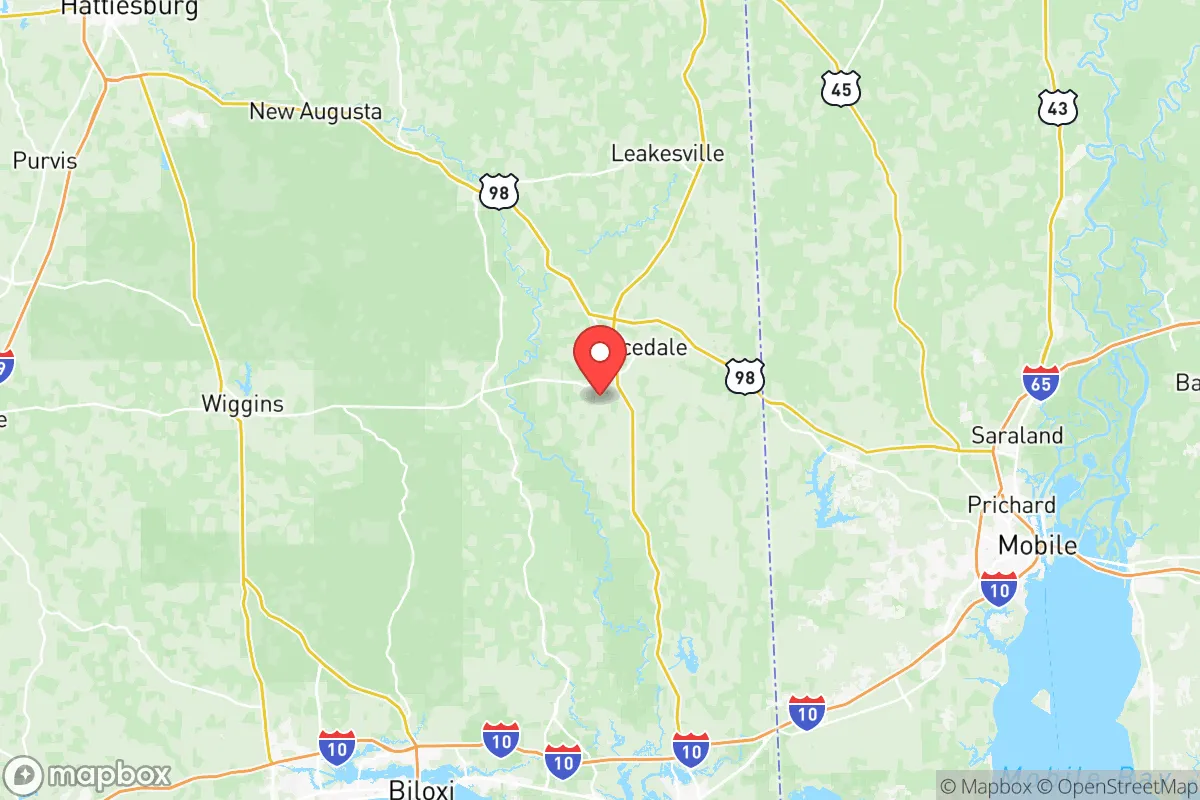
The R+21 PVI puts George County in the same league as the most conservative counties in the state, like neighboring Greene County (R+22) and Stone County (R+20). By contrast, the state’s R+11 rating is pulled leftward by the Jackson metro area (Hinds County is D+15) and the Mississippi Delta. Within George County itself, the political geography is surprisingly uniform. The county seat, Lucedale, is the largest town and votes about as red as the rural precincts—there’s no real blue pocket. The unincorporated communities of Agricola and Barton are even more conservative, often hitting 85-90% Republican in presidential races. The only precinct that ever shows a slight Democratic lean is the small area around the George County Industrial Park, where a handful of unionized manufacturing workers sometimes split their tickets, but even that precinct hasn’t gone blue since 2012. For context, the swing precincts of the state—places like DeSoto County’s Southaven or Harrison County’s Biloxi—don’t exist here. George County is a solid, unmixed red.
What this means for residents
For conservative residents, the political climate is a comfortable fit. Local offices—from the Board of Supervisors to the school board—are held by Republicans, and the county’s legislative delegation in Jackson is uniformly GOP. Policy debates tend to center on property taxes, timber and poultry regulations, and road funding, not culture-war flashpoints. For liberal residents, the reality is more isolating. There is no active Democratic Party organization in the county, and progressive candidates rarely bother to campaign here. Socially, being openly left-leaning can be a liability in small-town interactions, though most people just keep their politics private. The practical effect is that local government moves slowly on issues like broadband expansion or workforce housing, which lack the same grassroots urgency as, say, Second Amendment sanctuary resolutions—which the county passed unanimously in 2021.
One cultural distinction worth noting: George County is part of the Pine Belt region, and its politics are shaped by a strong hunting and timber culture that prizes self-reliance over government intervention. Unlike the Gulf Coast counties to the south, which have a more tourism-driven economy and a slightly more moderate GOP flavor, George County’s conservatism is rooted in rural economics and church life. The county’s small population—around 25,000—means that personal relationships still matter more than party labels in local races. A candidate’s family name and reputation in the community can outweigh their party affiliation, though that’s a nuance that rarely affects the final tally. Looking ahead, the county’s political trajectory is flat: no demographic shifts, no in-migration of outsiders, and no economic diversification on the horizon that would shake up the voting patterns. George County will remain R+21 for the foreseeable future, a quiet, consistent red anchor in a state that’s already deep in the GOP column.

State Political ClimatePolitical Climate in Mississippi
State Political AnalysisPolitical Environment in the State
Mississippi is one of the most reliably Republican states in the country, with a Cook Partisan Voting Index of R+11, meaning it votes about 11 points more Republican than the national average. The state hasn’t voted for a Democratic presidential candidate since Jimmy Carter in 1976, and every statewide elected office is held by Republicans. Over the past 20 years, the GOP’s hold has only tightened as rural white voters consolidated behind the party, while the Black population—roughly 38% of the state—remains overwhelmingly Democratic. The result is a deeply polarized but stable political landscape where Republicans control the legislature, the governor’s mansion, and the courts, and where Democratic strength is concentrated in the Mississippi Delta and a handful of urban centers.
Urban vs. rural divide
The political map of Mississippi is a study in contrast. The state’s two major metro areas—Jackson and the Gulf Coast cities of Biloxi and Gulfport—are Democratic-leaning, but for different reasons. Jackson, the capital and largest city, is majority-Black and reliably blue; Hinds County, which contains most of Jackson, gave Joe Biden 79% of the vote in 2020. The Gulf Coast, by contrast, has a more mixed electorate, with Biloxi and Gulfport trending Democratic due to unionized casino workers and a sizable Black population, but the surrounding Harrison County still went for Trump by a narrow margin. Outside these pockets, the state is deeply red. The northeastern hill country around Tupelo and Oxford is solidly Republican, driven by white evangelical voters and a growing suburban base. The Mississippi Delta—places like Greenville and Clarksdale—is the most Democratic region in the state, with Black-majority counties routinely voting 80%+ Democratic. But these areas have shrinking populations, which further amplifies the rural Republican vote. The fastest-growing counties are the suburban rings around Jackson—Madison and Rankin counties—which are heavily Republican and have flipped from purple to deep red over the past decade.
Policy environment
Mississippi’s policy environment is among the most conservative in the nation. The state has no income tax on wages (it phased out the individual income tax in 2022, with full elimination by 2026), and the corporate income tax is being phased out as well. Sales tax is a flat 7%, among the highest in the country, and property taxes are low by national standards. The regulatory posture is business-friendly: Mississippi is a right-to-work state, has weak union protections, and offers generous incentives for economic development. Education policy is a flashpoint: the state has a school choice program (the Mississippi Education Scholarship Account) that allows parents to use public funds for private school tuition, but public school funding remains among the lowest per-pupil in the nation. Healthcare is a major issue—Mississippi has not expanded Medicaid under the Affordable Care Act, leaving roughly 200,000 low-income adults in a coverage gap. Election laws are restrictive: the state requires a government-issued photo ID to vote, has no early voting (except absentee by mail with an excuse), and has strict voter purges. Abortion is banned with no exceptions for rape or incest, following the 2022 Dobbs decision. Gun laws are permissive: no permit is required to carry a concealed firearm (constitutional carry was enacted in 2016), and there are no red-flag laws.
Recent policy direction
Over the past five years, Mississippi has moved decisively to the right on nearly every front. In 2023, the legislature passed a law banning gender-affirming care for minors, overriding a veto from Governor Tate Reeves. In 2024, the state enacted a near-total abortion ban with no exceptions for rape or incest, and a law requiring that public school teachers display the Ten Commandments in every classroom. On gun rights, the state has resisted any new restrictions, and in 2023 it passed a law prohibiting local governments from enacting their own gun ordinances. On property rights, Mississippi has a strong eminent domain protection law, but it also allows for the seizure of property in drug cases through civil asset forfeiture. On voting, the legislature has tightened absentee ballot rules and shortened the window for mail-in ballots. On privacy and surveillance, the state has no comprehensive data privacy law, and law enforcement can access cell phone location data without a warrant in some cases. The overall direction is toward maximizing individual liberty in economic and gun matters while restricting it on social issues like abortion and transgender rights.
Civil unrest & political movements
Mississippi has a long history of racial tension, but large-scale civil unrest has been rare in recent years. The 2020 George Floyd protests in Jackson were significant but largely peaceful, with some property damage. The state has seen a rise in organized conservative activism, particularly around school board meetings and library boards, where groups like the Mississippi Parents’ Campaign have pushed for book bans and curriculum restrictions. Immigration politics are less heated than in border states, but there is a vocal anti-immigrant faction that has pushed for state-level enforcement, though Mississippi has no sanctuary cities. Secessionist rhetoric is mostly fringe, confined to a few online groups and the occasional county resolution. Election integrity controversies flared after 2020, with the state GOP passing a law to create a new election integrity unit, but there have been no major fraud cases. The most visible flashpoint for a new resident would be the cultural divide between Jackson and the rest of the state—Jackson’s progressive city government often clashes with the state legislature over issues like police funding and LGBTQ+ rights.
Projection
Over the next 5-10 years, Mississippi is likely to remain solidly Republican, but the margins may narrow slightly as the Black population grows in suburban areas and as younger, more moderate whites move into the state’s growing metro areas. The Delta will continue to lose population, further reducing Democratic votes. The biggest wildcard is in-migration: Mississippi is attracting retirees and remote workers from higher-tax states like California and Illinois, and these newcomers tend to be more conservative on fiscal issues but more moderate on social ones. If this trend accelerates, it could shift the GOP primary electorate toward a more libertarian-leaning faction. The state’s policy direction is unlikely to reverse—Medicaid expansion remains a non-starter, abortion will stay banned, and gun laws will remain permissive. But there could be incremental changes: a push for school choice expansion, a possible move to legalize medical marijuana (which failed in 2024 but has strong public support), and continued tax cuts. A new resident moving in now should expect a state that is politically stable, deeply conservative, and resistant to change, but with a growing urban-rural divide that could produce more competitive local elections in places like Madison County and the Gulf Coast.
Bottom line for a new resident: If you’re a conservative, you’ll find a state that aligns with your values on taxes, guns, and social issues, with a government that is responsive to your concerns. If you’re a liberal, you’ll be in a clear minority, but you’ll find like-minded communities in Jackson, the Delta, and parts of the Gulf Coast. The practical takeaway is that Mississippi is a low-tax, low-regulation state where your personal liberties on economic and gun matters are broad, but your social freedoms—especially around reproductive rights and LGBTQ+ issues—are sharply limited. The political climate is stable and unlikely to shift dramatically, so you can plan accordingly.
* Values derived from national, state, county, city and local statistics and may differ in a specific area. Last updated: 2026-11-07T05:06:09.000Z
Narrative content on this page is AI-generated and may contain mistakes. Verify any details that matter before acting on them.
ReloMaps may earn a commission from affiliate links at no extra cost to you.

