
Photo: Wikipedia
Demographics of George County
Affluence Level in George County
A middle-class area roughly in line with national averages across income, home values, education, and employment.
People of George County
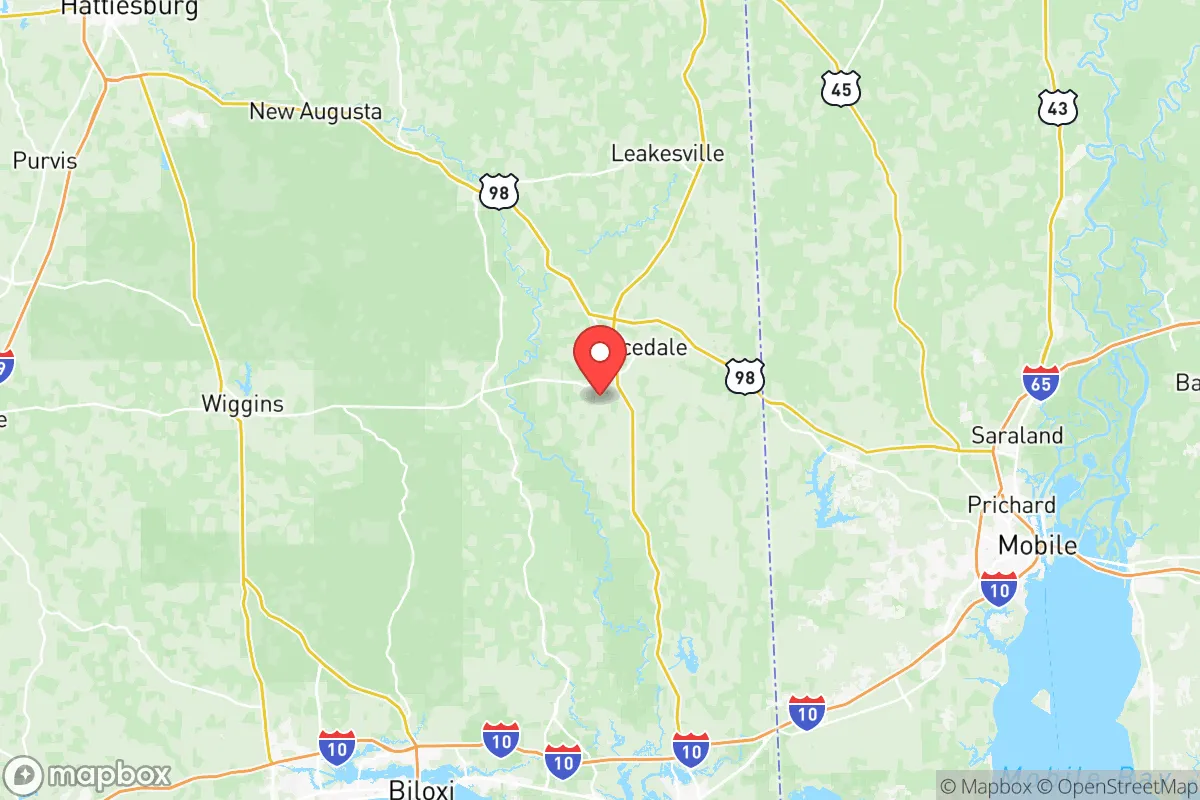
George County, Mississippi, is a deeply rooted, predominantly rural community where 24,870 residents share a strong sense of place shaped by generations of family ties. With a population that is 84.9% White, 7.8% Black, and 3.0% Hispanic, the county’s character is defined by its slow growth, low population density, and a cultural identity tied to timber, agriculture, and Southern Baptist traditions. The foreign-born population is a negligible 0.3%, and only 17.1% of adults hold a college degree, reflecting a community where local roots and practical trades remain central to daily life.
Settlement & growth (pre-1960)
Long before European settlers arrived, the area now known as George County was part of the ancestral homeland of the Choctaw Nation. The Choctaw used the Pascagoula River and its tributaries—including the Black Creek and Leaf River—for travel, fishing, and hunting. After the Treaty of Dancing Rabbit Creek in 1830, the Choctaw were forcibly removed to Oklahoma, opening the piney woods to American settlers. The region remained sparsely populated through the early 19th century, as the sandy, pine-covered terrain was considered marginal for plantation agriculture.
The first permanent American settlers were primarily Scots-Irish and English families who arrived from the Carolinas, Georgia, and other parts of the Deep South between the 1820s and 1850s. They were drawn by cheap, available land under federal land grants and the promise of subsistence farming and timber extraction. These early settlers established small, isolated homesteads along the Pascagoula River and its creeks. The community of Lucedale, now the county seat, began as a trading post and sawmill stop in the 1880s, growing slowly as the timber industry expanded. The arrival of the Gulf and Ship Island Railroad in the 1890s transformed Lucedale into a shipping hub for yellow pine lumber, attracting additional workers from neighboring Alabama and the Mississippi coast.
George County was officially created in 1910 from parts of Greene and Jackson counties, named for U.S. Senator James Z. George. At that time, the population was overwhelmingly rural, white, and native-born, with a small Black population descended from enslaved families who had worked on scattered small farms before the Civil War. The county’s economy remained tied to timber, turpentine, and subsistence farming through the Great Depression. During the 1930s and 1940s, the Civilian Conservation Corps and Works Progress Administration built roads, bridges, and the Bowie and Agricola community centers, but the county saw little in-migration. The post-World War II era brought modest growth as returning veterans took advantage of the GI Bill to buy small farms or find work in the expanding timber and paper mills, particularly at the Masonite plant in nearby Laurel. By 1960, George County’s population had reached roughly 11,000, still overwhelmingly white and native-born, with small Black communities concentrated in the Basin and Barton areas.
Modern era (post-1965)
The 1965 Hart-Cellar Act, which dramatically reshaped U.S. immigration patterns, had almost no effect on George County. The county’s foreign-born population remains at 0.3% in 2026, one of the lowest rates in Mississippi. Unlike many parts of the Sun Belt, George County did not experience significant immigration from Latin America, Asia, or the Indian subcontinent. The small Hispanic population of 3.0% is largely composed of families who moved from Texas or Mexico for work in the poultry and timber industries, with a small concentration in and around Lucedale. The East/Southeast Asian population (0.3%) and Indian subcontinent population (0.0%) are negligible, reflecting the county’s lack of the high-tech or university sectors that attract such groups elsewhere.
The most significant demographic shift since 1965 has been domestic: the slow, steady out-migration of young adults seeking education and employment in Gulf Coast cities like Biloxi, Gulfport, and Mobile, Alabama. This has left George County with an older age profile than the state average. At the same time, the county has attracted a small but consistent number of retirees and second-home buyers from the Mississippi coast, drawn by lower property taxes and a quieter lifestyle. These newcomers tend to settle on rural acreage near Lucedale or along the Pascagoula River in the Merrill community. The Black population has remained stable at around 7.8%, with families concentrated in the same historic communities of Basin and Barton, as well as in Lucedale itself. Suburbanization has been minimal; there are no large subdivisions or master-planned communities. Instead, new housing is scattered along county roads, with a few small subdivisions near Lucedale’s school district.
The future
George County’s population is projected to remain stable or grow very slowly over the next 10–20 years, likely reaching 26,000–27,000 by 2040. The county will almost certainly remain one of the least diverse in Mississippi, with the white population continuing to dominate at roughly 83–85%. The Hispanic share may rise modestly to 4–5% as families follow agricultural and construction jobs, but the foreign-born population will likely stay below 1%. The Black population is expected to hold steady or decline slightly, as younger Black residents continue to move to coastal cities for better job opportunities. The county’s cultural identity will remain deeply conservative, evangelical, and family-oriented, with little pressure for change from outside groups. New residents will continue to be mostly domestic migrants from the Gulf Coast and other parts of Mississippi, seeking affordable land and a slower pace of life.
For someone moving in now, George County offers a stable, predictable community where neighbors know each other, church attendance is high, and the pace of life is unhurried. The trade-offs are clear: limited job diversity, low educational attainment, and minimal ethnic or cultural diversity. The county is not becoming more cosmopolitan or diverse; it is quietly holding its course as a rural, white-majority enclave in the Deep South. For those who value deep roots, low crime, and wide-open spaces, that is precisely the appeal.

* Values derived from national, state, county, city and local statistics and may differ in a specific area. Last updated: 2026-11-07T05:06:09.000Z
Narrative content on this page is AI-generated and may contain mistakes. Verify any details that matter before acting on them.
ReloMaps may earn a commission from affiliate links at no extra cost to you.

