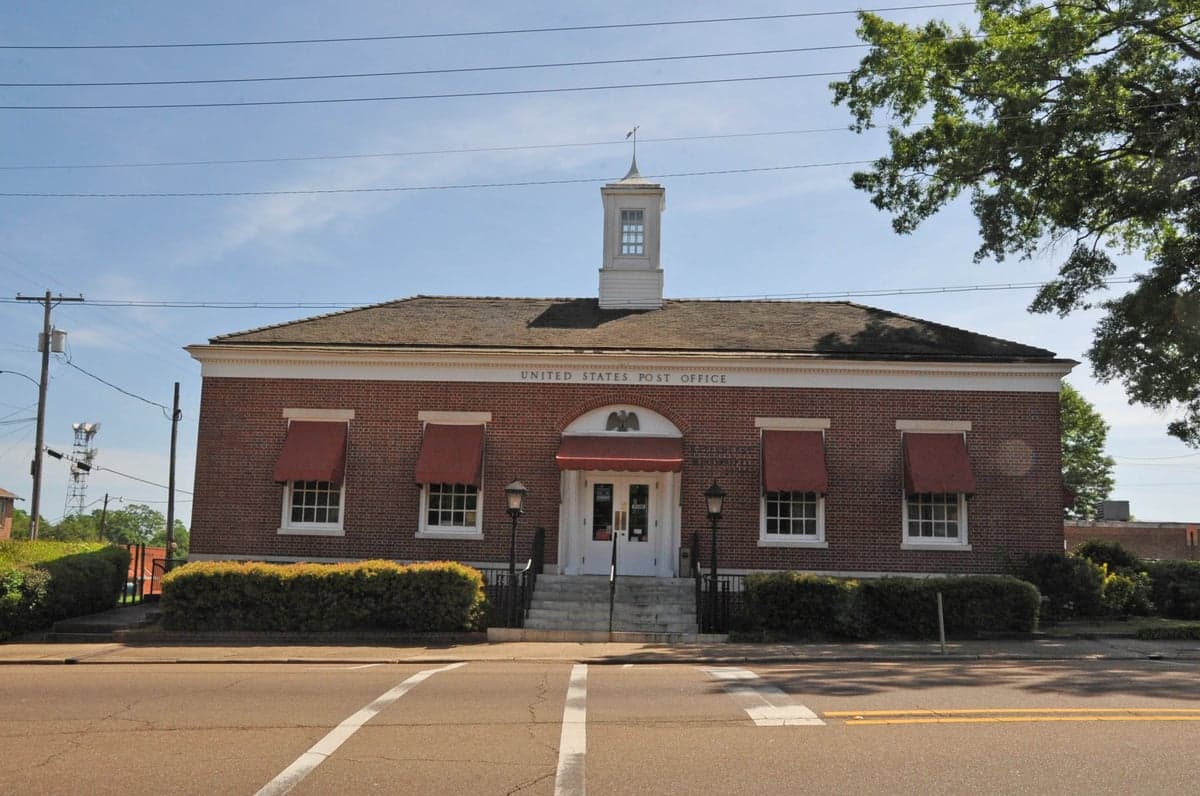
Photo: Wikipedia
Political ClimatePolitical Climate in Copiah County
Showing county-level results — no local-only data available.
Lean and PVI are calculated from this county’s 2020 and 2024 presidential results, Cook-style.
Political rankings in Mississippi
- Most Conservative Cities in Mississippi
- Most Liberal Cities in Mississippi
- Best Liberal-Leaning Towns in the South
- Best Liberal-Leaning Towns in the Deep South
- Safest Liberal-Leaning Towns in the South
- Safest Conservative-Leaning Towns in the South
- Affordable Small Towns for Conservatives
- Safest Conservative-Leaning Cities in the U.S.
- Most Conservative Counties in Mississippi
- Most Liberal Counties in Mississippi
Local Political AnalysisPolitical Analysis of Copiah County
Copiah County is a genuine political outlier in Mississippi — a D+11 county sitting in the middle of an R+11 state, a 22-point gap that makes it one of the most striking Democratic strongholds in the Deep South. The county has voted for Democratic presidential candidates consistently for decades, even as the rest of the state has shifted hard to the right. That isn't a fluke of one election; it's a long-standing pattern rooted in the county's demographics and its Black-majority electorate, which turns out at high rates and votes overwhelmingly Democratic.
How it compares
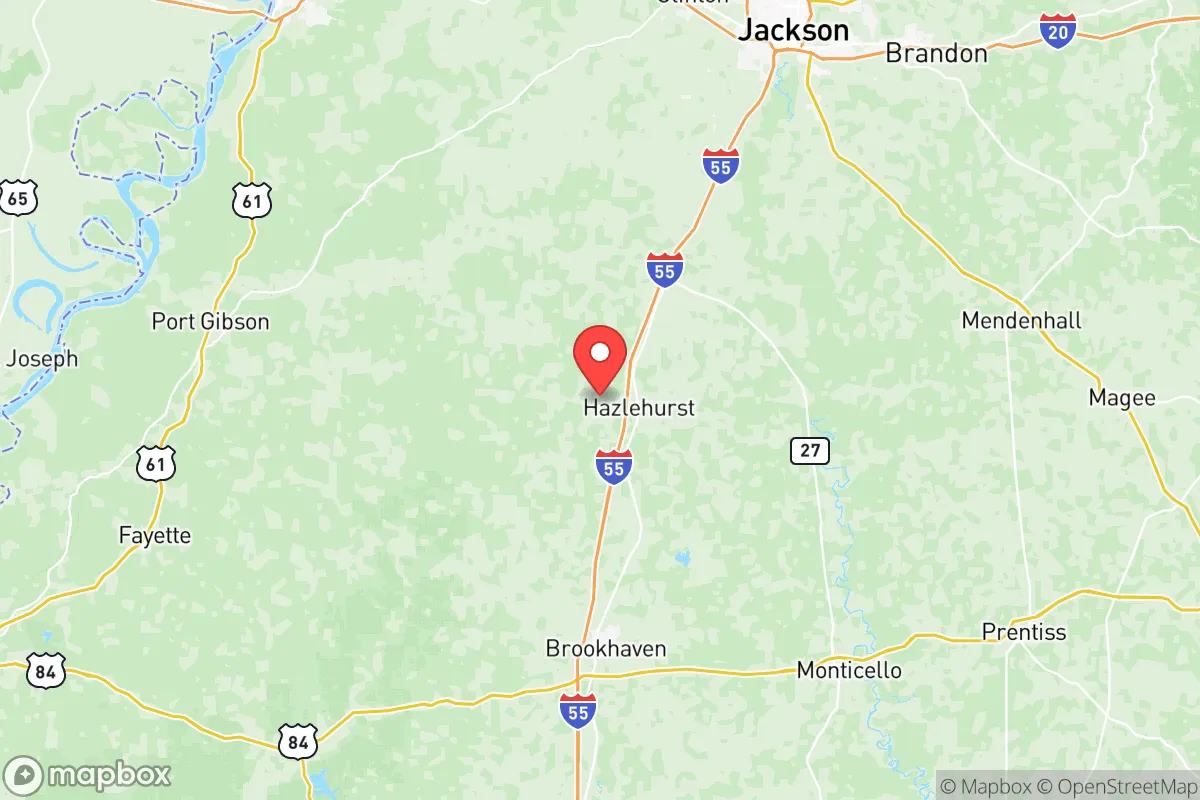
The contrast with the rest of Mississippi couldn't be starker. While the state as a whole has a Cook PVI of R+11 — meaning it votes about 11 points more Republican than the national average — Copiah County sits at D+11, voting about 11 points more Democratic. That's a 22-point spread between county and state, one of the largest in the region. In practical terms, a Democrat running for statewide office can expect to win Copiah by double digits, while the same candidate might lose neighboring counties like Simpson or Lincoln by 30 points or more. The county's largest town, Hazlehurst, is the anchor of the Democratic vote, with its majority-Black precincts delivering margins that often exceed 70-80% Democratic. Smaller communities like Crystal Springs and Wesson show more mixed results — Crystal Springs has a significant Black population and leans blue, while Wesson, home to Copiah-Lincoln Community College and a larger white population, tilts red. The swing precincts are in the rural areas between these towns, where a handful of votes can shift the countywide margin by a point or two.
What this means for residents
For conservative residents, the practical reality is that their votes rarely carry the county, but they're not without influence — Republican candidates still compete in Wesson and the western parts of the county, and local offices like sheriff and chancery clerk often see competitive races where crossover voting matters. For liberal residents, the county is a rare safe space in Mississippi where Democratic candidates actually campaign and where local elected officials tend to reflect the county's Democratic lean. That said, the county is not a progressive bastion in the national sense — it's a conservative-leaning Democratic county, where voters support Democrats but also hold traditional views on issues like gun rights and religion. The county's Democratic Party is a coalition of Black voters and a smaller number of white moderates, and that coalition has held together through decades of statewide Republican dominance.
One of the most telling cultural distinctions is how Copiah County handles its politics: it's less about partisan labels and more about personal relationships. The county's Democratic lean is less an ideological statement than a reflection of community ties and historical voting patterns. In Hazlehurst, the county seat, local politics are dominated by issues like infrastructure, the poultry plants that employ hundreds of residents, and the railroad that runs through town — not by national culture wars. The county has voted for Democrats like Jim Hood for attorney general and Mike Espy for Senate, even as those same candidates lost badly elsewhere in the state. Looking ahead, the county's trajectory is stable — demographic trends suggest the Democratic lean will persist, though turnout fluctuations in midterm and off-year elections can narrow the margins. For anyone moving to Copiah County, the political climate is a reminder that Mississippi isn't a monolith, and that a single county can hold its own against the state's dominant political winds.

State Political ClimatePolitical Climate in Mississippi
State Political AnalysisPolitical Environment in the State
Mississippi is one of the most reliably Republican states in the country, carrying a Cook PVI of R+11, but the story is more layered than a simple red-state label. The GOP has dominated every statewide office and both U.S. Senate seats for over a decade, yet the state’s politics are still shaped by a deep racial divide, a powerful rural-urban split, and a legacy of Democratic control that only fully collapsed in the 2010s. For a relocator, the practical reality is that Mississippi is a solidly conservative state on fiscal and social issues, but its internal battles are fought over how fast it modernizes, not whether it turns blue.
Urban vs. rural divide
The political map of Mississippi breaks down along predictable geographic lines, but the margins are stark. The state’s only true metropolitan anchor, Jackson, is a Democratic stronghold where Hinds County routinely votes 80%+ for Democratic candidates, driven by a majority-Black electorate and a concentration of state government workers and educators. The Gulf Coast, particularly Biloxi and Gulfport, leans Republican but is more competitive than the interior, with a mix of military retirees, casino workers, and a growing Hispanic population that keeps races closer. The northeastern corner around Tupelo is the state’s most interesting swing territory — a manufacturing and logistics hub with a moderate Republican tilt, where local Democrats still win county offices. The rural Delta, stretching from Greenville to Clarksdale, is overwhelmingly Democratic and majority-Black, but its population has been shrinking for decades, diluting its electoral weight. The real engine of the state’s R+11 lean is the suburban and exurban crescent around Jackson — places like Madison and Brandon — plus the pine belt of the southeast, where Hattiesburg and Laurel vote Republican by 20-30 point margins. The 2020 presidential race saw Donald Trump carry the state by 16.5 points, but the map was a near-perfect proxy for race and density: every majority-white rural county went red, every majority-Black county went blue, and the suburbs decided the overall margin.
Policy environment
Mississippi’s policy environment is defined by a low-tax, low-service philosophy that is among the most conservative in the nation. The state has no income tax on Social Security benefits, a flat 4.7% personal income tax that is scheduled to phase out entirely by 2026, and a 7% sales tax that hits groceries and essentials hard. Property taxes are among the lowest in the country, with a homestead exemption that shields a significant portion of primary residences. The regulatory posture is business-friendly to the point of being permissive — the state is a right-to-work state, has no state-level minimum wage above the federal $7.25, and offers generous incentive packages for manufacturers, particularly in the automotive and aerospace sectors around Canton and Columbus. Education policy is a mixed bag: the state has a school choice program that expanded in 2024 to allow universal Education Savings Accounts, but public schools remain chronically underfunded, with teacher pay lagging the regional average. Healthcare is the most contentious policy area — Mississippi rejected Medicaid expansion for a decade, keeping the state’s uninsured rate near the highest in the nation, though a 2025 legislative session finally passed a limited expansion tied to work requirements. Election laws are restrictive by national standards: voter ID is required, no-excuse absentee voting is unavailable, and the state has one of the shortest early voting windows in the country, though a 2024 law added two weeks of in-person early voting for the first time.
Recent policy direction
The last five years have pushed Mississippi decisively toward a conservative-libertarian posture on individual liberties, with a legislative agenda that mirrors the national GOP’s priorities. On gun law, the state passed permitless carry in 2021, allowing any adult to carry a concealed firearm without a license, and in 2024 added a "stand your ground" expansion that removes the duty to retreat in any place where a person has a legal right to be. Parental and education rights took center stage in 2022 with the passage of the "REAL Act," which prohibits instruction on gender identity and sexual orientation in K-8 classrooms, and the 2024 universal school choice law that lets parents redirect state funding to private or homeschool settings. On speech and privacy, the state passed a 2023 law banning TikTok on government devices and a 2024 measure requiring parental consent for minors to create social media accounts. Medical and bodily autonomy is the sharpest flashpoint: Mississippi’s 2023 near-total abortion ban, with exceptions only for rape, incest, or life endangerment, is the most restrictive in the nation, and the state has also banned gender-affirming care for minors and restricted transgender athletes from school sports. Property rights saw a win for landowners in 2024 with a law limiting eminent domain for private economic development, while taxation moved toward elimination of the income tax entirely, with a 2025 bill that accelerates the phase-out to 2027. Voting access is the one area where the state has actually loosened restrictions, with the 2024 early voting law and a 2025 measure allowing online voter registration, though same-day registration remains illegal.
Civil unrest & political movements
Mississippi’s political movements are quieter than its reputation suggests, but the flashpoints are real. The state has a long history of civil rights activism, and the Black Lives Matter protests of 2020 were significant in Jackson and Oxford, home to the University of Mississippi, where a Confederate statue was removed from the campus square after years of controversy. The right-wing movement is organized around the state’s robust gun culture and evangelical churches, with groups like the Mississippi Freedom Caucus pushing for stricter immigration enforcement and school prayer amendments. Immigration politics are a growing issue along the Gulf Coast, where a 2024 law requires local law enforcement to cooperate with federal immigration authorities and penalizes sanctuary policies, though no Mississippi city has ever declared itself a sanctuary. Secession and nullification rhetoric is mostly fringe, but it surfaced in 2021 when a handful of county supervisors passed symbolic resolutions against federal vaccine mandates. Election integrity controversies have been minimal compared to other Southern states — the 2020 and 2022 elections ran smoothly, and the state’s Republican Secretary of State has publicly defended the accuracy of the vote. The most visible flashpoint for a new resident is the flag issue: the state retired its Confederate-themed flag in 2020 and adopted a new magnolia design, a change that passed with bipartisan support but still rankles some rural conservatives.
Projection
Over the next five to ten years, Mississippi’s politics are likely to stay firmly Republican, but the character of that conservatism is shifting. The income tax phase-out will make the state even more attractive to retirees and remote workers, particularly along the Gulf Coast and in the Oxford-Hernando corridor near Memphis, which is seeing steady in-migration from Tennessee and Texas. The demographic trend is toward a slightly more diverse electorate — the Hispanic population grew 30% between 2010 and 2020, concentrated in the coastal counties and around Petal — but the white rural vote remains dominant. The real fight in the next decade will be internal: a growing faction of the GOP wants to fully eliminate the income tax and privatize education, while a more moderate wing, backed by the business community, is pushing for Medicaid expansion and infrastructure investment. The Delta’s population decline will continue to shrink the Democratic base, but Jackson’s growth as a regional logistics hub could stabilize the urban vote. A new resident moving in now should expect a state that is more conservative on fiscal policy, more restrictive on social issues, and more engaged in national culture wars, but also one that is slowly modernizing its election infrastructure and diversifying its economy.
For a new resident, the bottom line is that Mississippi offers a genuinely low-tax, low-regulation environment where conservative values are encoded into law, but it comes with trade-offs. You will pay less in taxes and have broad gun and property rights, but you will also have fewer public services, a weaker healthcare safety net, and a political culture that is deeply skeptical of government intervention. Liberal residents will find themselves in a clear minority, with limited political power outside of Jackson and the Delta, but the state’s small size means individual voices can still matter in local races. The practical takeaway is to choose your county carefully — Madison and Rankin counties offer the most affluent, fastest-growing conservative suburbs, while Hattiesburg and Oxford provide college-town moderation. Mississippi is not a place of political ambiguity; it is a place where the direction is clear, and the only question is how fast it gets there.
* Values derived from national, state, county, city and local statistics and may differ in a specific area. Last updated: 2026-10-30T16:42:09.000Z
Narrative content on this page is AI-generated and may contain mistakes. Verify any details that matter before acting on them.
ReloMaps may earn a commission from affiliate links at no extra cost to you.

