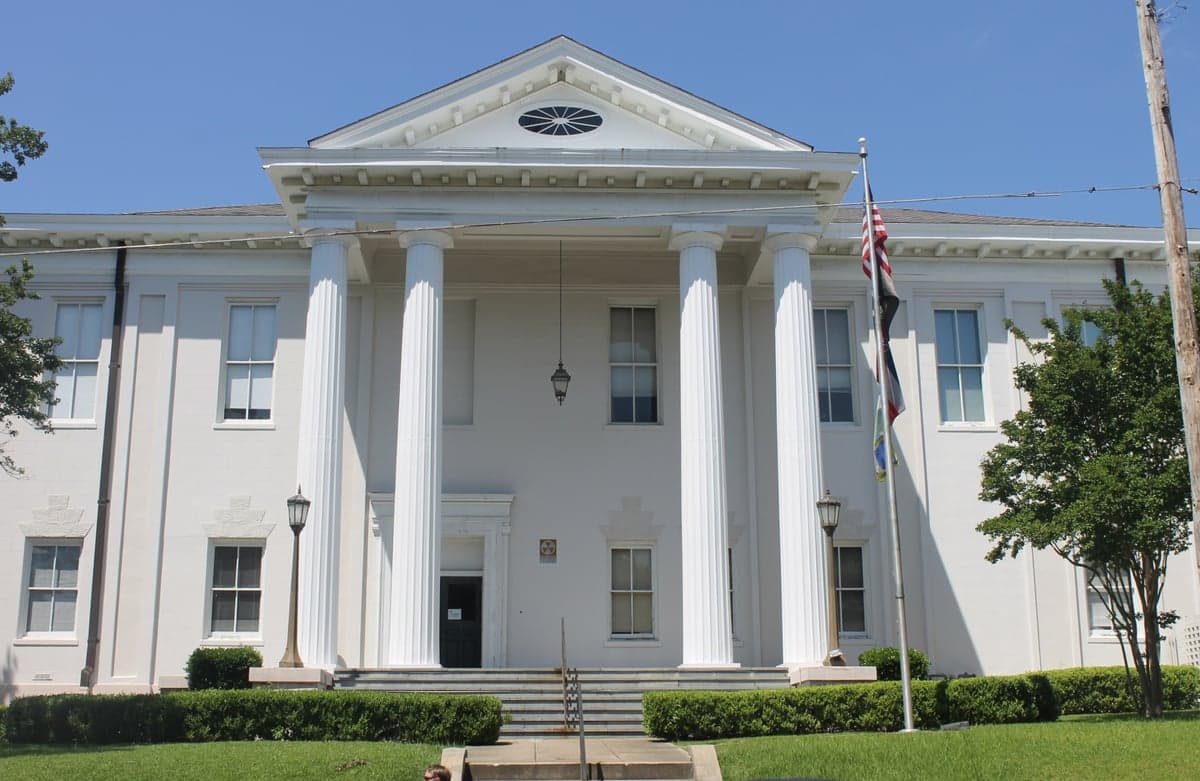

Photo: Wikipedia
Political ClimatePolitical Climate in Adams County
Showing district-level results — no local-only data available.
Local Political AnalysisPolitical Analysis of Adams County
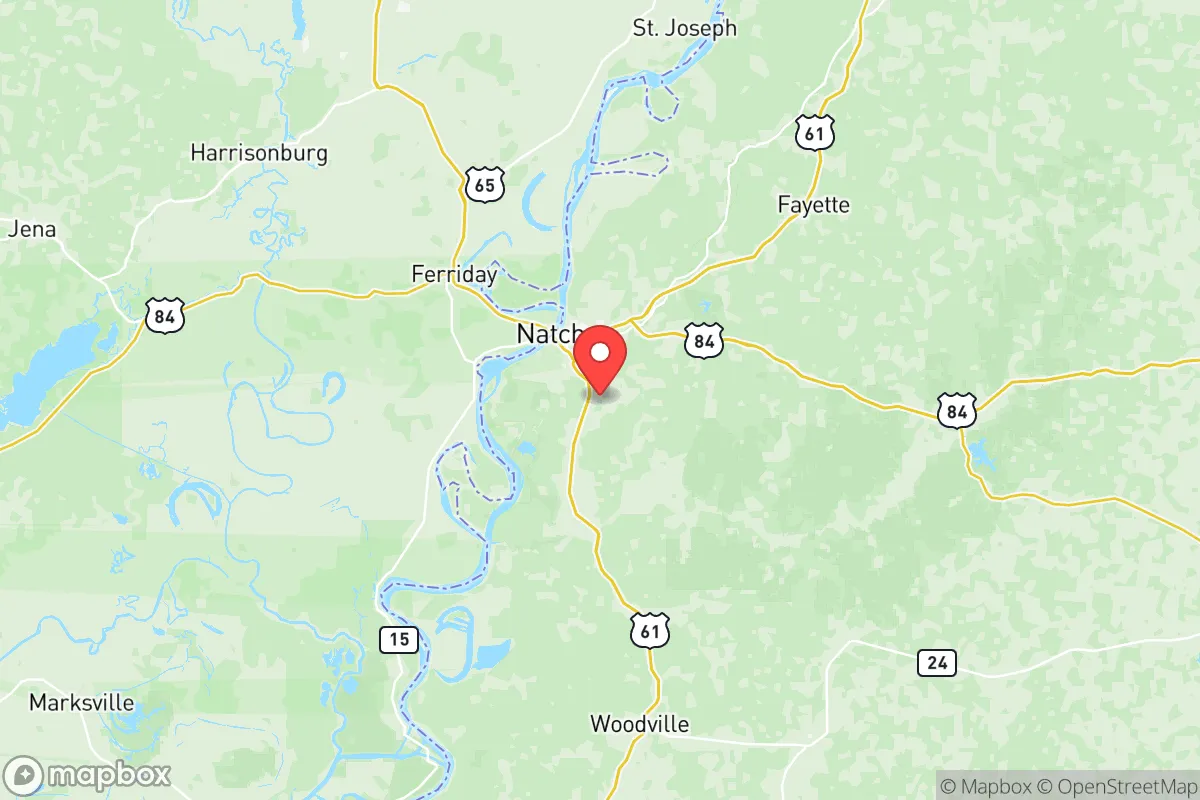
Adams County, Mississippi, is a Democratic stronghold in a deeply Republican state, carrying a Cook PVI of D+11 compared to Mississippi’s overall R+11. This 22-point gap makes it one of the most politically distinct areas in the state, a legacy of its majority-Black population and historic labor and civil rights organizing. The county has trended steadily Democratic in presidential elections since the 1990s, though turnout has dipped in midterms, and local races often see more cross-party voting than the national numbers suggest. Natchez, the county seat and largest city, anchors the Democratic vote, while smaller communities like Washington and the rural precincts around Sibley and Stanton show more Republican leanings, creating a patchwork of political microclimates within the county.
How it compares
Adams County’s D+11 rating stands in stark contrast to Mississippi’s R+11, meaning a Democrat running for president here typically wins by about 11 points, while statewide Republicans win by a similar margin. In practice, this means Natchez and its immediate suburbs—places like the neighborhoods around Duncan Park and the historic downtown—vote heavily Democratic, often by 70% or more. Meanwhile, the rural precincts west of the Mississippi River levee and the areas around the county’s northern edge, including the unincorporated community of Cranfield, lean Republican, sometimes by 15-20 points. The swing precincts are in the more mixed-income areas around the Natchez-Adams County School District and the industrial zones near the port, where economic concerns often override party loyalty. Statewide, Adams County is an outlier: most Mississippi counties with similar demographics are smaller and more rural, while Adams has a larger urban core and a more diverse economy, which keeps its politics distinct from the rest of the state.
What this means for residents
For conservative residents, living in a D+11 county means their votes are often outmatched in local elections, but they still have influence in state and federal races where the county’s margin is less decisive. Republican candidates for governor or Senate still campaign here, knowing that even a 10-point loss in Adams County is better than a 20-point one, and local GOP clubs in places like the Natchez Trace area remain active. For liberal residents, the county’s lean means they can reliably elect Democratic officials to county boards, the school board, and the chancery court, but they face an uphill battle in statewide primaries where the party’s base is more rural and conservative. The practical effect is that Adams County residents often feel like they’re living in two political worlds: one where their local government reflects their values, and another where the state legislature and governor’s office are firmly Republican. This tension shows up in debates over local funding for infrastructure versus state-level tax cuts, and in the way residents talk about everything from school funding to healthcare access.
Culturally, Adams County’s political identity is tied to its history as a river town and a center of Black political power in Mississippi. Natchez has a long tradition of Black elected officials, including the current mayor and several aldermen, and the city’s annual Natchez Literary and Cinema Celebration often highlights civil rights history. This creates a more openly progressive public discourse than in most of the state, with active NAACP and Democratic Party chapters. At the same time, the county’s rural areas maintain a quieter, more conservative culture, with strong church ties and a focus on property rights and gun ownership. The result is a county where political conversations are more common and more nuanced than in the rest of Mississippi, but where the divide between Natchez and the countryside can feel as wide as the river itself. For newcomers, the key is understanding that Adams County’s politics are not monolithic—they’re a living reflection of its geography, history, and the people who choose to call it home.

State Political ClimatePolitical Climate in Mississippi
State Political AnalysisPolitical Environment in the State
Mississippi is one of the most reliably Republican states in the country, with a Cook Partisan Voting Index of R+11, meaning it votes about 11 points more Republican than the national average. The state hasn't voted for a Democratic presidential candidate since Jimmy Carter in 1976, and the GOP holds every statewide office, both U.S. Senate seats, and a supermajority in the state legislature. Over the last 20 years, the shift has been steady but not dramatic—rural areas have become more deeply red while the Jackson metro area has become more Democratic, creating a sharper urban-rural split than you'd see in a place like Texas or Florida.
Urban vs. rural divide
The political map of Mississippi is straightforward: the rural Delta, the Pine Belt, and the northeastern hill country are deeply Republican, while the urban cores and the majority-Black counties along the Mississippi River and the I-55 corridor lean Democratic. Jackson (Hinds County) is the state's Democratic stronghold, consistently voting 80%+ for Democratic candidates. The Gulf Coast—places like Biloxi, Gulfport, and Pascagoula—is reliably Republican but with a libertarian streak, especially on gun rights and taxes. DeSoto County, just south of Memphis, is the fastest-growing and most consistently Republican county in the state, often voting 70%+ for GOP candidates. Oxford (Lafayette County), home to the University of Mississippi, is a notable outlier—it's a blue dot in a red region, driven by the student and faculty population. Starkville (Oktibbeha County) and Hattiesburg (Forrest County) show similar patterns, with college towns pulling left while the surrounding counties stay red. The rural counties along the Natchez Trace and the Tennessee-Tombigbee Waterway are among the most conservative in the nation, with some precincts voting 90%+ Republican.
Policy environment
Mississippi's policy environment is shaped by a low-tax, low-regulation philosophy. There is no state income tax on the first $5,000 of income for individuals, and the top marginal rate is 4.7%—one of the lowest in the South. The state has a right-to-work law, no state-level minimum wage above the federal $7.25, and a business-friendly regulatory climate. Education policy is dominated by school choice: Mississippi has a robust charter school law, a voucher program for students with disabilities, and a growing Education Scholarship Account (ESA) program that allows parents to use state funds for private school tuition. Healthcare is a mixed bag—the state did not expand Medicaid under the Affordable Care Act, leaving about 200,000 residents in the coverage gap, but it has one of the lowest per-capita healthcare costs in the nation. Election laws are among the most restrictive in the country: voter ID is required, early voting is limited to absentee ballots with an excuse, and same-day registration is not allowed. The state also has a strict photo ID requirement for voting and a ban on ballot harvesting.
Recent policy direction
Over the last five years, Mississippi has moved decisively to the right on a range of issues. In 2023, the legislature passed a near-total abortion ban with no exceptions for rape or incest, triggering a legal fight that has left the law in limbo. Gun laws are among the most permissive in the nation: permitless carry (constitutional carry) was signed into law in 2016, and the state has a strong "stand your ground" statute. In 2024, the legislature passed a law banning gender-affirming care for minors, overriding a veto from Governor Tate Reeves. On education, the state passed the "Mississippi Parental Rights Act" in 2023, which requires schools to notify parents of any curriculum changes and allows parents to opt their children out of any instruction they find objectionable. Property rights are strong—Mississippi has a "right to farm" law that protects agricultural operations from nuisance lawsuits, and it's a "Dillon's Rule" state, meaning local governments have only the powers explicitly granted by the state. On privacy, the state has no comprehensive data privacy law, but it does have a law banning warrantless drone surveillance of private property. Tax policy is trending downward: the legislature passed a phased reduction of the state income tax in 2022, with the goal of eliminating it entirely by 2030. Voting access has tightened: in 2023, the legislature passed a law requiring proof of citizenship to register to vote, and it banned the use of drop boxes for absentee ballots.
Civil unrest & political movements
Mississippi has a long history of civil rights activism, and that legacy continues today. The Jackson area has seen periodic protests over police brutality and racial justice, most notably after the 2020 killing of George Floyd, when demonstrations in Jackson and Gulfport drew hundreds of participants. The state also has a strong conservative activist movement, particularly around gun rights and school choice. The Mississippi Freedom Caucus, a group of hardline conservative state legislators, has pushed for further tax cuts, restrictions on abortion, and limits on local government authority. Immigration politics are less visible than in border states, but the legislature passed a law in 2023 requiring all state and local law enforcement to cooperate with federal immigration authorities. There is no sanctuary city movement in Mississippi—every county and municipality complies with federal immigration enforcement. Election integrity has been a flashpoint: after the 2020 election, the state conducted a forensic audit of the results, which found no evidence of widespread fraud, but the legislature still passed new voting restrictions in 2023. Secessionist rhetoric is rare but not unheard of—a few local Republican parties have passed resolutions calling for a "convention of states" to amend the U.S. Constitution, but there's no serious secession movement.
Projection
Over the next 5-10 years, Mississippi is likely to become even more Republican, but the margin of victory may narrow slightly as the Jackson metro area continues to grow and diversify. The state's population is aging and slowly declining, with the biggest losses in the rural Delta and the Pine Belt. In-migration is modest—mostly retirees from the Midwest and Gulf Coast, plus a small but growing number of remote workers drawn to low housing costs. The DeSoto County area will continue to grow as a Memphis exurb, pulling in more moderate Republicans and some Democrats. The college towns—Oxford, Starkville, Hattiesburg—will become more Democratic as younger, more educated residents move in. The state's political trajectory is toward further tax cuts, expanded school choice, and continued restrictions on abortion and transgender rights. The Medicaid expansion debate is likely to resurface as hospitals in rural areas continue to close—the state has lost 10 rural hospitals since 2010, more than any other state. A new resident moving in now should expect a state that is deeply conservative but not monolithic, with a growing urban-rural divide and a policy environment that is increasingly shaped by the national culture war.
For a new resident, the bottom line is this: Mississippi is a state where conservative values are baked into the law and the culture. If you're a conservative, you'll find a welcoming environment with low taxes, strong gun rights, and a government that is generally aligned with your views. If you're a liberal, you'll find a state where your political voice is limited but not silenced—the Jackson metro and the college towns offer communities where progressive values are shared, but you'll be in the minority statewide. The state's low cost of living and slow pace of life are major draws, but the political climate is not for everyone. If you're looking for a place where your vote matters in a national sense, Mississippi is not it—the state is safely Republican. But if you're looking for a place where the government mostly stays out of your way and the culture is traditional, Mississippi delivers on that promise.
* Values derived from national, state, county, city and local statistics and may differ in a specific area. Last updated: 2026-07-02T23:48:39.000Z
Narrative content on this page is AI-generated and may contain mistakes. Verify any details that matter before acting on them.
ReloMaps may earn a commission from affiliate links at no extra cost to you.

