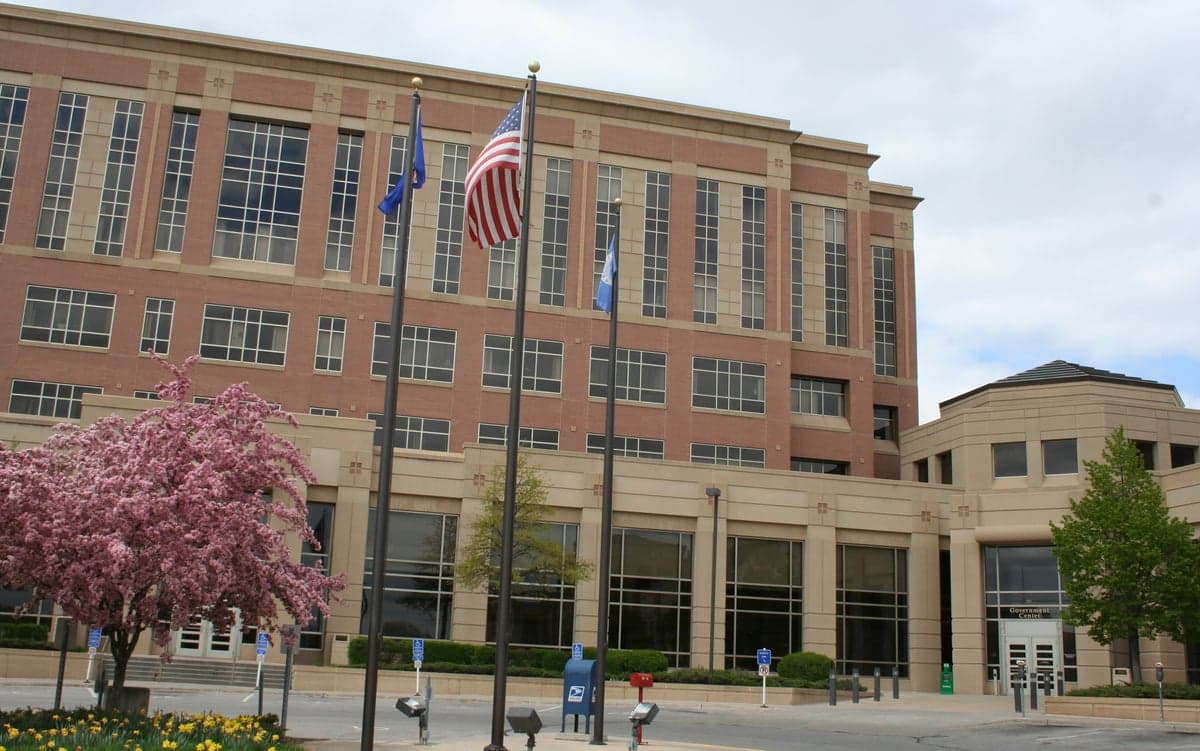
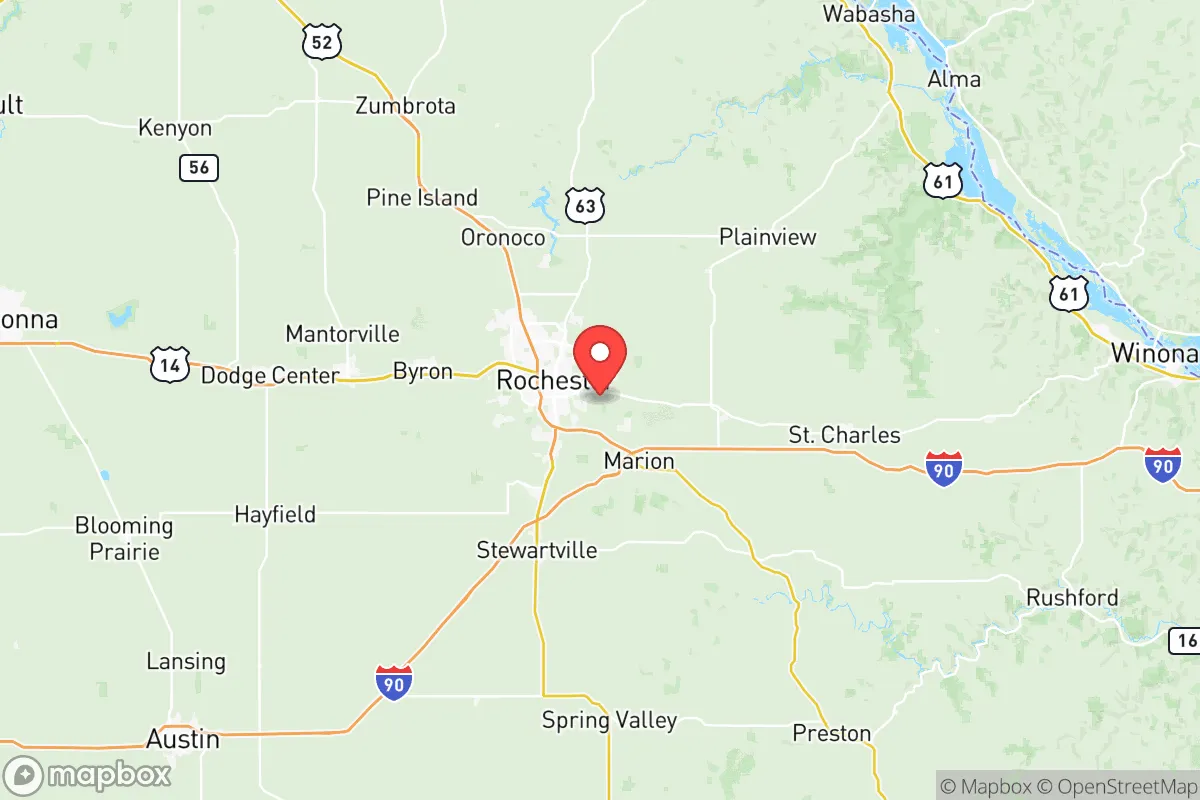
Photo: Wikipedia
Political ClimatePolitical Climate in Olmsted County
Showing state-level results — no local-only data available.
Local Political AnalysisPolitical Analysis of Olmsted County
Olmsted County, anchored by Rochester, is a Democratic stronghold in southeastern Minnesota, but its politics are far more moderate and pragmatic than the progressive bastions of the Twin Cities. The county has voted for the Democratic presidential candidate in every election since 2004, with margins typically hovering around 10-15 points. However, this Democratic lean is heavily driven by Rochester's medical and tech workforce, while the county's rural townships and smaller communities like Byron, Stewartville, and Eyota consistently vote Republican, creating a distinct urban-rural split that defines local elections.
How it compares
Compared to Minnesota as a whole, Olmsted County is slightly more Democratic than the state average, but it lacks the deep-blue intensity of Hennepin or Ramsey counties. In 2020, Joe Biden won Olmsted County by roughly 13 points, while carrying the state by about 7 points. The county's politics are shaped by the Mayo Clinic's massive presence — roughly one in three jobs in the county is tied to Mayo or its affiliates — which attracts a highly educated, relatively affluent workforce that tends to lean center-left on social issues but remains fiscally cautious. This creates a political culture that is reliably Democratic but not reflexively progressive. For example, Rochester voters have consistently supported moderate Democrats for local office and have rejected more progressive ballot initiatives, like a 2022 proposal to shift to ranked-choice voting. Meanwhile, the county's rural precincts in the townships around Chatfield and Dover vote Republican by margins of 20-30 points, making county commission races more competitive than the presidential results suggest.
What this means for residents
For liberal residents, Olmsted County offers a comfortable environment where Democratic candidates are competitive and local policies tend to be inclusive — the county has a Human Rights Commission and non-discrimination ordinances that cover sexual orientation and gender identity. Progressive voters can expect their values to be represented in county government, though they may find the pace of change slower than in Minneapolis or St. Paul. For conservative residents, the picture is more nuanced. While they are outnumbered countywide, they hold significant influence in the county's rural townships and in smaller cities like Pine Island and Kasson, where Republican candidates routinely win local offices. The county's political moderation means that conservative voices are not marginalized — school board races, county commission seats, and city council positions in the smaller towns remain genuinely competitive. Property taxes in Olmsted County are higher than the state average, a perennial issue for conservative voters, but the county's strong economy and low unemployment rate (consistently below 3%) mean that most residents, regardless of political affiliation, benefit from the area's stability.
Culturally, Olmsted County stands apart from both the Twin Cities metro and greater rural Minnesota. The Mayo Clinic's international draw gives Rochester a more diverse and globally minded population than most of southern Minnesota, with a significant Somali and Southeast Asian community that has shifted local politics leftward on immigration and refugee resettlement. At the same time, the county's agricultural roots remain strong, and the annual Olmsted County Fair in Rochester is a genuine crossroads where urban and rural residents mix. The practical upshot is that political disagreements in Olmsted County rarely turn toxic — neighbors who disagree on national politics still show up for the same community events, and local governance tends to focus on bread-and-butter issues like road maintenance, school funding, and economic development rather than culture war flashpoints. This is likely to persist as long as the county's economy remains strong and its political balance stays moderate.

State Political ClimatePolitical Climate in Minnesota
State Political AnalysisPolitical Environment in the State
Minnesota has undergone a dramatic political transformation over the past decade, shifting from a classic purple battleground to a state where Democrats now hold unified control of the governorship, state House, and state Senate. The state voted for Hillary Clinton by just 1.5 points in 2016, but by 2020, Joe Biden carried it by over 7 points, and in 2024, the Democratic margin held steady at roughly 5 points. This shift is driven almost entirely by the explosive growth and leftward movement of the Twin Cities metro, while Greater Minnesota has swung hard in the opposite direction, creating one of the starkest urban-rural political divides in the country.
Urban vs. rural divide
The political map of Minnesota is essentially two different countries. The seven-county Twin Cities metro area, home to over 60% of the state's population, votes overwhelmingly Democratic. Hennepin County (Minneapolis) and Ramsey County (St. Paul) are deep blue, but the real story is the suburban ring. Counties like Washington, Dakota, and Anoka — which were reliably Republican as recently as 2012 — have flipped decisively. In 2024, Dakota County voted for the Democratic candidate by over 10 points, a seismic shift from its Republican lean just a decade ago. Meanwhile, outstate Minnesota — places like St. Cloud, Rochester, Duluth, and the Iron Range — tells a different story. The Iron Range, once a Democratic stronghold of union miners, has flipped hard to the right over cultural and gun issues. St. Cloud, a growing regional hub, is now a Republican-leaning city surrounded by deep-red rural townships. Rochester, home to the Mayo Clinic, remains a moderate Democratic island in a sea of red southeastern Minnesota. The result is a state where statewide elections are decided almost entirely by turnout in the suburbs of Minneapolis and St. Paul.
Policy environment
Minnesota's policy environment is a study in contrasts. The state has a progressive income tax with a top marginal rate of 9.85%, one of the highest in the nation, and a statewide sales tax of 6.875% that local jurisdictions can add to. Property taxes are moderate but vary wildly by county. The regulatory posture is generally business-friendly in practice but increasingly progressive in labor and environmental law. Education is a Democratic priority — the state spends over $16,000 per pupil annually, among the highest in the country, and has a robust public school system with strong teacher unions. School choice is limited; there are charter schools but no voucher program. Healthcare is dominated by the Mayo Clinic and HealthPartners, and the state runs its own health insurance exchange, MNsure. Election laws are among the most accessible in the nation: same-day voter registration, no-excuse absentee voting, and automatic voter registration at DMVs. For a conservative relocator, the tax burden and regulatory climate are the biggest headwinds; for a liberal relocator, the social safety net and public services are major draws.
Recent policy direction
The 2023-2024 legislative session was a watershed moment for Minnesota's policy direction. Democrats passed a sweeping package that included codified abortion rights, a paid family and medical leave program, a ban on "conversion therapy," and a law requiring all utilities to be carbon-free by 2040. On guns, the state passed universal background checks and a "red flag" law allowing courts to temporarily seize firearms from individuals deemed a risk. For conservatives, these moves represent a significant loss of Second Amendment protections and parental autonomy. On the education front, the state passed a law requiring schools to provide free menstrual products and banned book banning in public libraries, while also expanding access to gender-affirming care for minors — a flashpoint for parental rights advocates. On property rights, Minnesota has not passed any major rent control or land-use reform, but Minneapolis did eliminate single-family zoning in 2018, a move that has been replicated in some suburbs. On privacy and surveillance, the state passed a data privacy law in 2024 giving residents more control over how companies use their personal data. Voting access expanded further with automatic voter registration and pre-registration for 16- and 17-year-olds. For a relocator, the bottom line is clear: Minnesota is moving decisively toward a European-style social democracy on the policy front, with all the trade-offs that entails.
Civil unrest & political movements
Minnesota has been a flashpoint for national political movements. The murder of George Floyd in Minneapolis in 2020 sparked the largest protests in the state's history, leading to widespread property damage, a controversial police reform debate, and a lasting shift in the city's political culture. The "defund the police" movement gained traction in Minneapolis city government, though it was later walked back after a spike in violent crime. On the right, the "Trump Train" convoys and the "Let Them Breathe" movement against COVID restrictions were major organizing forces in Greater Minnesota. The state has also seen significant immigration politics: Minnesota is a sanctuary state with a 2023 law prohibiting state and local law enforcement from cooperating with federal immigration authorities except in limited circumstances. This has made it a destination for Somali, Hmong, and Latino immigrant communities, particularly in the Twin Cities and in rural meatpacking towns like Willmar and Worthington. Election integrity has been a persistent controversy; despite no evidence of widespread fraud, Republican activists have pushed for stricter voter ID laws, which have been repeatedly blocked by the Democratic majority. The result is a state where political activism is high on both sides, and where a new resident will encounter visible political expression — yard signs, bumper stickers, and local protests — more than in most states.
Projection
Over the next 5-10 years, Minnesota's political trajectory is likely to continue its current path, but with some important caveats. The Twin Cities metro will continue to grow and become more diverse and Democratic, while Greater Minnesota will continue to shrink and become more Republican. The key swing areas will be the outer-ring suburbs like Lakeville, Prior Lake, and Woodbury, where moderate voters will decide whether the state remains solidly blue or drifts back toward purple. In-migration is a wild card: Minnesota is gaining residents from other Midwestern states and from the West Coast, but the net flow is modest compared to Sun Belt states. The state's high taxes and cold winters are a deterrent for some, but the strong economy, high quality of life, and progressive policies are a draw for others. The most likely scenario is that Minnesota remains a Democratic-leaning state for the foreseeable future, but with a narrower margin than the 2020-2024 peak, as the rural backlash intensifies and the suburbs moderate. A conservative relocator should expect to live in a state where their political views are in the minority at the state level, but where local control in Greater Minnesota and many suburbs still allows for a conservative lifestyle.
For a new resident, the practical takeaway is this: Minnesota is a state where your political experience will depend heavily on where you live. If you move to the Twin Cities metro, you will be in a deeply progressive environment with high taxes, strong public services, and a culture that values diversity and government action. If you move to Greater Minnesota, you will find a more conservative, rural lifestyle with lower property taxes and a greater sense of local autonomy. The state's political climate is polarized, but it is also stable — the Democratic majority is likely to persist, but it is not hegemonic, and the rural-urban divide means that both conservatives and liberals can find communities that match their values. The key is to choose your location carefully and understand that state-level policy will continue to lean left, regardless of where you live.
* Values derived from national, state, county, city and local statistics and may differ in a specific area. Last updated: 2026-08-08T14:59:11.000Z
Narrative content on this page is AI-generated and may contain mistakes. Verify any details that matter before acting on them.
ReloMaps may earn a commission from affiliate links at no extra cost to you.

