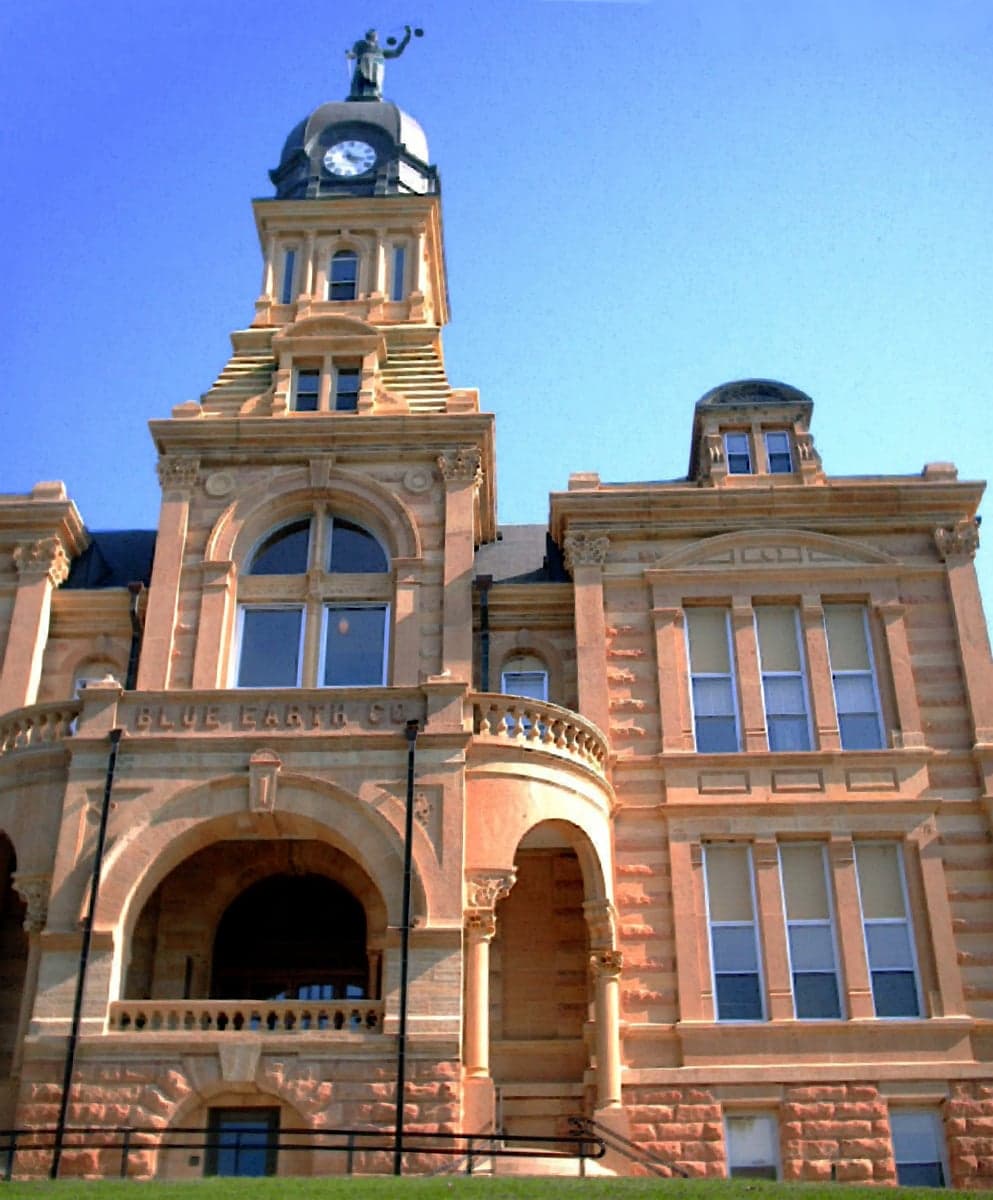
Photo: Wikipedia
Political ClimatePolitical Climate in Blue Earth County
Showing district-level results — no local-only data available.
Local Political AnalysisPolitical Analysis of Blue Earth County
Blue Earth County has been trending in a concerning direction over the past decade, shifting from a reliably conservative stronghold to a more competitive, left-leaning battleground. The county’s Cook Partisan Voting Index (PVI) of R+6 might sound solidly red, but that number masks a real erosion of traditional values, especially in and around Mankato. The rural townships and smaller communities like Mapleton, Lake Crystal, and Amboy still vote overwhelmingly Republican, but the city of Mankato itself—home to Minnesota State University and a growing population of younger, more progressive transplants—has been pulling the county leftward. In 2020, Mankato’s precincts went for Biden by double digits, while the surrounding farm country held the line for Trump. That split is getting wider every cycle.
How it compares
Compared to the rest of Minnesota, Blue Earth County is still a bit of a red island in a sea of blue, but the gap is closing fast. The state as a whole has a Cook PVI that leans Democratic (D+1), driven by the metro areas of Minneapolis and St. Paul. Blue Earth County’s R+6 rating puts it to the right of the state average, but that margin has shrunk by about 4 points since 2016. The real story is in the swing precincts—places like North Mankato and Eagle Lake—where you used to see comfortable Republican wins. Now, those areas are toss-ups, with local school board and county commission races often decided by a few hundred votes. The state legislature’s recent push for things like gun control measures and gender identity policies in schools has been a wake-up call for a lot of folks here who feel like their voices are being drowned out by the Twin Cities.
What this means for residents
For people who value limited government and personal freedoms, the shift is unsettling. You’re seeing more local ordinances that feel like government overreach—like the city of Mankato’s push for stricter rental regulations and its embrace of “sanctuary city” policies that limit cooperation with federal immigration enforcement. Property taxes have crept up as the county expands social services, and there’s a growing sense that the rural townships are subsidizing the urban core’s progressive experiments. If you’re a conservative looking to put down roots, the county’s rural precincts—especially around Good Thunder and Pemberton—still offer a strong sense of community and a local government that respects your rights. But you’ll want to keep an eye on the county board elections; they’re the front line in the fight to keep Blue Earth County from going the way of Hennepin or Ramsey.
Culturally, the divide is real. The Mankato area has become a hub for arts festivals, bike lanes, and craft breweries that cater to a younger, more progressive crowd, while the outlying towns still hold onto their county fairs, church suppers, and hunting traditions. The policy differences are stark: rural townships have pushed back against mask mandates and vaccine passports, while Mankato’s city council has been more willing to impose them. If you’re looking for a place where your Second Amendment rights are respected and your tax dollars aren’t funding programs you disagree with, the rural parts of Blue Earth County are still a good bet—for now. But the long-term trend is worrying, and it’s worth getting involved locally if you want to keep it that way.

State Political ClimatePolitical Climate in Minnesota
State Political AnalysisPolitical Environment in the State
Minnesota has shifted from a classic purple battleground to a solidly blue state over the past 15 years, driven largely by the explosive growth of the Twin Cities metro area and a dramatic collapse of rural Democratic support. The state hasn’t voted for a Republican presidential candidate since 1972, and since 2020, Democrats have held a trifecta in state government, passing a sweeping progressive agenda that has many conservatives questioning whether this is still the Minnesota they grew up in. The 2024 election saw Kamala Harris win the state by about 4 points, a narrower margin than 2020 but still a clear rejection of the GOP’s statewide brand, even as rural and exurban counties like Wright and Sherburne continue to trend deeper red.
Urban vs. rural divide
The political map of Minnesota is a tale of two worlds. The Twin Cities metro—Hennepin, Ramsey, and Dakota counties—generates roughly 55% of the state’s vote and is overwhelmingly Democratic. Minneapolis and St. Paul are among the most progressive cities in the Midwest, with policies like rent control, defunded police budgets (later partially restored), and sanctuary city ordinances. Meanwhile, Greater Minnesota is a sea of red. Counties like Otter Tail, Stearns, and Olmsted (home to Rochester) have shifted rightward, with Olmsted County flipping from blue to red in 2024 for the first time in decades. The Iron Range, once a Democratic stronghold, has seen a mass exodus of union voters to the GOP over mining, gun rights, and cultural issues. The divide isn’t just geographic—it’s cultural. A family in Duluth or Mankato lives under a completely different political reality than someone in Edina or Maple Grove.
Policy environment
Since the DFL (Minnesota’s Democratic-Farmer-Labor Party) took full control in 2023, the policy environment has shifted hard left. The state now has a progressive income tax with a top rate of 9.85%, one of the highest in the nation, and a new capital gains tax on investment income over $1 million. Property taxes are locally set but have risen sharply in metro counties to fund expanded government programs. The 2023 session also passed a paid family and medical leave program funded by a new payroll tax, a carbon-free electricity mandate by 2040, and a law requiring all new cars sold in the state to be zero-emission by 2035. On education, Minnesota has eliminated the “opt-out” provision for comprehensive sex education and passed a law requiring schools to adopt policies that affirm transgender students’ chosen names and pronouns, even without parental consent. Election laws have been loosened: automatic voter registration, same-day registration, and no-excuse absentee voting are all in place, with no voter ID requirement. For a conservative, the policy environment feels like a checklist of everything they oppose.
Trajectory & freedom
Minnesota is clearly becoming less free by any measure of personal liberty that conservatives care about. The 2023 legislative session was a watershed moment. The state passed a “red flag” extreme risk protection order law, allowing courts to temporarily confiscate firearms from individuals deemed a threat, without a criminal conviction or mental health commitment. A new “universal background check” law expanded checks to private sales, and a permit-to-purchase requirement was tightened. On parental rights, the state passed a law banning conversion therapy for minors, but also enacted a “trans refuge” law that shields minors traveling to Minnesota for gender-affirming care from out-of-state legal action, effectively overriding parental rights from other states. Medical autonomy took a hit with the forced unionization of home childcare providers and a law that allows the state to seize property for “public safety” without compensation in certain environmental cases. Property rights are under pressure from a new “climate justice” law that allows environmental activists to sue developers for carbon emissions. The only bright spot for freedom advocates was the defeat of a proposed “clean energy” mandate that would have banned natural gas hookups in new homes—that one died in committee, but it’s coming back.
Civil unrest & political movements
Minnesota has been a flashpoint for civil unrest since the 2020 George Floyd protests, which caused over $500 million in damage in Minneapolis and St. Paul. The aftermath saw a surge in left-wing activism, with groups like the Minnesota Freedom Fund and the Twin Cities Coalition for Justice 4 Jamar becoming permanent fixtures. On the right, the “Burnsville” and “Lakeville” suburbs have become organizing hubs for conservative parents’ groups fighting school board policies on critical race theory and transgender issues. Immigration politics are hot: Minnesota is a sanctuary state, with a 2023 law prohibiting state and local law enforcement from cooperating with federal immigration authorities. This has led to a visible increase in immigrant populations in Willmar and Worthington, where meatpacking plants have drawn large Somali and Karen communities. Election integrity remains a sore point. The 2020 election saw a record number of absentee ballots, and while no widespread fraud was proven, the state’s automatic voter registration system has been criticized for registering non-citizens—a 2024 audit found over 1,000 non-citizens on the rolls, though the state claimed it was a data error. Secession talk is mostly a fringe joke, but the “Greater Minnesota” vs. “Metro” resentment is real and growing.
Projection
Over the next 5-10 years, Minnesota is likely to become even more blue, but with a twist. The Twin Cities metro will continue to grow, driven by corporate relocations (Amazon, Google, and UnitedHealth Group are expanding) and a steady influx of immigrants. This will cement the Democratic majority. However, the exurbs—places like Elk River, St. Michael, and North Branch—are filling with families fleeing metro taxes and crime, and they vote heavily Republican. The state’s rural areas will continue to depopulate, but the remaining voters will be even more conservative. The wildcard is the Iron Range: if the mining industry collapses under green energy mandates, those counties could flip back to blue out of desperation. Expect more progressive legislation: a state-level public option for healthcare, a wealth tax, and a ban on new gas stations are all on the table. For a conservative moving in now, the next decade will feel like a slow-motion takeover by a single-party state, with fewer checks on government power and a culture that increasingly marginalizes traditional values.
For a conservative considering relocation, Minnesota offers a high quality of life in its rural and exurban pockets, but the political trajectory is unmistakably hostile to your values. You’ll pay high taxes, watch your gun rights erode, and see your kids’ schools adopt policies you disagree with. The best bet is to target counties like Wright or Sherburne, where local governments are still conservative, but be prepared for a constant fight against state-level overreach. If you value low taxes, strong parental rights, and a culture that respects individual liberty, Minnesota is not the refuge it once was.
* Values derived from national, state, county, city and local statistics and may differ in a specific area. Last updated: 2026-06-06T23:11:41.000Z
Narrative content on this page is AI-generated and may contain mistakes. Verify any details that matter before acting on them.
ReloMaps may earn a commission from affiliate links at no extra cost to you.

