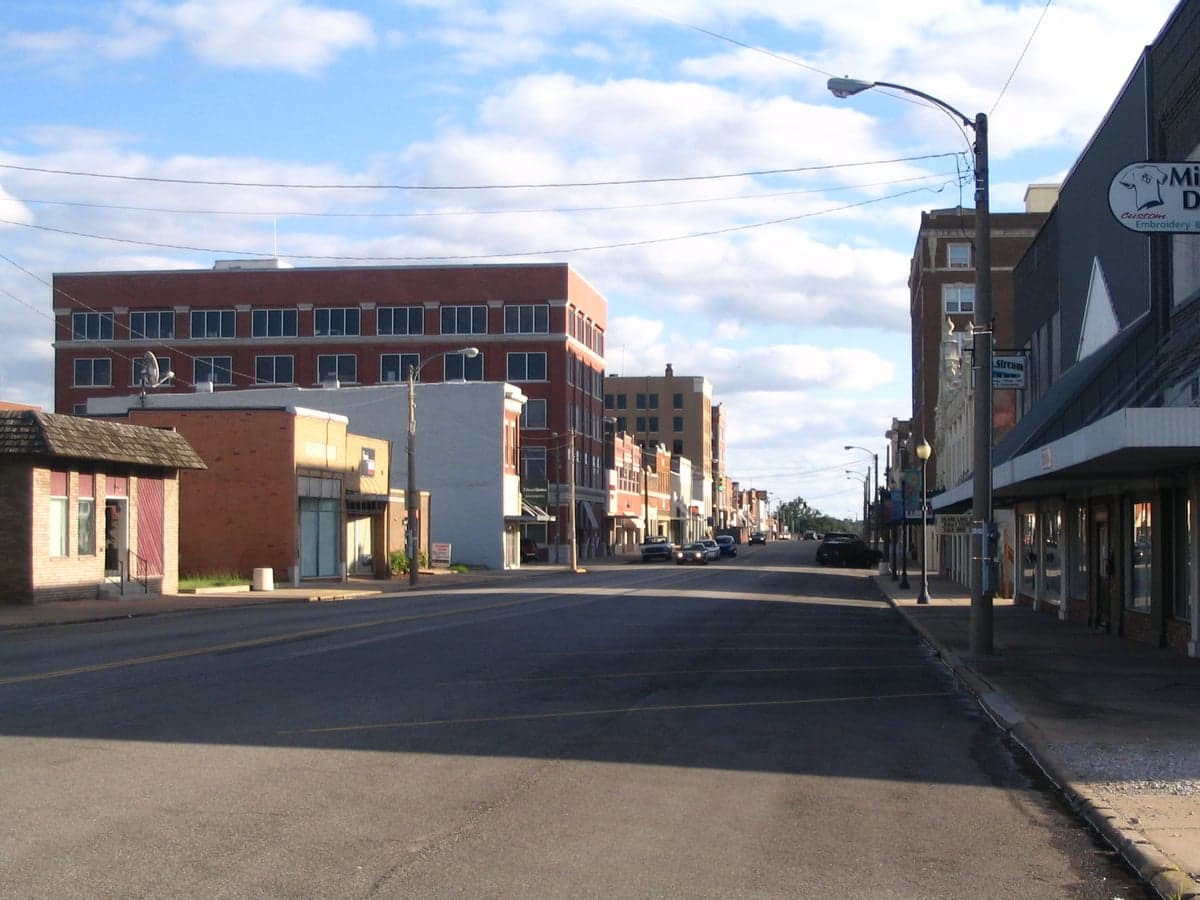
Photo: Wikipedia
Strategic Assessment of Miami, OK
Workable tactical position. Some exposure to population density or targets, but generally defensible in a crisis.
What does the Strategic Assessment tell us?
Our Strategic Assessment grades tactical survivability of an area. Major population centers, military targets, fallout zones, natural disasters, and border exposure all drive risk — lower exposure means a more defensible position in a crisis.
This is heavily inspired by Joel Skousen's Strategic Relocation book. Highly recommended you checkout the book ($)What does this tell us?
Our Strategic Assessment grades tactical survivability of an area. Major population centers, military targets, fallout zones, natural disasters, and border exposure all drive risk — lower exposure means a more defensible position in a crisis.
This is heavily inspired by Joel Skousen's Strategic Relocation book. Highly recommended you checkout the book ($)Strategic Pillars

Key Distances
Regional Safe Places
Below is our recommended "safe zones" in Oklahoma and the surrounding area based on our strategic heuristics. For most people, it's unrealistic to live in a “safe zone” full-time due to work, family or other personal reasons. They tend to be more rural. However, many of these areas are perfect for second homes and retreat properties that double as a vacation home or even a short-term rental.
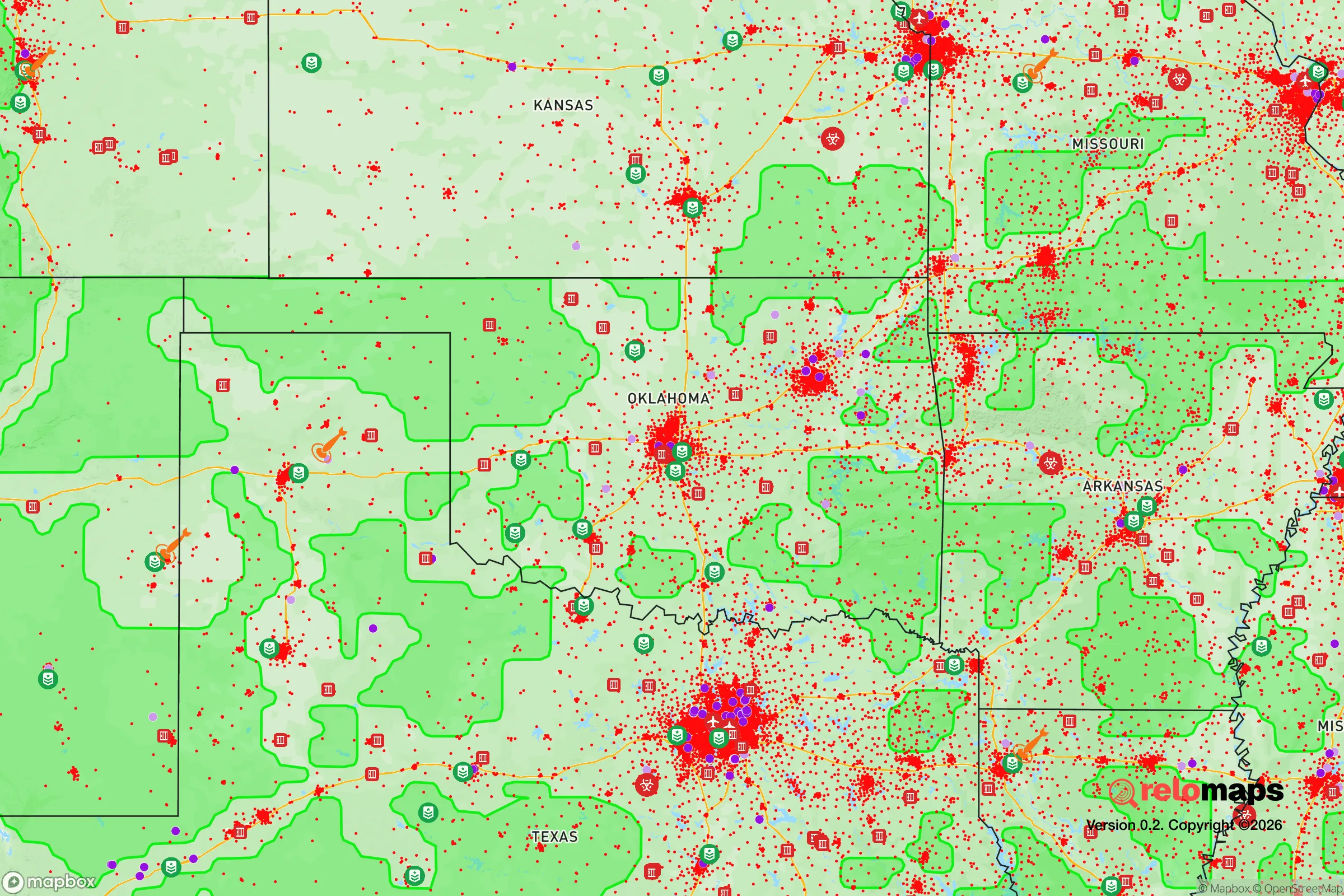
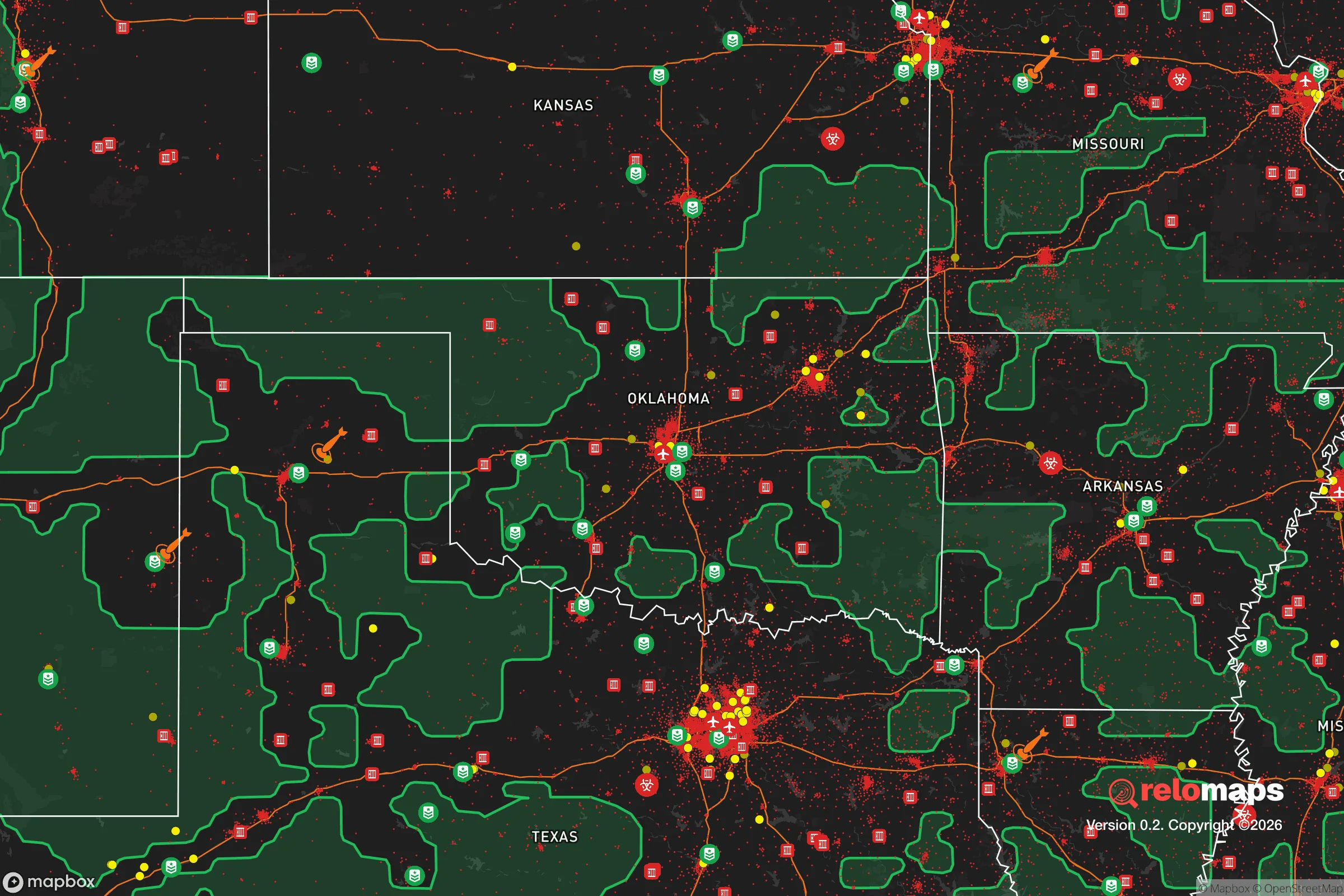


Important Note: For informational purposes only. This does not mean nothing bad ever happens in the green zones. Please use common sense. This is based on public data and modeled with AI. We tried to take a conservative approach but mistakes happen. We update this regularly as new information becomes available.
Solar Generator Recommendations
Backup power matters more here than in safer locations. We've picked three solar generators across budgets and capacity tiers — start with the budget unit if you only need a few essentials, or step up if you want to run a fridge and HVAC for days at a time.

Jackery Portable Power Station Explorer 300
Budget OptionPower on the Go: Weighing only 11 lbs, it's convenient to set up and store with book-sized foldable solar panels

BLUETTI Portable Power Station AC180
Designed for both indoor and outdoor scenarios, AC180 is highly capable as it has a robost capacity and continuous output power.

EF ECOFLOW DELTA Pro Ultra Power Station
Upgraded PickEcoFlow DELTA Pro Ultra is a whole-home energy system designed to grow with your family. Integrated with the Smart Home Panel 2, it scales to meet your evolving energy needs — keeping your home powered, intelligent, and secure through every stage of life.
We earn a commission, at no additional cost to you.
Strategic Assessment Analysis
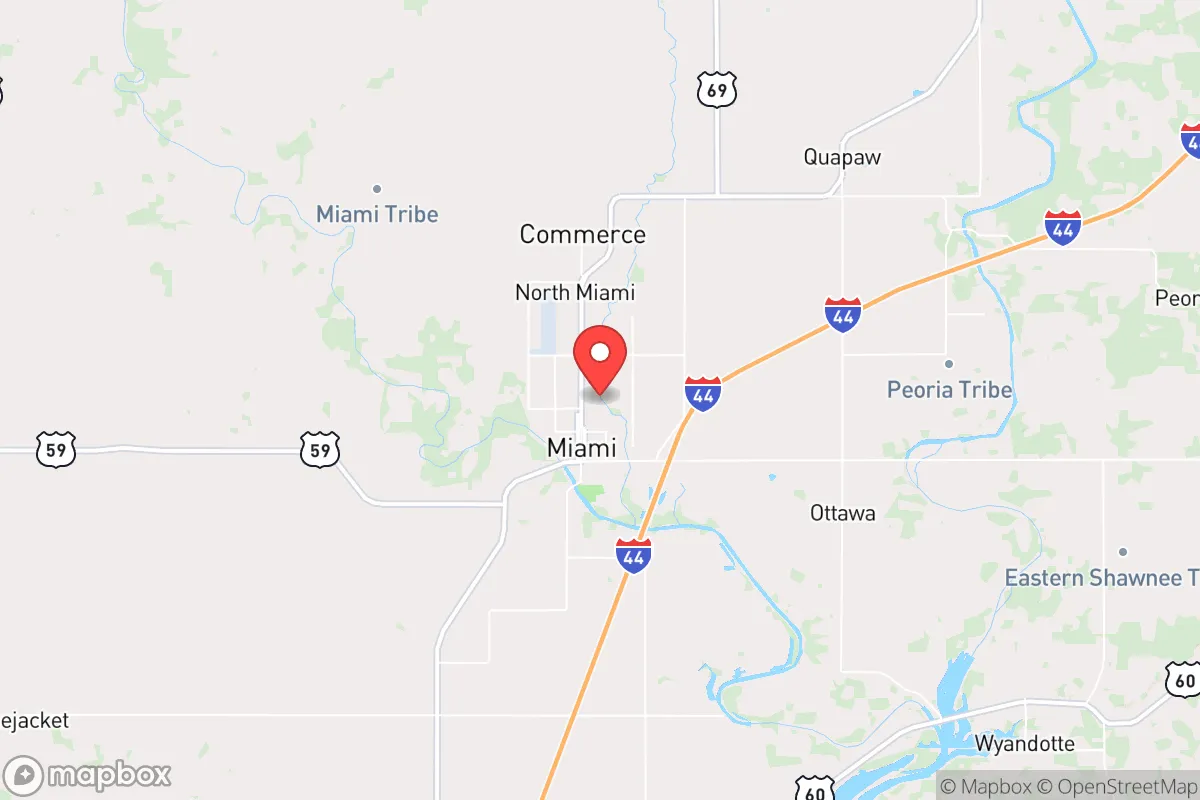
Miami, Oklahoma, sits in a strategic pocket of the Ozark Plateau that offers genuine resilience advantages for those thinking long-term about security and self-sufficiency. Its location—roughly 90 miles northeast of Tulsa and 90 miles southwest of Joplin, Missouri—places it far enough from major metropolitan blast zones to avoid immediate fallout dangers, yet close enough to access regional supply chains and medical infrastructure when conditions are stable. The area’s low population density, rural character, and position along the Neosho River and Interstate 44 corridor give it a rare combination of isolation and connectivity that preppers and survivalists should take seriously.
Geographic position and natural advantages for long-term security
Miami’s geography is its strongest card. The town sits in Ottawa County, part of the Ozark Plateau, which means rolling hills, limestone bluffs, and abundant freshwater sources. The Neosho River and Spring River converge nearby, providing reliable surface water that doesn’t depend on municipal treatment plants. The region’s karst topography means numerous springs and seeps—natural water sources that are harder to contaminate or cut off than city mains. The surrounding countryside is a patchwork of small farms, timberland, and pasture, which translates to a local food production base that many suburban areas lack entirely. The Ozarks’ moderate climate reduces the risk of extreme weather events compared to Tornado Alley’s core, though severe storms do occur. The area’s elevation—around 800 feet—keeps it above floodplains for the most part, and the rocky soil means less mud and better drainage for off-grid infrastructure like root cellars or earth-sheltered structures. For a relocator, this is terrain that supports both retreat and resupply without the vulnerabilities of flat, open plains or dense forest that can become fire hazards.
Risks, exposures, and proximity to fallout-relevant landmarks
No location is immune, and Miami has specific exposures that a serious prepper must weigh. The most obvious risk is the town’s proximity to the Quapaw Nation’s Superfund site—the Tar Creek Superfund area, one of the largest environmental cleanup zones in the country, left over from lead and zinc mining. While remediation is ongoing, the legacy of heavy metal contamination in soil and water means that any long-term subsistence gardening or well water use requires testing and filtration. That’s a manageable but non-negotiable cost. On the security side, Miami sits about 70 miles from the Wolff Creek Generating Station (a nuclear power plant near Burlington, Kansas) and roughly 100 miles from the Fort Leonard Wood military installation in Missouri. Neither is a primary target in a major conflict, but both could become secondary fallout sources or staging areas during civil unrest. The Interstate 44 corridor, while useful for resupply, also funnels traffic from Tulsa and Joplin—meaning that during a crisis, Miami could see evacuees or looters moving through. The town’s population of roughly 13,000 is small enough to avoid the chaos of a city, but the surrounding county’s 31,000 residents mean that local resources (fuel, groceries, hardware) could deplete quickly if a regional event occurs. The nearest major medical center is in Joplin, which is a 45-minute drive under normal conditions—a vulnerability if roads are blocked or the hospital is overwhelmed.
Practical resilience for a relocator: food, water, energy, and defensibility
For someone serious about self-reliance, Miami offers a workable baseline. Water is the strongest asset: the Neosho River and multiple springs provide year-round flow, and the water table is shallow enough for hand-dug wells in many areas. The city’s municipal water comes from the Neosho, but a prepper should plan on a private well with a hand pump or a rainwater catchment system—both are feasible here. Food production is viable but requires effort: the growing season runs roughly April through October, with hot summers and mild winters that allow for cold-hardy crops. Local soil is rocky and alkaline, so raised beds or imported topsoil are recommended. The area has a strong hunting culture—deer, turkey, and small game are abundant—and fishing in the rivers is reliable. For energy, the Ozarks get decent sun (about 200 sunny days per year), and the tree cover means ample firewood for heating and cooking. Solar panels paired with battery storage are a practical investment; the region’s grid is served by the Grand River Dam Authority, which is stable but not hardened against cyber or physical attack. Defensibility is moderate: the terrain offers natural chokepoints (river crossings, narrow valleys), but the town itself is spread out with many access roads. A rural property with a long driveway, a creek boundary, and a view of approach routes would be ideal. The local law enforcement presence is small—Ottawa County has about 30 deputies—so in a prolonged breakdown, residents would largely rely on themselves and neighbors. The area’s conservative culture means a higher likelihood of armed, self-reliant neighbors, which is a net positive for community defense but also means that conflict resolution skills and low-profile behavior are essential to avoid drawing unwanted attention.
The overall strategic picture for Miami, Oklahoma, is one of cautious viability. It avoids the worst fallout zones of major cities and offers genuine natural resources—water, timber, game, and arable land—that many relocation targets lack. The trade-offs are real: the Superfund legacy requires vigilance, the I-44 corridor is a double-edged sword, and the nearest trauma center is a long drive. For a single individual or a family willing to invest in water filtration, soil remediation, and off-grid energy, this area provides a defensible, low-profile base with room to grow food and store supplies. It is not a fortress, but it is a place where a prepared person can build a sustainable life without the constant background threat of urban collapse. The key is to arrive with a plan, not just a hope—and Miami gives you the raw materials to execute that plan if you’re willing to work the land and keep your head down.

* Values derived from national, state, county, city and local statistics and may differ in a specific area. Last updated: 2026-04-25T13:52:20.000Z
Narrative content on this page is AI-generated and may contain mistakes. Verify any details that matter before acting on them.
ReloMaps may earn a commission from affiliate links at no extra cost to you.

