
Photo: Wikipedia
Personal Sovereignty in Miami, OK
Strong independent fundamentals that actively favor personal liberty and low regulation.
What does Personal Sovereignty tell us?
Personal Sovereignty measures your capacity for self-reliance and independence with minimal government friction. Higher scores mean fewer barriers between you and the way you want to live... but it assumes you have the space you need and good neighbors.
What does this tell us?
Personal Sovereignty measures your capacity for self-reliance and independence with minimal government friction. Higher scores mean fewer barriers between you and the way you want to live... but it assumes you have the space you need and good neighbors.
State Policy
Energy independence: Net exporter (180% of energy produced in-state)
Personal Liberty
Homesteading

Personal Liberty Analysis
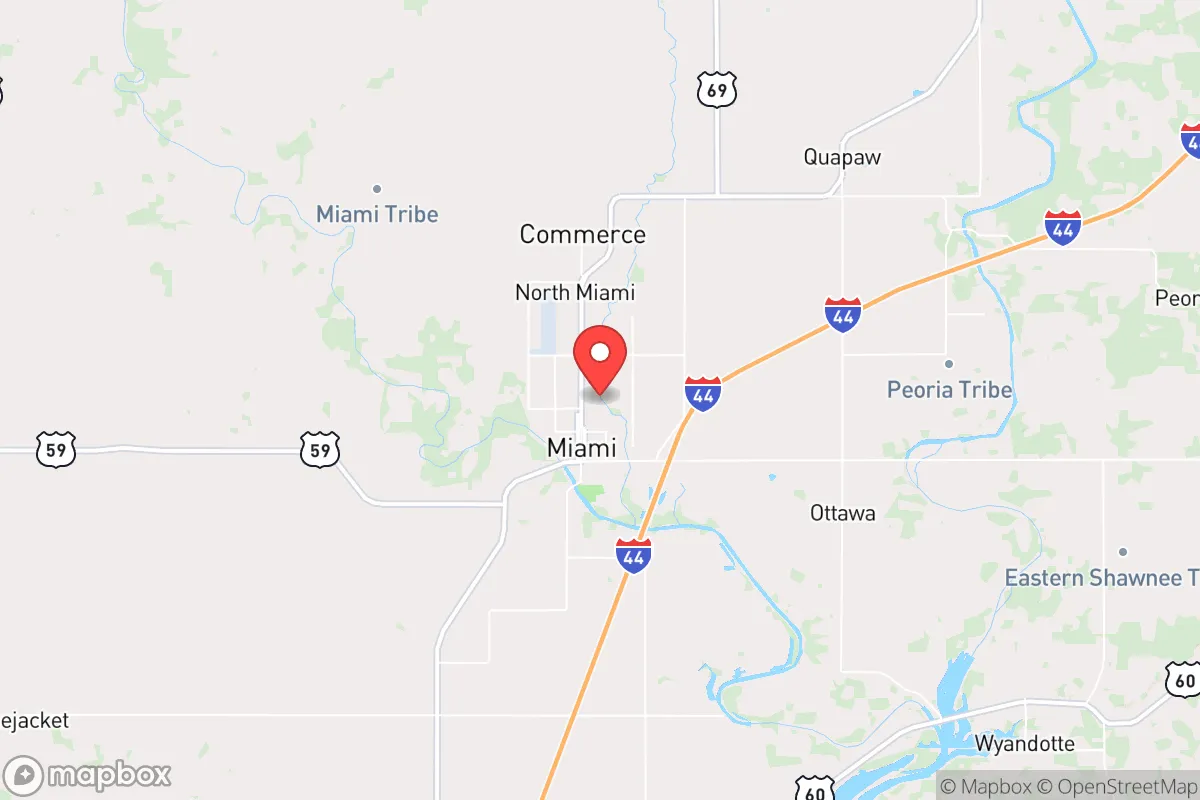
Miami, Oklahoma, offers a personal sovereignty environment that stands in sharp contrast to the coastal and urban jurisdictions where government overreach has become routine. Nestled in the far northeast corner of the state, this small city of roughly 13,000 residents operates under the legal and cultural umbrella of a state that has consistently pushed back against federal encroachment on individual rights. For those evaluating relocation from a survivalist or prepper perspective, Miami provides a baseline of autonomy that is increasingly rare in modern America, though it is not without its own local nuances that require careful consideration.
Tax burden and regulatory posture in northeast Oklahoma
Oklahoma’s overall tax climate is among the most favorable in the nation for those seeking to minimize government extraction from their earnings. The state levies a flat income tax of 4.75% on all taxable income, with no progressive brackets that punish higher earners. Property taxes in Ottawa County, where Miami sits, are notably low — typically ranging from 0.6% to 0.9% of assessed value, which is roughly half the national average. This means a $200,000 home carries an annual tax bill of around $1,200 to $1,800, leaving far more capital in private hands for self-reliance investments like land, equipment, and supplies. Sales tax in Miami is 9.75% (4.5% state, 5.25% local), which is higher than rural Oklahoma averages but still manageable. The regulatory posture at the state level is decidedly hands-off: Oklahoma is a right-to-work state with minimal occupational licensing burdens compared to blue states, and there are no state-level building codes enforced in unincorporated areas of Ottawa County. However, Miami itself does enforce city zoning and building permits, so those seeking maximum regulatory freedom should look to the surrounding rural areas rather than within city limits.
Self-defense and gun law specifics for Miami residents
Oklahoma is a constitutional carry state, meaning any law-abiding adult 21 or older can carry a firearm openly or concealed without a permit. This is a foundational pillar of personal sovereignty for the prepper mindset. Miami residents face no local restrictions beyond state law — there are no city-level magazine bans, no "assault weapon" registries, and no red flag laws as of 2026. The state preempts all local firearm ordinances, so Miami city council cannot impose its own gun control measures even if it wanted to. Stand-your-ground law is fully in effect, with no duty to retreat in any place where the individual is lawfully present. Castle doctrine protections extend to vehicles and workplaces, not just residences. For those building a defensive capability, Oklahoma also allows suppressors and short-barreled rifles with federal NFA compliance, and there are no state-level restrictions on magazine capacity. The nearest gun-friendly ranges and training facilities are within a 30-minute drive, including the Miami Gun Club and private land options in the surrounding countryside. One practical consideration: Ottawa County has a relatively low violent crime rate (roughly 2.5 per 1,000 residents), but property crime is more common, making home defense a legitimate concern rather than a paranoid fantasy.
Self-reliance and homesteading viability in the Miami area
For those serious about food security, water independence, and off-grid living, the land around Miami offers genuine opportunity. Within a 10- to 20-mile radius of downtown, residential lots of 1 to 5 acres are common and affordable — prices range from $5,000 to $15,000 per acre depending on proximity to the Grand Lake area. Zoning in unincorporated Ottawa County is minimal: no county-wide building codes, no mandatory inspections for owner-built structures, and no prohibition on rainwater collection systems. The Oklahoma Water Resources Board allows rainwater harvesting without permits for residential use, and groundwater rights follow the "reasonable use" doctrine, meaning landowners can drill a well for domestic purposes without a permit as long as it doesn't harm neighboring wells. Solar panels face no state-level restrictions, and net metering is available through the local electric cooperative, though rates are less favorable than in some states. For those wanting to go fully off-grid, the county does not require connection to municipal water or sewer on rural parcels. Growing seasons run about 200 days, with fertile soil in the Neosho River valley suitable for gardens and small orchards. The primary limitation is the occasional drought — average annual rainfall is around 42 inches, but dry spells do occur, making well depth and storage capacity important planning factors. Livestock is permitted on parcels of 5 acres or more in most rural zoning districts, with chickens and small animals allowed on smaller lots.
Personal liberties: parental rights, medical autonomy, speech, and property
Oklahoma has been at the forefront of protecting parental rights in education. State law requires school districts to notify parents of any medical or mental health services offered to students and prohibits schools from withholding information about a child's well-being. Miami Public Schools, the primary district, operates under these statutes, and the local school board has been responsive to conservative concerns. Medical autonomy is a mixed picture: Oklahoma has strict abortion laws with near-total prohibition, which aligns with many conservative values, but the state also has a vaccine mandate for school attendance that includes exemptions only for medical reasons — philosophical and religious exemptions were removed in 2022. This is a significant point of friction for those who view medical choice as a core sovereignty issue. Free speech protections are robust under the Oklahoma Constitution, which explicitly protects "the right to speak freely, write, and print on any subject." There are no state-level hate speech laws that criminalize protected speech, and Miami has no local ordinances restricting political expression. Property rights are strongly protected: Oklahoma is a "private property rights" state under the Oklahoma Property Rights Protection Act, which requires government entities to prove a compelling interest before taking land via eminent domain. The state also has a right-to-farm law that shields agricultural operations from nuisance lawsuits, which matters if you plan to keep livestock or run a small farm near residential areas.
In the broader landscape of American sovereignty, Miami, Oklahoma, ranks as a solid mid-tier option for those prioritizing personal autonomy. It lacks the extreme regulatory freedom of places like rural Alaska or the Texas Panhandle, but it also avoids the outright hostility to individual rights found in states like California, New York, or Illinois. The combination of constitutional carry, low property taxes, minimal building codes in rural areas, and strong parental rights creates a foundation that allows a determined individual to build a self-reliant life without constant government interference. The main trade-offs are the higher local sales tax, the school vaccine mandate, and the need to live outside city limits for maximum regulatory freedom. For a single person or family willing to navigate those specific constraints, Miami offers a sovereignty baseline that is both legally protected and practically achievable — a rare combination in an era of expanding government control.

* Values derived from national, state, county, city and local statistics and may differ in a specific area. Last updated: 2026-04-25T13:52:20.000Z
Narrative content on this page is AI-generated and may contain mistakes. Verify any details that matter before acting on them.
ReloMaps may earn a commission from affiliate links at no extra cost to you.

