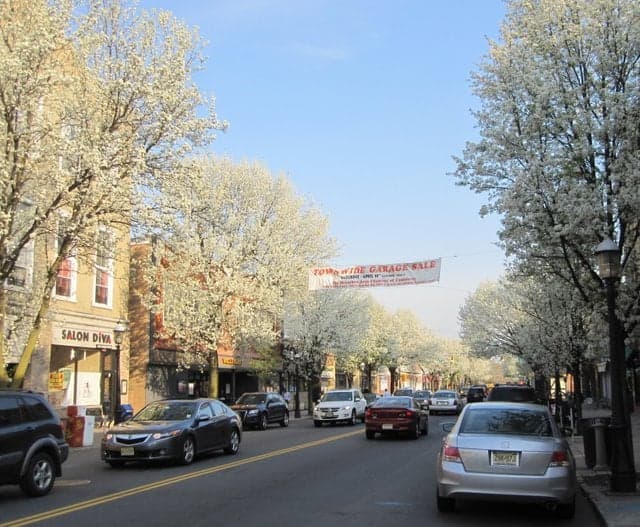
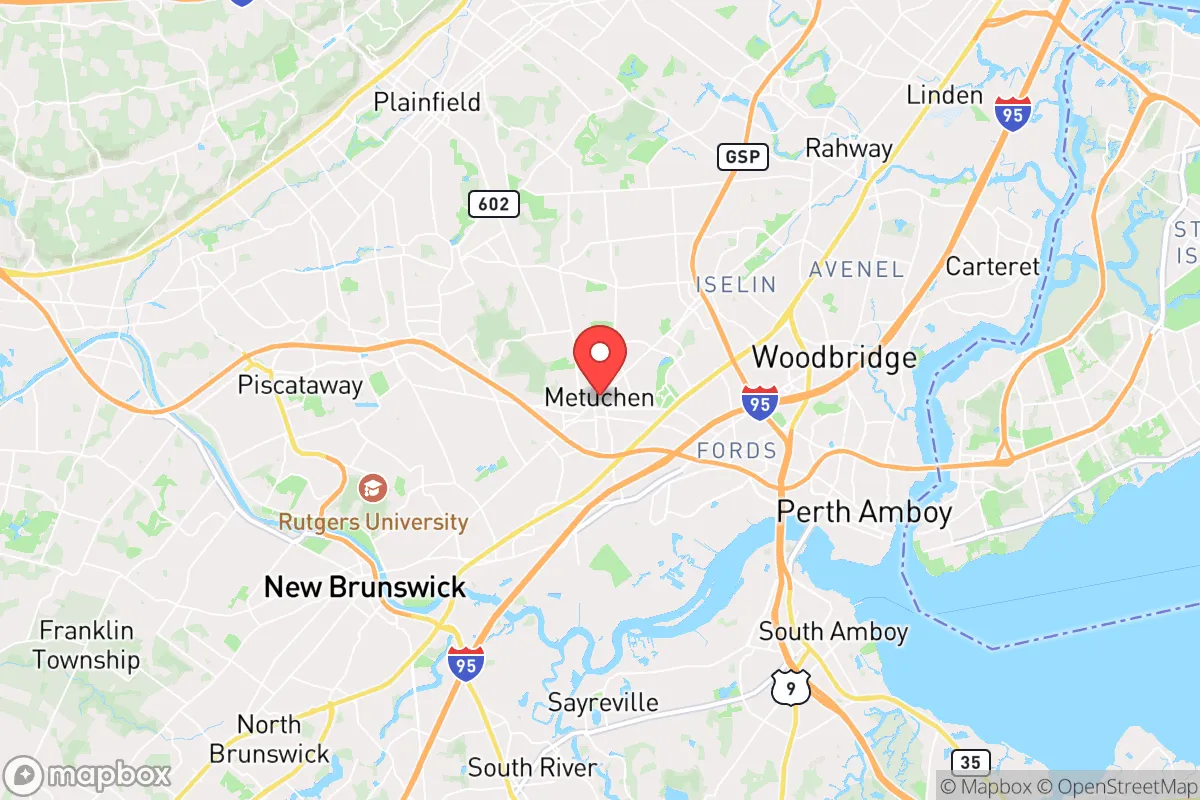
Photo: Wikipedia
Demographics of Metuchen, NJ
Affluence Level in Metuchen, NJ
An upper-middle-class area. Household wealth, education levels, and homeownership run ahead of national benchmarks.
People of Metuchen, NJ
The people of Metuchen, New Jersey, today form a dense, highly educated community of 14,982 residents, with a distinctive identity as a walkable, family-oriented borough that balances historic charm with modern diversity. Over 66% of adults hold a college degree, and the population is notably split between a 61.8% white majority and significant minority communities: 8.5% Indian (subcontinent), 8.4% East/Southeast Asian, 7.7% Hispanic, and 5.0% Black, with only 5.0% foreign-born overall. This is not a transient suburb but a rooted place where multi-generational families and new arrivals coexist in a compact, 1.8-square-mile footprint. The borough’s human history is one of successive waves — from colonial farmers to 19th-century industrial workers to late-20th-century professionals — each leaving a visible mark on its neighborhoods.
How the city was settled and grew
Metuchen’s earliest European settlers were Dutch and English farmers who arrived in the late 1600s, drawn by fertile land along the Raritan River watershed. The borough’s real growth began after the Camden and Amboy Railroad arrived in the 1830s, transforming it into a commuter stop for New York City and Philadelphia. By the late 19th century, Metuchen became known as the "Brainy Borough" for its concentration of writers, educators, and inventors — a reputation cemented by the founding of the Metuchen Edison History Museum area near the current borough hall. The first major wave of immigrant labor came from Irish and German workers who built the railroad and later the local brickworks and potteries, settling in the Hillside Avenue and Lake Avenue corridors, where modest worker cottages still stand. A second wave of Italian and Polish immigrants arrived between 1890 and 1920, taking jobs in the borough’s thriving clay and tile industries; they concentrated in the Central Avenue and Main Street neighborhoods, establishing St. Francis of Assisi Church and the Polish American Home Association as community anchors. By 1930, Metuchen’s population had reached roughly 5,000, and the borough was a solidly white, Catholic and Protestant, middle-class suburb with a small African American community centered near the Amboy Avenue corridor.
Modern era (post-1965)
The 1965 Immigration and Nationality Act reshaped Metuchen’s population, though the change was gradual. The borough’s proximity to Rutgers University and major pharmaceutical employers like Merck (in nearby Rahway) and Johnson & Johnson (in New Brunswick) began attracting highly educated professionals. The first significant non-white influx came from East/Southeast Asian families — particularly Chinese and Korean — who moved into the Middlesex Avenue and Woodland Avenue neighborhoods in the 1980s and 1990s, drawn by the borough’s top-rated public schools. Indian (subcontinent) families began arriving in larger numbers after 2000, clustering in the South Park Drive and Morningside Drive areas, where newer single-family homes offered space for multi-generational households. Hispanic residents, primarily of Puerto Rican and Mexican heritage, grew steadily from the 1990s onward, settling along the Route 27 corridor and in the Edison border area near the Metuchen train station. The Black population, which had been small and historically concentrated near Amboy Avenue, became more dispersed as middle-class African American families moved into the borough’s western neighborhoods. By 2020, Metuchen had shifted from a nearly all-white suburb (95% white in 1970) to a racially diverse community where no single group holds a supermajority. The white share dropped to 61.8%, while Indian and East/Southeast Asian communities together now represent nearly 17% of residents — a striking change in a borough of just 15,000 people.
The future
Metuchen’s population is likely to continue diversifying, though at a slower pace than in the 2000s and 2010s. The borough is essentially built out — with no large tracts of undeveloped land — so future growth will come from redevelopment and in-fill housing, particularly along the Main Street and Middlesex Avenue corridors where mixed-use projects are replacing older commercial buildings. The Indian and East/Southeast Asian populations are expected to grow modestly as families already in the borough attract relatives and as professionals continue to commute to nearby tech and pharmaceutical hubs. The white population, while still the largest group, is aging in place; younger white families are increasingly priced out by rising home values (median home price above $600,000 as of 2025), which may accelerate turnover to higher-income Asian and Indian buyers. Hispanic and Black shares are likely to remain stable or grow slightly, as the borough’s affordability gap relative to neighboring Edison and Woodbridge narrows. The cultural identity of Metuchen is evolving from a quiet, historically white "Brainy Borough" into a more cosmopolitan, multi-ethnic suburb where the public schools reflect the new diversity — with significant numbers of Indian, Chinese, Korean, and Hispanic students alongside white peers.
For someone moving in now, Metuchen offers a stable, highly educated community with strong schools and a walkable downtown, but at a price point that increasingly selects for professionals and dual-income families. The borough is becoming more diverse in every dimension — racial, ethnic, and economic — while retaining its small-town feel and historic architecture. New arrivals will find a place where the old "Brainy Borough" identity is being rewritten by the children of Indian engineers, Chinese researchers, and Korean small-business owners, all sharing the same train platform and school hallways.

* Values derived from national, state, county, city and local statistics and may differ in a specific area. Last updated: 2026-11-13T05:34:26.000Z
Narrative content on this page is AI-generated and may contain mistakes. Verify any details that matter before acting on them.
ReloMaps may earn a commission from affiliate links at no extra cost to you.

