

Photo: Wikipedia
Political ClimatePolitical Climate in Meridian, MS
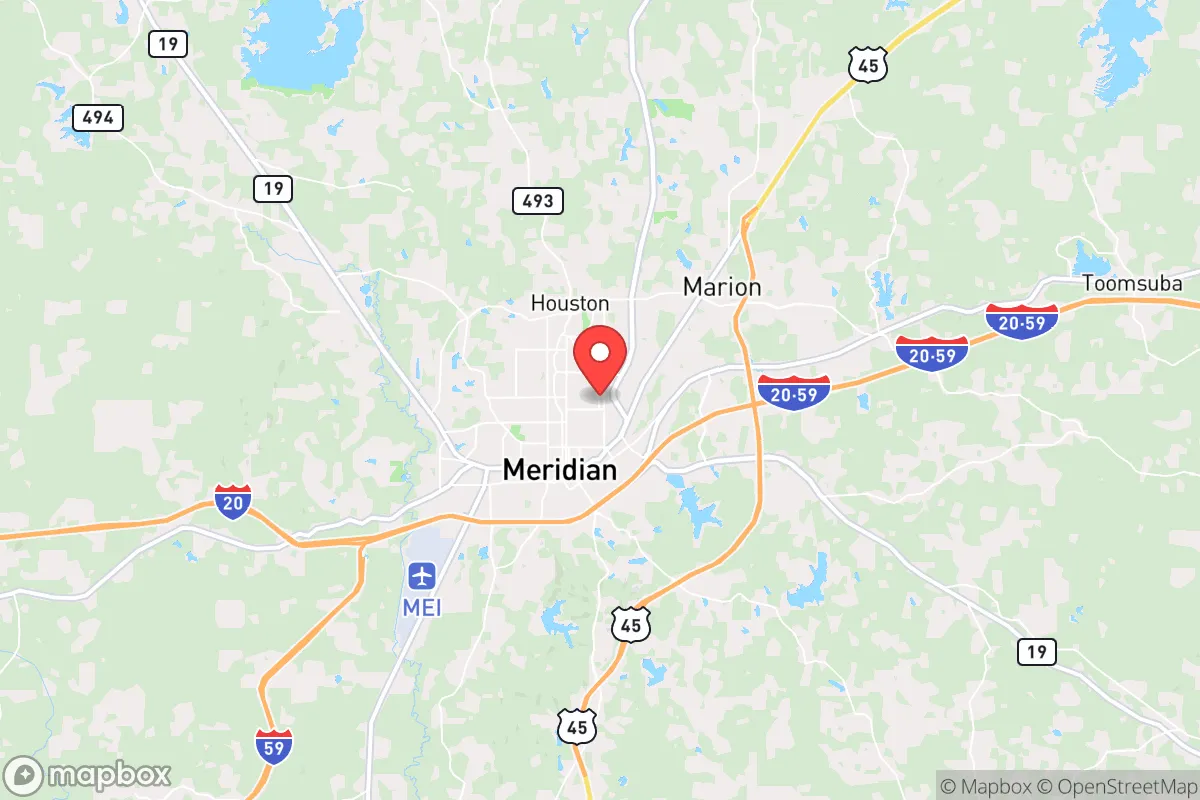
District shown is the primary district for this city’s centroid. Cities may span multiple districts.
Local Political AnalysisPolitical Analysis of Meridian, MS
Meridian has long been a reliably conservative area, and the numbers back that up. The city and Lauderdale County sit within a congressional district with a Cook Partisan Voting Index (PVI) of R+14, which is a solid three points more Republican than the state of Mississippi's overall PVI of R+11. What this means in plain terms is that while Mississippi as a whole is already a deep red state, Meridian and its surrounding area are even more deeply entrenched in that conservative lean. If you look at the trend over the last decade or two, it's really stayed pretty steady—there hasn't been a major swing one way or the other, just a consistent, reliable Republican majority in most local, state, and federal elections.
How it compares
To put it in perspective, if you drive west on I-20 roughly 90 miles to the Jackson metro area, you'll find a more competitive political landscape, especially in Hinds County, which often votes Democratic. Head south toward Hattiesburg or the Gulf Coast, and you'll see a mix that’s slightly less Republican than Meridian's immediate area. But Meridian itself? It's really the anchor of east-central Mississippi's conservative bloc. The city itself used to have a bit more of a moderate Democratic presence—back in the day, there were union jobs tied to the railroad and the local industries that gave the local Democratic party more sway—but those days are pretty much gone now. The local economy's shift away from heavy industry and toward healthcare, education, and distribution centers has mirrored a broader political realignment. You won't find a lot of political hand-wringing at the local diner; it's predominantly a "don't tread on me" and "keep the government small" kind of vibe.
What this means for residents
For conservative residents, living in Meridian means you're in the political mainstream. Your values and voting patterns are reflected in the local school board, the county board of supervisors, and the state legislature. A Republican primary is often the de facto general election, and your vote carries weight in shaping local policy—from tax rates to road maintenance. For liberal residents, the reality is that you're in the decided minority. You won't find a lot of organized progressive activism, and local politics can feel like a one-party system. That said, it’s not an oppressive climate; people are generally polite, and most folks here are more interested in whether you're a good neighbor than who you voted for. The main practical impact is that if you're looking for a city with a robust, local progressive movement or a highly competitive two-party system, you’d find more of that in a place like Oxford or Starkville.
Culturally, Meridian's conservatism is wrapped up in its strong sense of community, deep religious roots, and a certain pride in being a "small city" that hasn't lost its character. There's less of the hard-edged, nationalized culture war stuff you see in some other parts of the country, and more of a local focus on things like the annual Jimmie Rodgers Festival or restoring the historic downtown. Policy-wise, this leans into things like lower property taxes relative to other parts of the state and a general resistance to new regulations on businesses. Looking ahead, the political trajectory is likely to stay put. As long as the region's demographic and economic mix holds steady—older, family-oriented, and fairly homogeneous—the R+14 lean is not going anywhere. It's just the water everyone swims in here, and for the most part, people are fine with that.

State Political ClimatePolitical Climate in Mississippi
State Political AnalysisPolitical Environment in the State
Mississippi is one of the most reliably Republican states in the nation, carrying a Cook PVI of R+11, meaning it votes about 11 points more Republican than the national average. The state hasn’t voted for a Democratic presidential candidate since Jimmy Carter in 1976, and the GOP has only tightened its grip since the 1990s realignment of the Deep South. The dominant coalition is a mix of white evangelical voters in rural and suburban areas, conservative African American voters in pockets of the Delta and Pine Belt, and a growing number of business-oriented transplants along the Gulf Coast. Over the last two decades, the state has drifted steadily rightward, with the legislature becoming near-supermajority Republican, though the governor’s mansion has remained in GOP hands since 2004.
Urban vs. rural divide
The political map splits cleanly along population density. The state’s only reliably blue strongholds are the majority-Black counties in the Mississippi Delta—places like Hinds County (Jackson), Sunflower County (Indianola), and Bolivar County (Cleveland)—where Democrats regularly win by 40 points. Jackson, the capital and largest city, is a deep blue island in a red state, driven by a large Black voting bloc and a well-organized Democratic machine. On the flip side, the fastest-growing suburban and exurban rings around Memphis—especially DeSoto County (Hernando, Southaven, Olive Branch)—are bright red, frequently giving Republicans 65-70% of the vote. The Gulf Coast counties—Harrison County (Gulfport, Biloxi) and Jackson County (Pascagoula)—lean Republican but with more moderation, influenced by military and maritime industries. The rural Pine Belt and Northeast Mississippi (Tupelo, Columbus, Starkville) have shifted from purple to solidly red over the past 20 years, as white voters abandoned the old conservative Democratic tradition.
Policy environment
Mississippi’s state-level policy is among the most conservative in the country. There is no state income tax on wages—Mississippi phased out its income tax in 2022, moving to a flat 4% rate that will drop to 0% by 2026 under current law. Sales taxes are moderate (7%), but property taxes are low, especially compared to neighboring Alabama and Tennessee. The state has a right-to-work law, weak unions, and minimal business regulations. Education policy is a hot-button issue: the state funds a school choice voucher program for special-needs students and has no charter school cap, but public school funding per pupil remains among the lowest nationally. Healthcare is largely unexpanded—Mississippi was one of the last states to reject full Medicaid expansion, though a partial expansion (covering the "coverage gap") passed in 2024 and is being phased in. Election laws are restrictive: voters must present a photo ID, same-day voter registration is not allowed, and absentee voting is limited to specific excuses. The state also bans almost all abortions, with no exceptions for rape or incest, under a trigger law that went into effect after Dobbs.
Recent policy direction
The past two years have seen a burst of new laws that sharpen the state’s conservative identity. In 2024, Governor Tate Reeves signed a permitless carry bill, allowing any law-abiding adult to carry a concealed handgun without a license—making Mississippi one of over 25 states with constitutional carry. Parental rights in education were codified through the "Parents’ Bill of Rights," which requires schools to notify parents about curriculum changes and allows them to opt children out of specific lessons. On medical autonomy, the state passed a law banning gender-affirming care for minors, with a threat of malpractice lawsuits against providers. Property rights were strengthened by a 2024 law making it easier to evict squatters. Surveillance and privacy: Mississippi expanded police use of drones and automated license plate readers with few warrant requirements, while also passing a data privacy law that restricts how Big Tech can collect children’s data. Voting access tightened slightly—a 2023 law shortened the early in-person voting window from 15 days to 10, though it added no-excuse mail-in voting for seniors over 65. The overall arc is toward more individual liberty on guns and taxes, less autonomy on medical decisions, and a cautious tightening of election procedures.
Civil unrest & political movements
Mississippi doesn’t see the large-scale protests common in larger states, but it has had flashpoints. In Jackson, the 2023 water crisis—where the city’s treatment plant failed for weeks—turned into a political movement, with residents suing the state over emergency management and demanding state intervention. The state has a small but vocal secessionist fringe, mostly operating online, and the "State Sovereignty Commission" (historically infamous) was formally abolished in the 2010s, though some rural counties still fly the state flag with the old Confederate emblem (the new flag, adopted in 2021, removed the battle flag). Immigration politics are muted: Mississippi has no sanctuary cities, and the state legislature passed a 2023 bill requiring all state contracts to verify employees’ immigration status through E-Verify. The 2020 election saw no major fraud controversies in Mississippi—the state’s Republican secretary of state, Michael Watson, certified the result without issue. The most visible political movement is the rural church-based conservative network, organized through groups like the Mississippi Family Council, which holds regular rallies against abortion and drag performances.
Projection
Over the next decade, Mississippi will likely stay deep red but with some demographic wrinkles. The Black population is slowly shrinking as younger, educated African Americans move to Atlanta or Houston, while white retirees and remote workers are drawn to the Gulf Coast’s low taxes and warm winters. DeSoto County is expected to keep growing as a Memphis exurb, solidifying the northern metro’s Republican lean. Hernando and Olive Branch are seeing new subdivisions filling with families who want Tennessee-level taxes but Mississippi-style zoning. The Delta will continue to depopulate, weakening the Democratic base. The biggest wild card is Medicaid expansion: if it’s fully implemented by 2030, it could reduce rural hospital closures and soften the state’s health despondency, but also lower the anti-government fervor that drives rural turnout. The state’s conservative tilt is stable, but the flavor may shift from culture-war intensity toward a more libertarian, low-tax, pro-business model, especially as new residents arrive from blue states.
For someone moving in, here’s the bottom-line: if you lean conservative, you’ll find your values reflected in state law and local governance—low taxes, gun freedom, school choice, and minimal bureaucracy. If you lean liberal, you’ll face an uphill fight on most issues, though you’ll have solidarity in Jackson, the Delta towns, and the college towns (Starkville, Hattiesburg). Your practical day-to-day freedoms depend on local jurisdiction: what’s legal in Southaven may not be enforced in Jackson. Pick your county carefully, and expect the state’s political direction to stay the same for the foreseeable future.
* Values derived from national, state, county, city and local statistics and may differ in a specific area. Last updated: 2026-07-07T00:39:28.000Z
Narrative content on this page is AI-generated and may contain mistakes. Verify any details that matter before acting on them.
ReloMaps may earn a commission from affiliate links at no extra cost to you.

