Photo: Wikipedia
Demographics of Meridian, MS
Affluence Level in Meridian, MS
A below-average socioeconomic profile. Incomes, home values, and educational attainment trail the U.S., with higher poverty and unemployment.
People of Meridian, MS
Meridian, Mississippi, is a city of 34,466 residents defined by its deep African American majority (62.4%) and a white population of 29.6%, creating a cultural and political identity distinct from much of the surrounding Lauderdale County. The city is notably less diverse than the national average, with a foreign-born population of just 1.2% and small Hispanic (2.0%), East/Southeast Asian (0.6%), and Indian subcontinent (0.5%) communities. This is a place where the legacy of railroad-era migration and post-Civil Rights suburbanization is still visible in the neighborhoods, and where the population has been slowly declining for decades, shaping a tight-knit, historically grounded community.
How the city was settled and grew
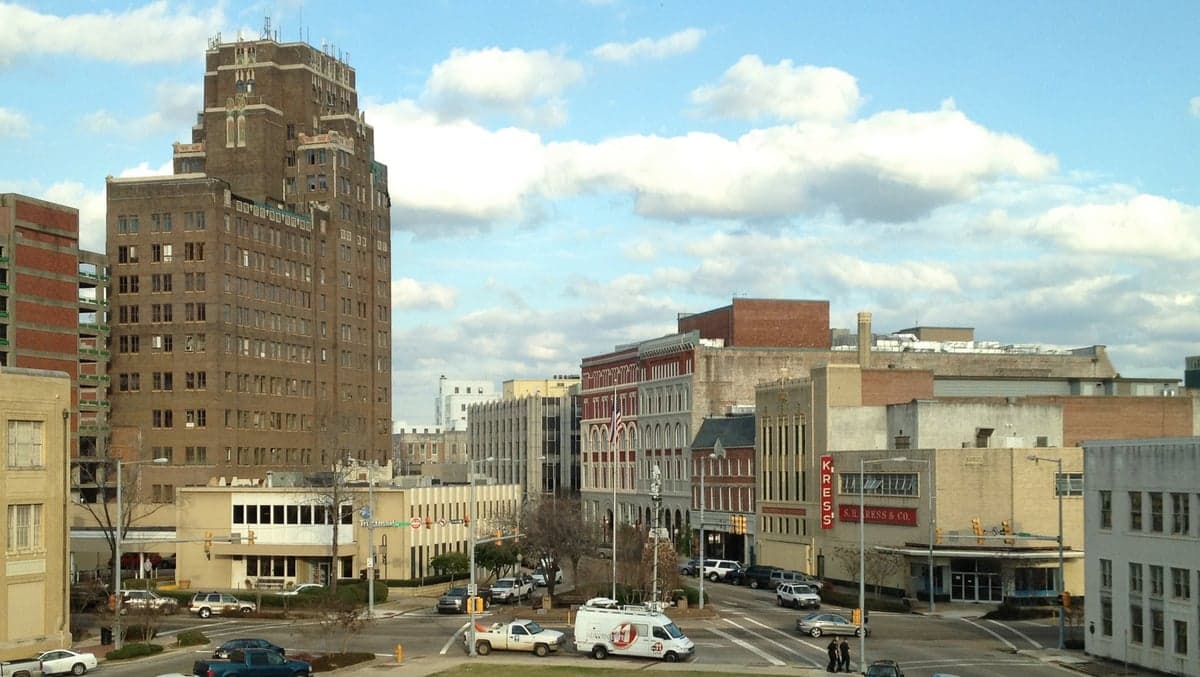
Meridian was founded in the 1850s as a railroad junction, a strategic crossing of the Mobile and Ohio and the Southern Railway lines that drew a wave of white laborers, merchants, and engineers from the Upper South and Northeast. The city’s original core, now the Meridian Downtown Historic District, was built by these early settlers, who erected the brick commercial blocks and Victorian homes that still anchor the city’s identity. The post-Civil War era brought a second major wave: freed African Americans from surrounding rural plantations moved into the city for railroad and service jobs, forming the foundation of the Black community that would become the majority. They settled in what is now the East End neighborhood, a historically Black area east of the railroad tracks, and in the West End, where working-class families built shotgun houses and churches that remain community anchors. By the early 20th century, Meridian had become a regional manufacturing and timber hub, drawing additional white migrants from the Deep South and a small number of Chinese immigrants who opened grocery stores, many settling near the Highland Park area. The city’s population peaked at around 41,000 in 1960, with a white majority that reflected the Jim Crow-era social order.
Modern era (post-1965)
The 1965 Hart-Cellar Act had little direct effect on Meridian’s demographics, as the city never attracted significant post-1965 immigration from Asia, Latin America, or the Middle East. Instead, the major post-1965 shift was domestic: white flight to suburban areas like Bonita and Collinsville in unincorporated Lauderdale County accelerated after school desegregation in the 1970s, leaving the city itself increasingly Black. By 2020, the white population had fallen to under 30%, while the Black share rose to over 62%. The North Hills neighborhood, once a white middle-class enclave, transitioned to a predominantly Black professional and middle-class area during the 1980s and 1990s. The small Hispanic community (2.0%) is largely concentrated in the South Meridian area, drawn by construction and poultry-processing jobs, while the tiny East/Southeast Asian and Indian communities are dispersed, with no single ethnic enclave. The city’s college-educated share (20.7%) is below the national average, reflecting the loss of many young professionals to larger metros like Jackson or Atlanta.
The future
Meridian’s population is projected to continue a slow decline, mirroring trends across much of rural Mississippi, with the city losing roughly 5-10% of its residents per decade since 1980. The population is becoming slightly more diverse in absolute terms, with the Hispanic share growing from under 1% in 2000 to 2.0% today, but the city remains overwhelmingly Black and white. New residential development is concentrated in the Northwest Meridian area, where newer subdivisions are attracting a mix of Black and white families, though the overall trend is dispersal rather than concentrated ethnic neighborhoods. The cultural identity is evolving toward a more explicit Black political and civic leadership, with the city electing its first Black mayor in 2009 and maintaining a majority-Black city council. For a newcomer, this means moving into a community where the social fabric is shaped by historically Black churches, HBCU alumni networks, and a strong sense of local pride, but where economic opportunities are limited and the population base is shrinking.
Meridian is becoming a smaller, more stable, and more distinctly Black-majority city, with a cultural identity rooted in its railroad and civil rights history rather than in new immigration. For someone moving in now, the city offers affordable housing, a slower pace of life, and a community where long-term residents know each other by name, but it requires accepting limited diversity, a declining tax base, and fewer amenities than a growing Sun Belt suburb would provide.

* Values derived from national, state, county, city and local statistics and may differ in a specific area. Last updated: 2026-07-07T00:39:28.000Z
Narrative content on this page is AI-generated and may contain mistakes. Verify any details that matter before acting on them.
ReloMaps may earn a commission from affiliate links at no extra cost to you.

