
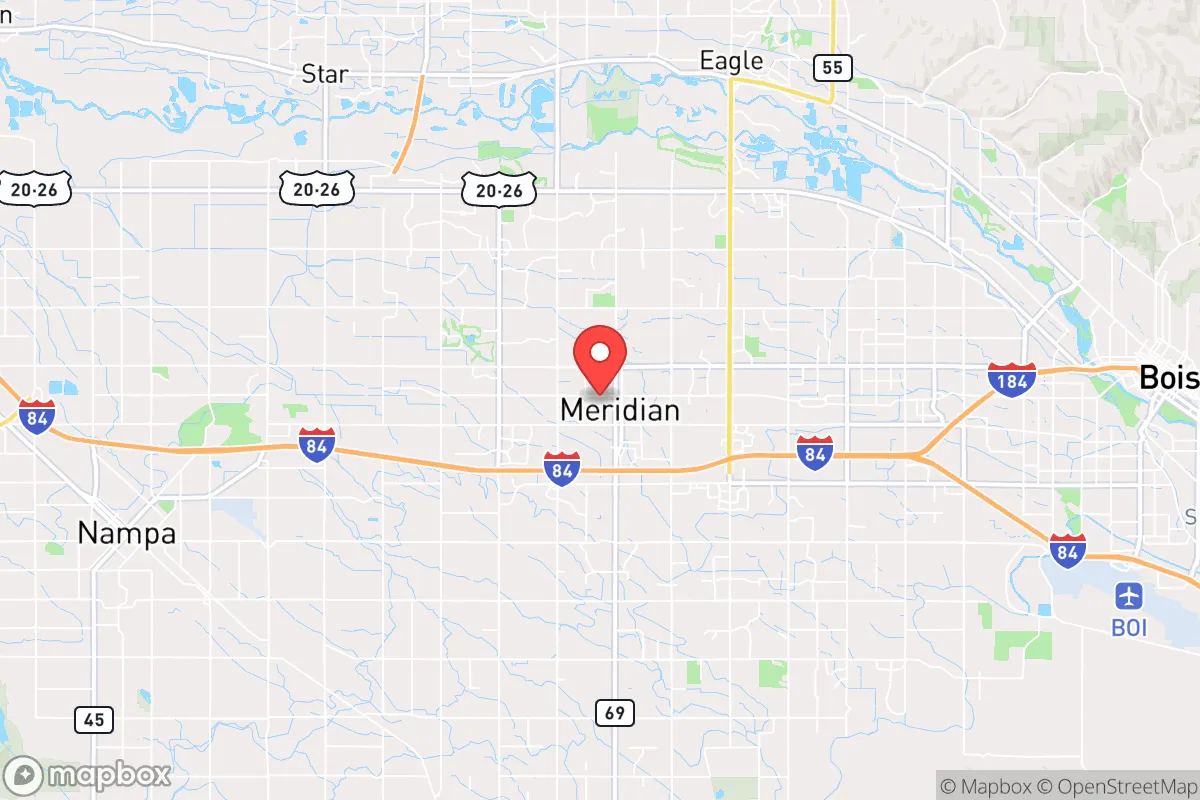
Photo: Wikipedia
Personal Sovereignty in Meridian, ID
Moderate friction. Expect trade-offs in some aspect of personal liberty and independence.
What does Personal Sovereignty tell us?
Personal Sovereignty measures your capacity for self-reliance and independence with minimal government friction. Higher scores mean fewer barriers between you and the way you want to live... but it assumes you have the space you need and good neighbors.
What does this tell us?
Personal Sovereignty measures your capacity for self-reliance and independence with minimal government friction. Higher scores mean fewer barriers between you and the way you want to live... but it assumes you have the space you need and good neighbors.
State Policy
Energy independence: Importer (25% of energy produced in-state)
Personal Liberty
Homesteading

Personal Liberty Analysis
Meridian, Idaho, offers a personal sovereignty environment that is among the strongest in the Intermountain West, driven by a state-level commitment to limited government, low taxation, and expansive individual rights. For a relocation-minded individual or family prioritizing autonomy, the city provides a practical balance of suburban convenience and rural-adjacent self-reliance, with Idaho’s constitutional and statutory framework consistently favoring personal choice over regulatory oversight. The key trade-off is that Meridian’s rapid growth—now over 130,000 residents—has introduced some zoning and development controls that are tighter than in more remote parts of the state, but the overall posture remains one of light-touch governance.
Tax burden and regulatory posture in Meridian
Idaho’s tax and regulatory environment is among the most favorable in the nation for those seeking to keep more of their earnings and operate with fewer bureaucratic hurdles. The state levies a flat income tax rate of 5.8% as of 2026, with no progressive brackets, and property taxes in Ada County (where Meridian sits) average roughly 0.7% of assessed value—well below the national median. There is no state-level estate or inheritance tax, and the sales tax is a flat 6%, applied to most goods but not to groceries or prescription drugs. For a family earning $100,000 annually, the combined state and local tax burden typically falls between 7% and 9% of income, significantly lower than in states like California or Oregon. Regulatory posture is equally restrained: Idaho has no state-level occupational licensing for over 60 professions that require it elsewhere, and the state’s “right-to-farm” laws protect agricultural operations from nuisance lawsuits, which matters for those considering small-scale homesteading. Meridian’s city government does enforce standard building codes and subdivision regulations, but permits for accessory dwelling units, home businesses, and minor construction are generally processed within weeks, not months. The overall message is that the state trusts individuals to make their own economic decisions, with minimal interference.
Self-defense and gun law specifics in Meridian
Idaho is a constitutional carry state, meaning that as of July 1, 2016, any law-abiding adult 18 or older may carry a concealed firearm without a permit, both inside and outside city limits. Meridian fully aligns with this framework: there are no additional city-level restrictions beyond state law, and the Ada County Sheriff’s Office issues enhanced concealed carry permits (which are recognized in 36 states) for those who want reciprocity while traveling. Stand-your-ground laws are in effect, with no duty to retreat in any place where a person has a legal right to be, and Idaho’s Castle Doctrine explicitly covers homes, vehicles, and workplaces. The state also preempts local governments from enacting stricter gun ordinances than state law, so Meridian cannot ban firearms in parks, libraries, or other public spaces—though private businesses may post signage prohibiting carry. For those interested in training, the Idaho Freedom Foundation and local gun clubs like the Ada County Sheriff’s Sportsman’s Range offer regular classes. The practical result is that a resident can legally carry a firearm for self-defense from the moment they move in, with no waiting period, background check beyond the federal NICS, or registration requirement for private sales. This is one of the most permissive self-defense environments in the country, comparable to states like Montana or Arizona.
Self-reliance and homesteading viability in Meridian
Meridian’s zoning and land-use policies make small-scale homesteading feasible, though not as open as rural Idaho counties. Standard residential lots in newer subdivisions range from 6,000 to 12,000 square feet, which is enough for a substantial vegetable garden, a small orchard (4-6 fruit trees), and a chicken coop—the city allows up to six hens per household with no roosters, and no permit is required for the coop itself. Goats, sheep, and other livestock are permitted on lots of one acre or larger, which are available in the city’s “Rural Residential” (RR) zone, primarily on the outskirts near Ten Mile Road and south of I-84. Off-grid feasibility is limited within city limits: Meridian requires connection to municipal water and sewer for all new construction, and solar panels are allowed but must meet standard building codes and HOA approvals if applicable. However, the city has no ordinance prohibiting rainwater collection, and many residents install 500- to 1,000-gallon cisterns for irrigation. For those seeking true off-grid living, the unincorporated areas of Ada County just outside Meridian—such as the Kuna-Meridian border or the rural pockets near Lake Lowell—allow private wells, septic systems, and off-grid solar with no county permits for systems under 10 kW. The state’s “right to dry” law prohibits HOAs from banning clotheslines, and Idaho’s liberal food freedom laws allow direct sales of homemade baked goods, canned goods, and eggs without a license, which supports a cottage-food economy. The bottom line is that Meridian offers a middle ground: you can raise a significant portion of your own food and reduce utility dependence, but full off-grid autonomy requires moving a few miles outside the city boundary.
Personal liberties in Meridian: parental rights, medical autonomy, speech, and property
Idaho’s legal framework strongly protects parental rights, medical autonomy, free speech, and property rights, and Meridian residents benefit directly from these state-level guarantees. The Idaho Parental Rights Act (2022) affirms that parents have the fundamental right to direct their children’s education, healthcare, and upbringing, and the state does not require parental consent for homeschooling beyond a simple notification to the local school district—no curriculum approval, testing mandates, or teacher qualifications are imposed. Medical autonomy is similarly broad: Idaho has no state-level vaccine mandate for adults or children (except for school attendance, which allows philosophical exemptions), and the state’s “Right to Try” law permits terminally ill patients to access experimental treatments without FDA approval. Free speech protections are robust, with Idaho being one of the few states with a specific statute (Idaho Code § 18-8501) that prohibits public universities from restricting speech based on viewpoint, and Meridian has no local noise or signage ordinances that would limit political or religious expression. Property rights are secured by Idaho’s “private property rights” law, which requires governments to prove a compelling interest before restricting land use, and the state’s eminent domain laws are among the most restrictive in the nation—condemnation for private economic development is prohibited. For homeowners, this means that Meridian’s zoning changes are subject to public hearing and judicial review, and the city cannot downzone property without compensation. The cumulative effect is that a resident can homeschool, refuse medical interventions, speak freely on public property, and develop their land with minimal government interference, all within a suburban setting.
Compared to other fast-growing cities in the West, Meridian offers an unusually high degree of personal sovereignty without requiring a rural or remote lifestyle. The tax burden is roughly half that of Boise’s, the gun laws are among the most permissive in the nation, and the regulatory environment for homesteading and personal liberty is light enough that most residents can live largely as they choose. The primary constraint is that Meridian’s growth has introduced some suburban zoning rules—particularly around lot size and utility connections—that limit full off-grid independence, but these are minor compared to the restrictions in cities like Portland, Denver, or Salt Lake City. For a conservative-leaning individual or family who values autonomy, self-reliance, and minimal government, Meridian ranks as one of the top suburban options in the Intermountain region, with the state’s legal framework acting as a reliable backstop against local overreach.

* Values derived from national, state, county, city and local statistics and may differ in a specific area. Last updated: 2026-07-08T12:44:28.000Z
Narrative content on this page is AI-generated and may contain mistakes. Verify any details that matter before acting on them.
ReloMaps may earn a commission from affiliate links at no extra cost to you.

