Photo: Wikipedia
Demographics of Meridian, ID
Affluence Level in Meridian, ID
An upper-middle-class area. Household wealth, education levels, and homeownership run ahead of national benchmarks.
People of Meridian, ID
Meridian, Idaho, today is a rapidly growing suburban city of 124,865 residents, characterized by a predominantly white (81.4%) and highly educated (44.4% college-educated) population. Its identity is shaped by a blend of agricultural heritage and modern master-planned communities, with a notably low foreign-born share (2.4%) that distinguishes it from many other fast-growing Sun Belt suburbs. The city’s residents are overwhelmingly native-born, with a Hispanic population of 9.5% and small East/Southeast Asian (1.8%), Black (1.5%), and Indian (0.3%) communities, reflecting a demographic profile that is less diverse than the national average but slowly shifting.
How the city was settled and grew
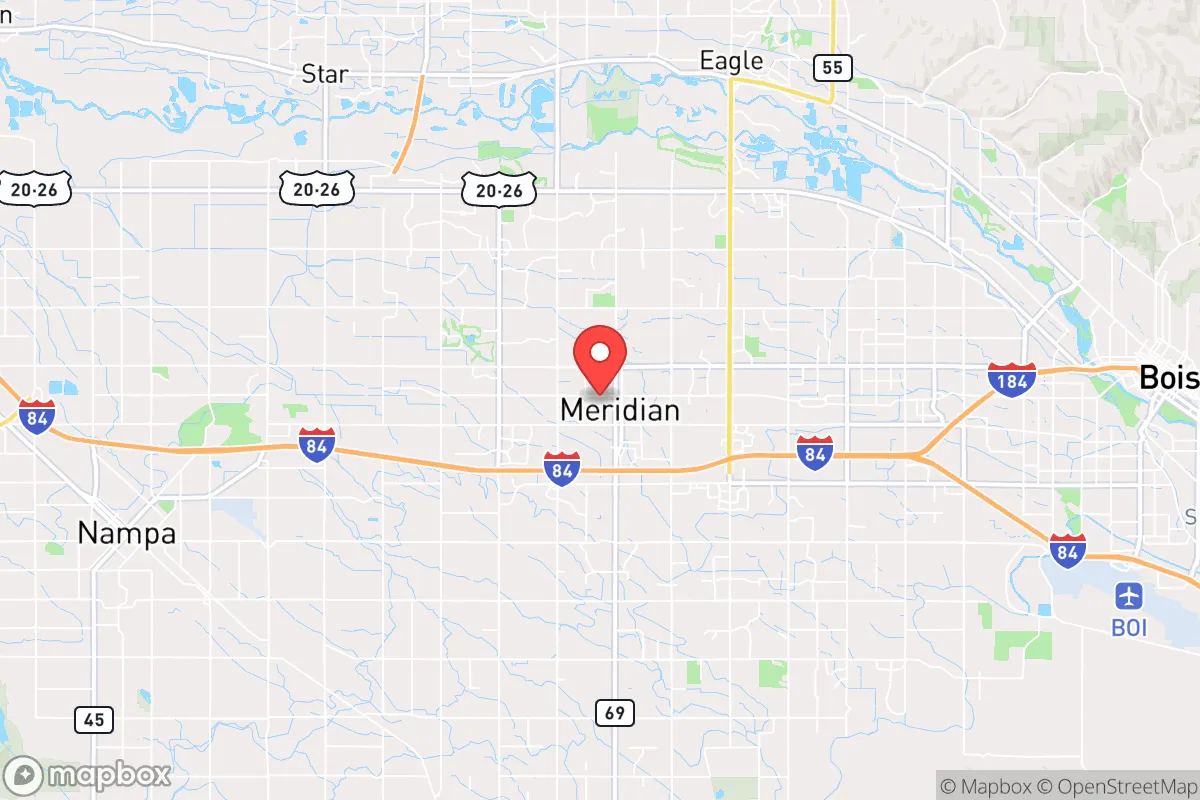
Meridian’s population history begins with the 1863 Homestead Act, which drew Anglo-American settlers to the fertile Boise River Valley for dryland farming and later irrigation. The city was officially founded in 1893 as a railroad stop on the Oregon Short Line, and its early residents were primarily farmers of Northern European descent—English, German, and Scandinavian—who established the Old Town Meridian district around Main Street and the railroad depot. This area, centered on the intersection of Meridian Road and Broadway Avenue, remains the historic core, with original farmhouses and early 20th-century commercial buildings. A second wave arrived during the 1930s-1950s, driven by the expansion of the nearby Mountain Home Air Force Base and the growth of Boise’s agricultural processing industries. These newcomers, still overwhelmingly white and native-born, settled in the Central Meridian neighborhoods along Fairview Avenue, where modest postwar ranch homes were built on former farmland. By 1960, Meridian’s population was just 2,795, and the city remained a small, homogeneous farming community.
Modern era (post-1965)
The post-1965 era transformed Meridian from a sleepy farm town into a major Boise suburb. The 1965 Immigration and Nationality Act had minimal direct impact here—foreign-born residents remain just 2.4%—but the real driver was domestic in-migration from California, the Pacific Northwest, and the Midwest, beginning in the 1980s and accelerating after 2000. These new residents, predominantly white and middle-class, were drawn by affordable housing, low crime, and Idaho’s conservative political climate. They concentrated in master-planned subdivisions like Ten Mile Crossing (southwest Meridian, developed from 2005 onward) and Linder Ranch (northwest Meridian, built in the 1990s), which feature large single-family homes and HOAs. The Hispanic population, which grew from under 3% in 1990 to 9.5% today, is largely composed of native-born U.S. citizens of Mexican descent who moved from California and other Western states, not recent immigrants. They are dispersed throughout the city but have a visible presence in South Meridian neighborhoods near Overland Road, where older, more affordable housing stock exists. The East/Southeast Asian community (1.8%) is small but concentrated in newer subdivisions near the Eagle Road corridor, particularly around the Meridian Crossroads shopping area, where many work in tech and healthcare. The Indian community (0.3%) and Black community (1.5%) are tiny and widely dispersed, with no single ethnic enclave.
The future
Meridian’s population is projected to continue growing rapidly, potentially exceeding 150,000 by 2035, driven by continued domestic in-migration from high-cost Western states. The city is becoming slightly more diverse, but slowly: the Hispanic share is expected to rise to 12-14% by 2040, while the white share will decline to around 75%. The East/Southeast Asian and Indian populations will likely grow modestly as tech and healthcare employers expand, but the foreign-born share will remain well below the national average. New growth is concentrating in the Northwest Meridian area, near the intersection of Chinden Boulevard and Ten Mile Road, where large master-planned communities like Avimor (technically in unincorporated Ada County but closely tied to Meridian) are attracting families with young children. The cultural identity is evolving from a purely agricultural suburb to a more diverse, amenity-rich city, but it remains overwhelmingly native-born, politically conservative, and family-oriented. The city’s low foreign-born share and high homeownership rate (around 70%) suggest it will retain its character as a predominantly white, middle-class suburb for the foreseeable future.
For someone moving in now, Meridian offers a stable, safe, and highly educated community with strong schools and a conservative ethos, but with limited racial and ethnic diversity. The population is growing fast, but the demographic profile is shifting only gradually, meaning newcomers will find a city that is more homogeneous than most other fast-growing Sun Belt suburbs. The key trade-off is between the area’s family-friendly stability and its relative lack of cultural diversity—a choice that aligns with the preferences of many domestic migrants from the West Coast.

* Values derived from national, state, county, city and local statistics and may differ in a specific area. Last updated: 2026-07-08T12:44:28.000Z
Narrative content on this page is AI-generated and may contain mistakes. Verify any details that matter before acting on them.
ReloMaps may earn a commission from affiliate links at no extra cost to you.

