Photo: Wikipedia
Demographics of Menominee, MI
Affluence Level in Menominee, MI
A below-average socioeconomic profile. Incomes, home values, and educational attainment trail the U.S., with higher poverty and unemployment.
People of Menominee, MI
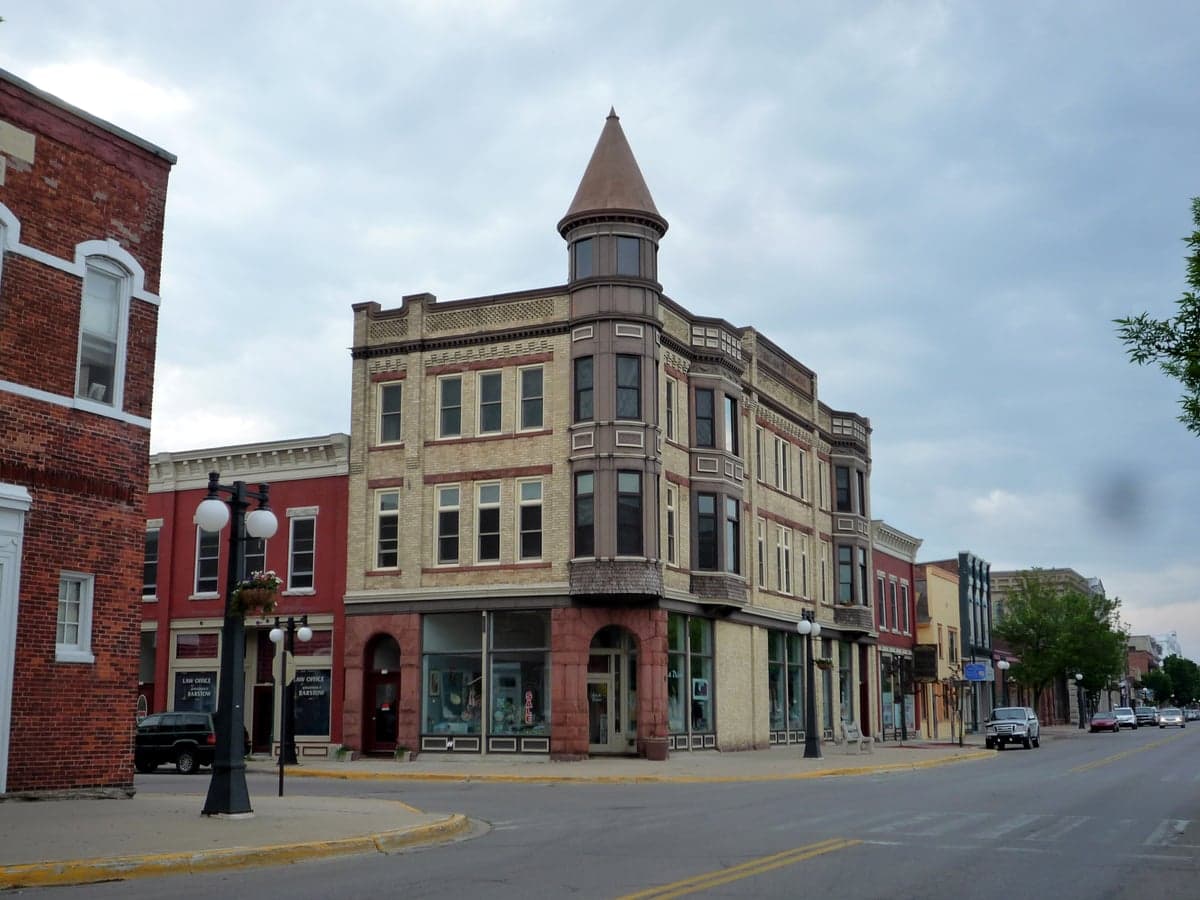
Today, Menominee, Michigan, is a small, predominantly white community of 8,370 residents, characterized by a strong working-class identity rooted in its industrial and maritime heritage. The city’s population density is low, and its distinctive identity is shaped by a deep sense of place along the Bay of Green Bay, with a social fabric that remains largely homogeneous. While the city has seen modest demographic shifts, it remains one of the least diverse communities in the Upper Peninsula, with a foreign-born population of just 1.3% and a college education rate of 17.0%.
How the city was settled and grew
Menominee’s original inhabitants were the Menominee Native American tribe, who lived along the bay for centuries before European contact. The first permanent white settlers arrived in the 1830s and 1840s, drawn by the region’s abundant timber and the strategic location at the mouth of the Menominee River. The city was formally platted in 1863, and its early growth was explosive, fueled by the lumber boom. By the 1870s, Menominee was one of the largest lumber-shipping ports on the Great Lakes, attracting waves of immigrants seeking work in the sawmills and shipyards. French-Canadian and Irish laborers formed the first major wave, settling in the West Side neighborhood near the mills along the river. A second wave of German and Scandinavian immigrants arrived in the 1880s and 1890s, establishing themselves in the East Side district, where they built churches, social halls, and small businesses. By 1900, the city’s population had swelled to over 10,000, making it the second-largest city in the Upper Peninsula. The decline of the lumber industry after 1910 led to a shift toward manufacturing, with companies like Lloyd Manufacturing (later Ansul) and the Menominee Paper Company providing stable employment through the mid-20th century. The South End neighborhood, near the paper mill, became home to a mix of later-arriving Polish and Italian families who worked in the factories.
Modern era (post-1965)
After the 1965 Hart-Cellar Act, Menominee saw virtually no new immigration from outside Europe, reflecting its geographic isolation and limited economic draw. The city’s population peaked at around 11,000 in the 1960s and has since declined steadily, losing roughly 25% of its residents by 2020. Domestic out-migration, particularly of younger adults seeking jobs in larger Midwestern cities, has been the dominant trend. The small Hispanic population (1.5%) and Black population (0.4%) are largely concentrated in the Downtown area and the Riverfront District, where rental housing is more available. These groups are dispersed rather than forming distinct ethnic enclaves. The city’s East/Southeast Asian population is effectively zero, and the Indian-subcontinent population is also zero. The North Shore neighborhood, with its newer single-family homes, has attracted a small number of white-collar professionals commuting to Marinette, Wisconsin, or Green Bay, but the overall demographic picture has remained remarkably stable. The college education rate of 17.0% is well below the national average, reflecting the area’s reliance on manufacturing and trades-based employment.
The future
Menominee’s population is projected to continue its slow decline, with the Census Bureau estimating a drop to roughly 8,000 by 2035. The city is becoming slightly older, with a median age rising above 45, as younger residents leave for opportunities elsewhere. Diversity is unlikely to increase significantly; the foreign-born share has remained below 2% for decades, and there are no major employers or refugee resettlement programs that would attract new immigrant groups. The small Hispanic population may grow modestly through natural increase, but it will remain a tiny fraction of the total. The West Side and East Side neighborhoods, with their aging housing stock, are seeing gradual depopulation, while the North Shore and Riverfront District are attracting a few retirees and remote workers drawn by lower home prices and waterfront access. The city’s cultural identity is likely to remain rooted in its Finnish and Scandinavian heritage, with events like the Waterfront Festival and the Menominee County Fair reinforcing a traditional, family-oriented community ethos.
For someone moving in now, Menominee offers a stable, low-cost, and safe environment with a strong sense of community, but it is not a place of rapid demographic change or growing diversity. The city is becoming quieter and older, with a population that values its history and slow pace of life. New residents will find a welcoming but insular community where most people have deep local roots, and where the economy remains tied to manufacturing, healthcare, and tourism. If you are seeking a tight-knit, predominantly white, working-class town with access to outdoor recreation and a low cost of living, Menominee fits that description precisely.

* Values derived from national, state, county, city and local statistics and may differ in a specific area. Last updated: 2026-11-22T17:22:35.000Z
Narrative content on this page is AI-generated and may contain mistakes. Verify any details that matter before acting on them.
ReloMaps may earn a commission from affiliate links at no extra cost to you.

