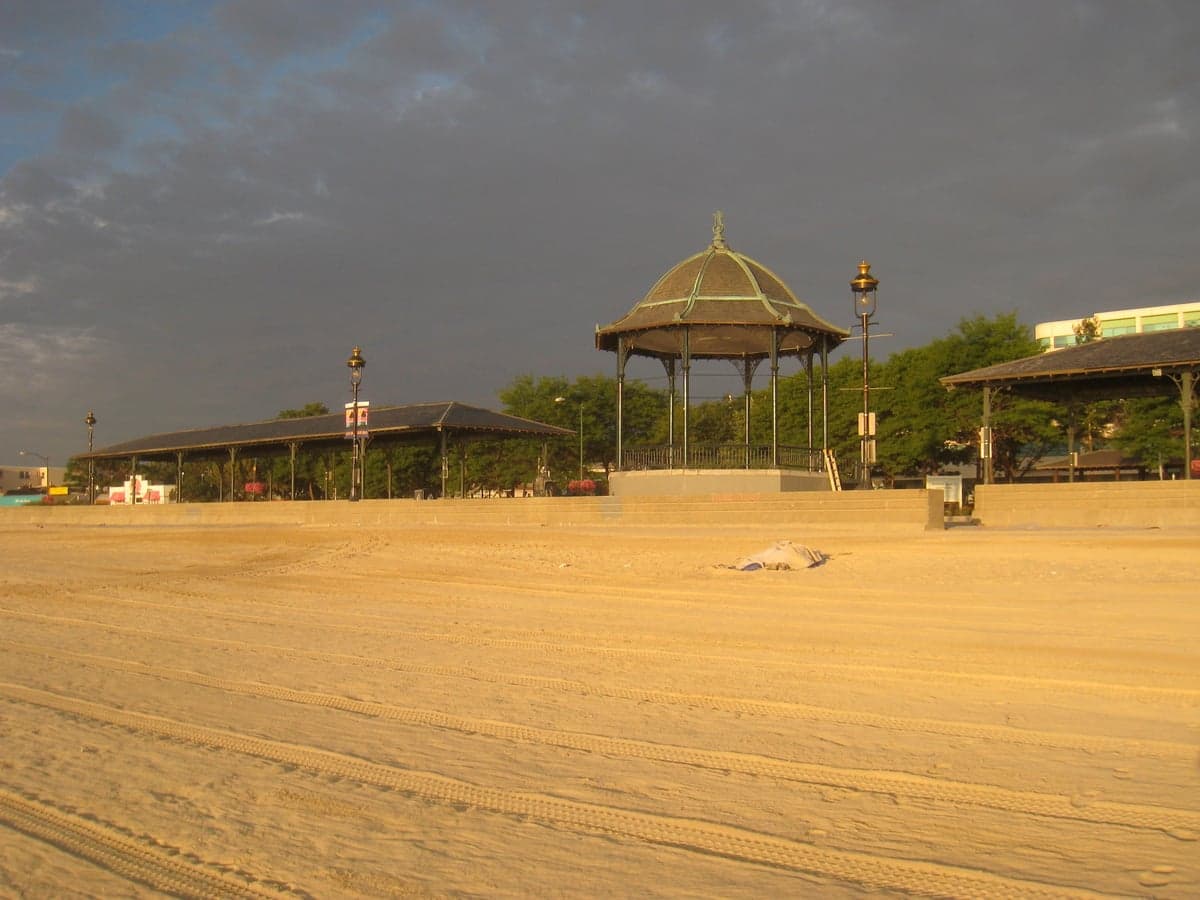
Photo: Wikipedia
Personal Sovereignty in Suffolk County
Viable for self-reliance. Generally workable, though some barriers may limit total independence.
What does Personal Sovereignty tell us?
Personal Sovereignty measures your capacity for self-reliance and independence with minimal government friction. Higher scores mean fewer barriers between you and the way you want to live... but it assumes you have the space you need and good neighbors.
What does this tell us?
Personal Sovereignty measures your capacity for self-reliance and independence with minimal government friction. Higher scores mean fewer barriers between you and the way you want to live... but it assumes you have the space you need and good neighbors.
State Policy
Energy independence: Importer (5% of energy produced in-state)
Personal Liberty
Homesteading

Personal Liberty Analysis
Suffolk County, Massachusetts, presents a challenging environment for those prioritizing personal sovereignty, with a dense regulatory framework and high tax burden that significantly constrains individual autonomy compared to much of the United States. The county, which encompasses Boston, Chelsea, Revere, and Winthrop, operates under some of the most restrictive state-level laws in the country regarding self-defense, property use, and personal liberties. For a relocation-minded individual or family with a conservative-leaning focus on self-reliance, the trade-offs are stark: you gain access to world-class urban amenities and a robust social safety net, but you surrender a substantial degree of control over your finances, your home, and your personal safety decisions.
Tax burden and regulatory posture: How heavy is the hand of government?
Suffolk County sits within a state known for its high tax burden and dense regulatory environment. Massachusetts ranks among the top five states nationally for combined state and local tax burden, and Suffolk County is the epicenter. The state's income tax is a flat 5.0% on all earned income, with a separate 4.0% tax on short-term capital gains and a 9.0% rate on long-term capital gains over a certain threshold. Property taxes in Suffolk County are moderate by Massachusetts standards but still substantial: the average effective property tax rate hovers around 1.1% of assessed home value, though this varies dramatically by municipality. Boston's residential rate is roughly $10.50 per $1,000 of assessed value, while Chelsea and Revere have slightly lower rates but higher commercial burdens. The regulatory posture is decidedly heavy-touch. Massachusetts has a statewide building code, strict environmental regulations (especially in coastal areas like Winthrop and Revere), and a notoriously complex permitting process for any home renovation or new construction. Zoning is highly localized, with Boston's zoning code being one of the most intricate in the nation, often requiring variances for even modest changes. For a homeowner seeking to add a workshop, a detached garage, or a rental unit, the process can be lengthy and expensive. The state also imposes a 6.25% sales tax, and the Massachusetts Paid Family and Medical Leave (PFML) program adds a payroll tax of 0.88% split between employer and employee. For a self-employed individual or small business owner, this represents a direct reduction in personal sovereignty over earnings and time.
Self-defense and gun law specifics: What are your rights to protect yourself?
This is the area of sharpest contrast for a sovereignty-minded reader. Massachusetts has some of the most restrictive gun laws in the United States, and Suffolk County enforces them rigorously. The state requires a License to Carry (LTC) for any handgun possession, whether open or concealed. The issuing authority is the local police department, and in Suffolk County—particularly Boston—the process is notoriously slow and discretionary. The Boston Police Department has a reputation for requiring extensive documentation, including character references and a demonstrated "proper reason" for carrying, which goes beyond the state's "may-issue" framework. In practice, obtaining an LTC in Boston can take 6-12 months and is not guaranteed. Chelsea and Revere are somewhat more efficient but still operate under the same restrictive state law. The state also bans "assault weapons" by name and feature, limits magazine capacity to 10 rounds, and requires a separate Firearms Identification (FID) card for long guns. There is no "stand your ground" law; instead, Massachusetts imposes a "duty to retreat" in public spaces before using deadly force. Self-defense in the home is protected under the "castle doctrine," but the burden of proof remains on the defender. For a family seeking to exercise the right to armed self-defense, Suffolk County is among the most difficult places in the country to do so legally and practically. The culture around firearms is overwhelmingly urban and restrictive, with few gun ranges or gun-friendly businesses within the county. For those who prioritize this aspect of sovereignty, the surrounding counties—like Plymouth or Essex—offer a significantly more permissive environment.
Self-reliance and homesteading viability: Can you live off the land here?
Homesteading and off-grid living are effectively non-viable within Suffolk County due to extreme density and restrictive zoning. The county is almost entirely urbanized, with Boston's population density exceeding 14,000 people per square mile. Lot sizes are tiny: the median residential lot in Boston is under 3,000 square feet, and in Chelsea and Revere, it's often smaller. Zoning codes in all four municipalities prohibit agricultural uses on residential lots, and keeping livestock—even chickens—is heavily regulated. Boston allows up to four hens (no roosters) on single-family lots, but requires a permit and annual inspection. Chelsea and Winthrop have outright bans on backyard poultry. Gardening is permitted but limited by space and soil quality; many urban lots have lead-contaminated soil from decades of industrial use. Off-grid systems like solar panels, rainwater collection, and composting toilets face significant regulatory hurdles. Boston requires building permits for solar installations, and net metering is available but subject to utility approval. Rainwater collection is legal but limited to 50 gallons per property without a permit. Composting toilets are not recognized as a primary sanitation solution; all homes must connect to municipal sewer. For a family seeking genuine self-reliance—growing food, generating power, managing waste—Suffolk County is fundamentally incompatible. The closest areas with viable homesteading potential are in western Massachusetts or southern New Hampshire, both a 60-90 minute drive from Boston.
Personal liberties: Parental rights, medical autonomy, speech, and property
Massachusetts generally leans progressive on social issues, which affects several dimensions of personal sovereignty. Parental rights are a mixed bag: the state has strong laws protecting parental involvement in education (including a "Parents' Bill of Rights" passed in 2022), but it also mandates comprehensive sex education in public schools and allows minors to consent to certain medical treatments without parental notification, including mental health care and substance abuse treatment. Medical autonomy is heavily restricted in one major area: Massachusetts has a strict vaccine mandate for school attendance, with no philosophical exemption, only medical and religious exemptions (the latter being narrowly interpreted). COVID-19 vaccine mandates for healthcare workers and state employees were among the strictest in the nation. On the other hand, the state has robust protections for reproductive healthcare and gender-affirming care. Free speech is generally protected under the First Amendment, but Massachusetts has a "hate speech" statute that can be used to prosecute certain types of expression, and Boston has strict permitting requirements for public demonstrations. Property rights are significantly constrained: the state has strong eminent domain powers, and Boston's rent control (reinstated in 2024 for certain units) limits what landlords can charge. Homeowners face strict historic preservation rules in many Boston neighborhoods (Beacon Hill, Back Bay, South End), where exterior changes require approval from a historic commission. For a family that values maximum control over their children's education, medical decisions, and property, Suffolk County's regulatory environment feels heavy. The surrounding suburbs—like Milton, Newton, or Needham—offer slightly more breathing room on property use but still operate under the same state-level constraints.
Overall, Suffolk County ranks among the lowest in the nation for personal sovereignty across the metrics that matter to a conservative-leaning individual: tax burden, self-defense rights, homesteading viability, and property autonomy. The trade-off is access to one of America's most dynamic urban economies, world-class healthcare, and a dense social infrastructure. For a family or individual who prioritizes self-reliance and minimal government interference, the county is a poor fit. The most sovereignty-friendly areas within commuting distance are in rural New Hampshire (which has no income tax, no sales tax, and constitutional carry) or the more conservative-leaning towns of central Massachusetts like Sturbridge or Spencer. Within Suffolk County itself, the least restrictive municipality is likely Revere, which has slightly lower taxes and a more permissive zoning culture than Boston, but the difference is marginal. For the sovereignty-minded reader, Suffolk County is best understood as a place to visit, not to build an independent life.

* Values derived from national, state, county, city and local statistics and may differ in a specific area. Last updated: 2026-06-18T10:33:47.000Z
Narrative content on this page is AI-generated and may contain mistakes. Verify any details that matter before acting on them.
ReloMaps may earn a commission from affiliate links at no extra cost to you.

