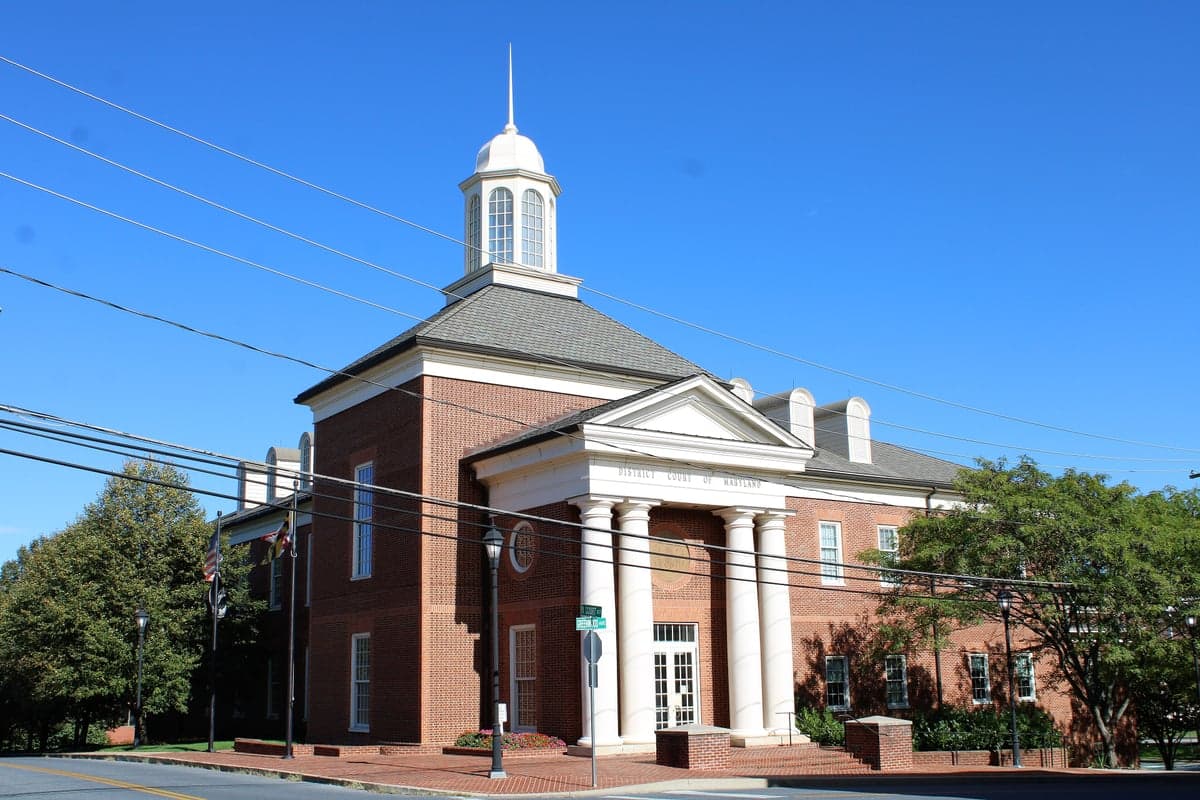
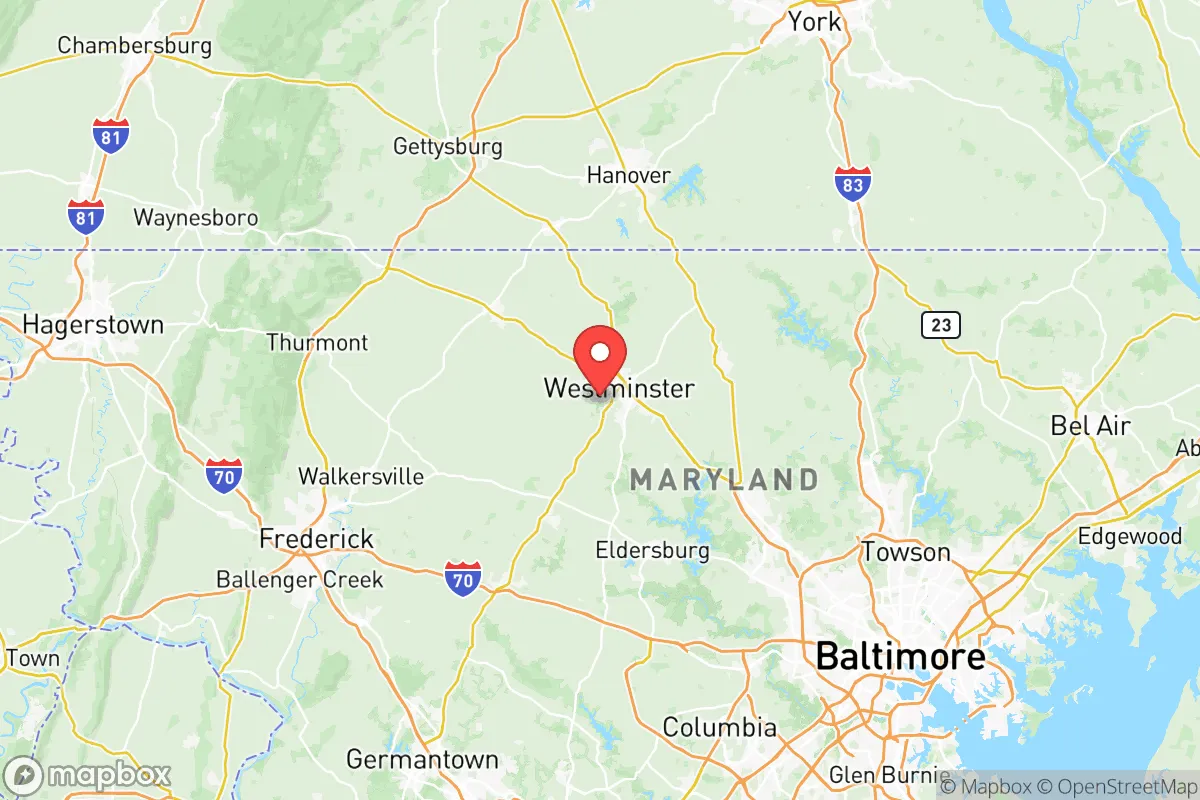
Photo: Wikipedia
Political ClimatePolitical Climate in Carroll County
Showing district-level results — no local-only data available.
Local Political AnalysisPolitical Analysis of Carroll County
Carroll County, Maryland, is a classic exurban redoubt in a deeply blue state, with a Cook PVI of D+10 that actually understates its conservative character compared to the state's D+17 lean. The county has been steadily trending rightward even as Maryland overall moves left, and the 2024 election saw Donald Trump win Carroll County by roughly 20 points, a margin that would have been unthinkable in the 1990s when it was still a swing county. The real story here is the growing divide between the rural north and the suburban south, with Westminster and Manchester holding the line as conservative strongholds while Sykesville and Eldersburg have become more competitive, though still reliably red.
How it compares
Maryland's D+17 PVI is driven by the massive Democratic margins in Montgomery and Prince George's counties, plus Baltimore City, which together produce statewide wins for Democrats even as Carroll County votes the other way. Carroll's D+10 PVI is a statistical artifact of its moderate history — in practice, the county has voted Republican in every presidential election since 2000, and the GOP holds every countywide office. The contrast is stark: drive 20 minutes south from Westminster into Howard County, and you go from a county where Trump signs outnumber Harris signs 5-to-1 to one where the opposite is true. The swing precincts are in the southern tier around Sykesville and Eldersburg, where commuters to Baltimore and DC have introduced more moderate voters, but even those areas broke for Trump by 8-12 points in 2024.
What this means for residents
For conservative residents, Carroll County feels like a refuge — the local government is reliably pro-business, gun rights are respected, and you can go to the Carroll County Farm Museum without hearing political arguments. The county commissioners are all Republican, and the school board tilts conservative, which matters a lot for curriculum debates. For liberal residents, it can feel isolating, but there are active Democratic clubs in Westminster and Sykesville, and the county's growth is slowly bringing more diversity. The practical reality is that property taxes are lower than in neighboring Howard or Montgomery counties, and the schools are solid, so many families accept the political trade-off. The biggest flashpoint in recent years has been library drag queen story hours and school library book challenges, which have drawn large crowds on both sides but ultimately resulted in conservative policy wins.
Culturally, Carroll County is distinct from the rest of Maryland in ways that go beyond voting. The county has a strong agricultural identity — the Carroll County 4-H & FFA Fair is a bigger deal than any political event — and a deep-rooted volunteer fire company tradition that shapes local politics. The Amish and Mennonite communities around Union Bridge and New Windsor add a layer of old-order conservatism that you won't find anywhere else in the state. Policy-wise, the county has fought state mandates on everything from septic systems to renewable energy, and the local government has a standing policy of non-cooperation with certain state gun laws. Looking ahead, the county is growing fastest in the south, and if that trend continues, the political complexion may shift slightly, but for the foreseeable future, Carroll County will remain Maryland's most reliably Republican large county.

State Political ClimatePolitical Climate in Maryland
State Political AnalysisPolitical Environment in the State
Maryland is one of the most reliably Democratic states in the country, with a Cook Partisan Voting Index of D+17, meaning it votes about 17 points more Democratic than the national average in presidential elections. The state hasn't voted for a Republican presidential candidate since George H.W. Bush in 1988, and Democrats hold supermajorities in both chambers of the General Assembly. Over the past 20 years, the Democratic lean has actually deepened as the Washington, D.C. suburbs have grown and diversified, while the once-competitive western and eastern parts of the state have become more reliably Republican but lost relative population share.
Urban vs. rural divide
The political map of Maryland is a textbook case of the urban-rural split. The entire Democratic majority is generated by the Washington, D.C. suburbs — Montgomery County, Prince George's County, and increasingly Howard County and Anne Arundel County — along with the city of Baltimore. Montgomery County alone casts about 15% of the state's vote and delivers margins of 70-80% Democratic. Prince George's is even more lopsided, often exceeding 85% Democratic. Meanwhile, the Eastern Shore counties like Worcester and Queen Anne's vote 60-65% Republican, and western Maryland — Garrett County, Allegany County, and Washington County — are similarly red. The Baltimore suburbs are more mixed: Baltimore County has trended Democratic in recent cycles, while Harford County and Carroll County remain solidly Republican. The result is a state where a conservative living in Cumberland or Ocean City feels completely disconnected from the politics of Bethesda or Columbia.
Policy environment
Maryland's policy environment reflects its Democratic supermajority. The state has a progressive income tax structure with rates from 2% to 5.75%, plus local county income taxes that push the combined top rate over 8% in some jurisdictions. Property taxes are moderate but vary significantly by county. Sales tax is 6%, with no local add-ons. The regulatory posture is generally pro-labor and pro-environment: the state has a $15 minimum wage, strict emissions standards, and aggressive renewable energy mandates. Education spending is among the highest in the nation per pupil, driven by the Blueprint for Maryland's Future law, which dramatically increased school funding. Healthcare policy leans left, with a state-based insurance exchange and expanded Medicaid. On election law, Maryland has no-excuse mail-in voting, same-day registration, and early voting — all popular with Democrats but viewed skeptically by conservatives who worry about ballot integrity. Gun laws are among the strictest in the country, including a handgun permit requirement, an assault weapons ban, and a magazine capacity limit.
Recent policy direction
The last five years have seen Maryland move decisively left on several fronts. In 2023, the General Assembly passed the Gun Safety Act, which expanded the list of "sensitive places" where firearms are prohibited, required a state police-issued permit for concealed carry, and banned firearms from private property without the owner's express permission — a direct response to the Supreme Court's Bruen decision. On education, the Blueprint for Maryland's Future (passed 2021) commits the state to massive new spending on early childhood education, teacher pay, and college and career readiness programs, funded by a permanent income tax surcharge on high earners. On medical and bodily autonomy, Maryland has codified abortion rights into state law, expanded access to gender-affirming care for minors, and passed a shield law protecting providers who serve out-of-state patients. On privacy and surveillance, the state passed the Maryland Online Data Privacy Act in 2024, giving residents more control over how companies collect and use their personal data. On property rights, the trend has been mixed: the state has tightened rent control options for local jurisdictions but also streamlined some housing approvals. On voting and ballot access, the state expanded mail-in voting permanently after the pandemic and now automatically sends ballots to all active registered voters — a move that has energized conservative concerns about election integrity but has not produced evidence of widespread fraud.
Civil unrest & political movements
Maryland has a history of visible political activism on both sides. The 2015 Baltimore protests following the death of Freddie Gray were a national flashpoint, leading to a state of emergency and National Guard deployment. Since then, the city has seen ongoing activism around police reform and criminal justice, including the 2021 passage of the Maryland Police Accountability Act, which overhauled disciplinary procedures and limited qualified immunity. On the right, the Maryland Shall Issue gun rights group has been highly active in litigation and lobbying, successfully challenging some aspects of the state's gun laws in federal court. Immigration politics are a persistent flashpoint: Maryland has a "sanctuary" policy that limits local law enforcement cooperation with federal immigration authorities, and several counties — including Montgomery and Prince George's — have explicitly declared themselves sanctuary jurisdictions. This has led to periodic confrontations with the federal government and heated local elections. Election integrity remains a live issue, with conservative groups regularly challenging the state's mail-in voting system and voter rolls. A new resident in the D.C. suburbs will see yard signs and bumper stickers for both sides, but the overall public discourse is dominated by progressive voices in the media and local government.
Projection
Over the next 5-10 years, Maryland is likely to become even more Democratic. The D.C. suburbs continue to grow, driven by federal employment, tech jobs, and immigration, while the rural counties in western Maryland and the Eastern Shore are either stagnant or losing population. The in-migration pattern is also partisan: people moving into Maryland tend to be younger, more diverse, and more liberal, while those leaving often cite taxes and regulation as reasons to relocate to Florida, Texas, or the Carolinas. The Republican Party in Maryland has become increasingly marginalized at the state level, though it remains competitive in local races in the rural counties and some Baltimore suburbs. A conservative moving to Maryland now should expect to live under a Democratic supermajority for the foreseeable future, with continued expansion of gun control, progressive taxation, and social welfare programs. A liberal moving in will find a state that largely aligns with their values, though they may be frustrated by the pace of change on housing affordability and crime in Baltimore.
For a new resident, the bottom line is straightforward: Maryland is a deeply blue state where conservative voters are a permanent minority at the state level, but can still find like-minded communities in the rural counties and some suburbs. The practical implications are clear — higher taxes, strict gun laws, and a regulatory environment that favors labor and environmental interests over business and property rights. If those tradeoffs are acceptable, Maryland offers excellent schools, strong job markets in the D.C. corridor, and a high quality of life. If not, the neighboring states of Pennsylvania, Virginia, and Delaware offer more politically balanced alternatives within commuting distance.
* Values derived from national, state, county, city and local statistics and may differ in a specific area. Last updated: 2026-07-12T11:39:13.000Z
Narrative content on this page is AI-generated and may contain mistakes. Verify any details that matter before acting on them.
ReloMaps may earn a commission from affiliate links at no extra cost to you.

