
Photo: Wikipedia
Demographics of Mars Hill, NC
Affluence Level in Mars Hill, NC
A middle-class area roughly in line with national averages across income, home values, education, and employment.
People of Mars Hill, NC
Today, Mars Hill, North Carolina, is a small, predominantly white college town of 2,738 residents, anchored by Mars Hill University and defined by a quiet, family-oriented character. The population is notably well-educated, with over half holding a college degree, and remains less diverse than the national average, with an 86.0% white demographic and a 5.1% Hispanic share. The town’s identity is a blend of Appalachian heritage, conservative-leaning values, and the intellectual influence of the university, creating a distinctive community that values tradition and education.
How the city was settled and grew
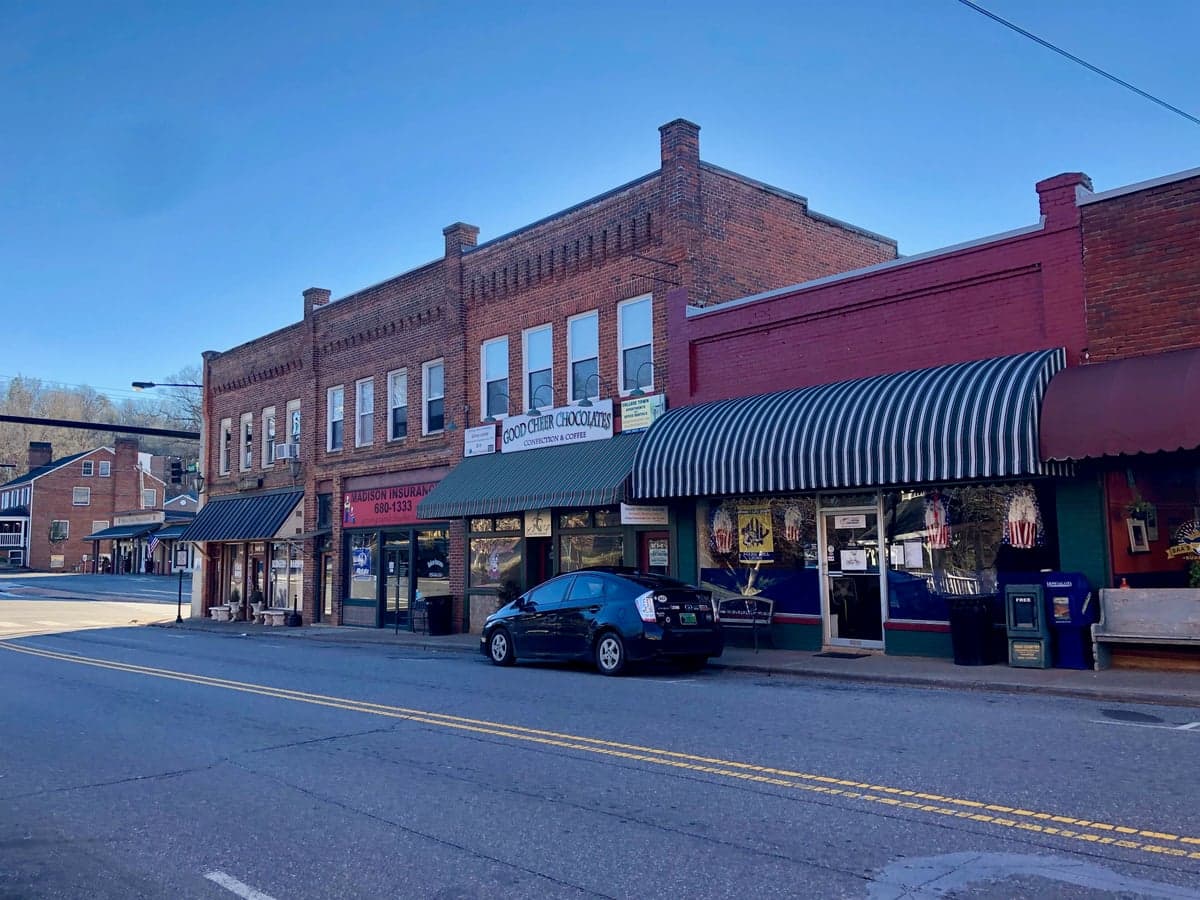
Mars Hill’s human history begins with the Cherokee people, who inhabited the surrounding Madison County mountains before European settlers arrived in the late 1700s. The town itself was formally established in the 1850s around the founding of what is now Mars Hill University (originally French Broad Baptist Institute) in 1856, which drew a wave of Scotch-Irish and English settlers from the broader Appalachian region. These early families—many of them farmers, merchants, and Baptist ministers—built the original core of the town along what is now Main Street, an area still referred to as Historic Downtown Mars Hill. The university’s founding created a small but steady demand for faculty housing and student boarding, leading to the development of College Street and the surrounding blocks, where professors and administrators built modest homes. The population remained overwhelmingly white and locally born through the early 20th century, with growth tied almost entirely to the university’s expansion and the agricultural economy of Madison County.
Modern era (post-1965)
After the 1965 Hart-Cellar Act, Mars Hill saw minimal direct immigration, consistent with its current foreign-born share of just 2.9%. The town’s modern demographic story is instead one of domestic in-migration, particularly from other parts of North Carolina and the Southeast. The university’s growth in the 1970s and 1980s attracted faculty and staff from outside the region, many of whom settled in the Mars Hill Heights neighborhood, a mid-century subdivision of ranch-style homes on the town’s western edge. The Hispanic population, now 5.1%, began to grow in the 1990s and 2000s, driven by agricultural and construction work in Madison County; these families concentrated in the South Main Street corridor and in rental housing near the university. The Black population, at 5.8%, has historical roots in the area’s small African American communities from the early 1900s, but the current share reflects a modest increase tied to university employment and student diversity. East and Southeast Asian residents (0.7%) are almost exclusively connected to the university, living in faculty housing or rentals in the Bailey Mountain area, while the Indian subcontinent population is effectively zero. The town’s overall racial composition has shifted only slightly since 2000, with white share declining from about 90% to 86%, and Hispanic and Black shares each rising a few points.
The future
Mars Hill’s population is projected to remain stable or grow slowly, with the university continuing to be the primary driver of demographic change. The town is becoming slightly more diverse, but at a pace far slower than the national average; the Hispanic share may rise to 7-8% over the next decade as families settle in the Bailey Mountain Road area and along US-23 near the town limits. The white population will likely remain the overwhelming majority, and the foreign-born share is expected to stay below 5%. New residential development is concentrated in the Mars Hill Ridge subdivision, a recent 55+ community attracting retirees from Florida and the Northeast, which is reinforcing the town’s older, whiter demographic. The cultural identity is evolving toward a more educated, slightly more diverse small town, but the conservative Appalachian character remains strong, with local politics and social norms reflecting traditional values. The university’s influence may gradually liberalize some segments of the population, but the broader Madison County context—rural, religious, and Republican-leaning—will continue to shape the town’s identity.
For someone moving to Mars Hill now, the town offers a stable, safe, and family-friendly environment with a strong sense of place, but little racial or cultural diversity. The population is becoming slightly more varied, but the change is slow, and the community remains overwhelmingly white, college-educated, and rooted in Appalachian traditions. New residents will find a place where the university and the surrounding rural culture coexist, and where the future looks much like the present—quiet, gradual, and predictable.

* Values derived from national, state, county, city and local statistics and may differ in a specific area. Last updated: 2026-10-20T17:07:26.000Z
Narrative content on this page is AI-generated and may contain mistakes. Verify any details that matter before acting on them.
ReloMaps may earn a commission from affiliate links at no extra cost to you.

