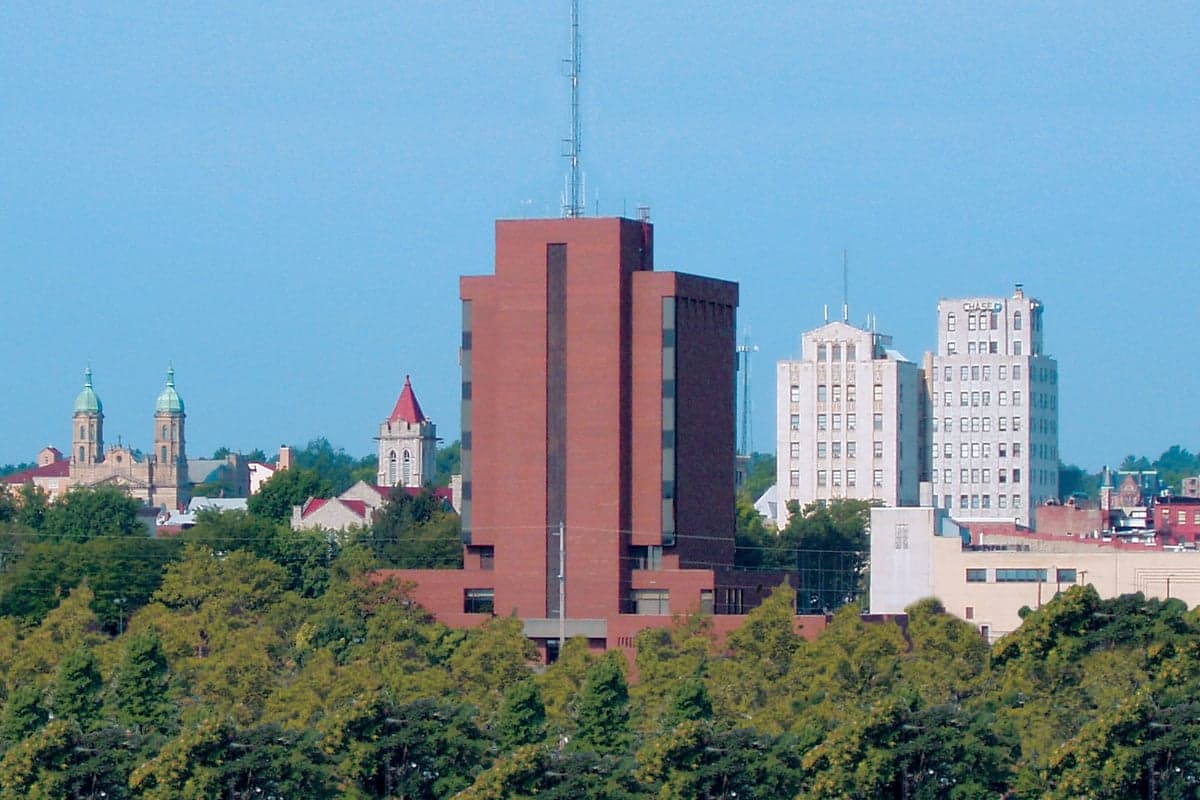
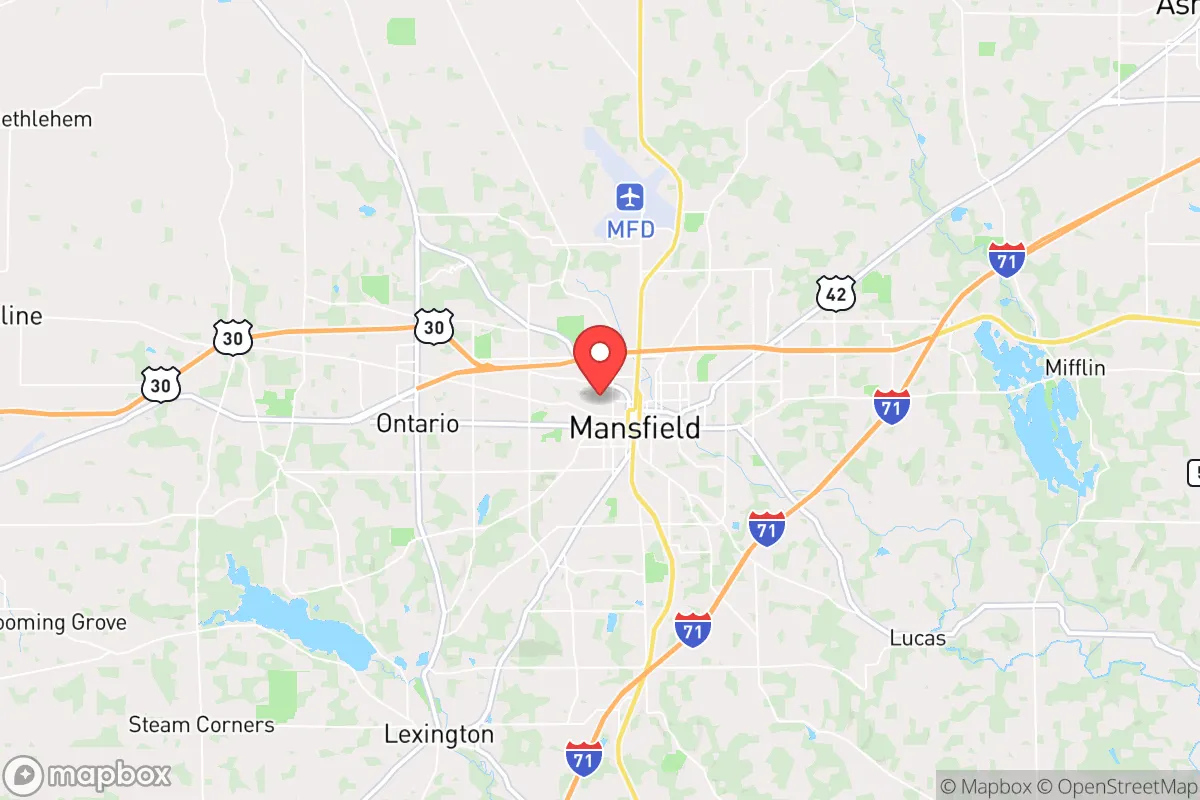
Photo: Wikipedia
Demographics of Mansfield, OH
Affluence Level in Mansfield, OH
A below-average socioeconomic profile. Incomes, home values, and educational attainment trail the U.S., with higher poverty and unemployment.
People of Mansfield, OH
The people of Mansfield, Ohio today number 47,686, forming a predominantly white (69.4%) and Black (17.7%) community with a notably small foreign-born population of just 0.5%. The city carries a distinct Rust Belt identity—shaped by generations of industrial labor, a shrinking but stabilizing population, and a strong sense of local roots. With only 15.9% of adults holding a college degree, Mansfield remains a working-class city where family ties and neighborhood loyalties run deep, even as economic shifts have reshaped who lives where.
How the city was settled and grew
Mansfield was founded in 1808 as the seat of Richland County, drawing its earliest settlers from New England and New York via the Connecticut Western Reserve. These Yankee pioneers—farmers, merchants, and craftsmen—built the town around the central square, now known as the Carnegie Square district, and established a Protestant, English-speaking character that persisted for decades. The real population boom came with the arrival of the railroads in the 1840s and 1850s, which turned Mansfield into a manufacturing hub. German and Irish immigrants arrived in large numbers during this period, settling in working-class neighborhoods like Woodland (east of the downtown core) and South Park, where they built churches, saloons, and row houses. By the early 20th century, the city's industrial base—led by the Ohio Brass Company, Westinghouse, and the Tappan Stove Company—drew a second wave of European immigrants, including Italians, Poles, and Slovaks, who concentrated in the Fourth Ward and along Park Avenue West. The Great Migration brought Black families from the South between 1910 and 1950, settling primarily in the Johns Park and West End neighborhoods, where they formed the foundation of Mansfield's African American community.
Modern era (post-1965)
The post-1965 period saw Mansfield's population peak at roughly 55,000 in 1970, then begin a long decline as manufacturing jobs moved overseas. The 1965 Hart-Cellar Act had little direct effect on Mansfield—its foreign-born share remains negligible at 0.5%—but domestic migration reshaped the city internally. White families with means moved to newer suburbs like Ontario and Madison Township, leaving older neighborhoods like Woodland and South Park with aging housing stock and lower property values. Black residents, who had been concentrated in Johns Park and the West End since the mid-20th century, saw those areas become more uniformly African American as white flight accelerated through the 1970s and 1980s. The Hispanic population, now 2.9%, grew modestly from the 1990s onward, settling mainly in the South Main Street corridor and near the industrial parks along U.S. Route 30. East/Southeast Asian residents (0.7%) and Indian-subcontinent residents (0.1%) remain tiny populations, largely clustered near the OhioHealth Mansfield Hospital and the North Lake Park area, often tied to medical or technical professions. The city's college-educated share—just 15.9%—reflects the departure of many younger, degree-holding residents to larger metro areas, leaving a population that is older, less mobile, and more rooted in place.
The future
Mansfield's population is likely to continue a slow decline or stabilize near 45,000–47,000 over the next decade, as outmigration of young adults offsets any new arrivals. The city is not homogenizing into a single identity; rather, it is tribalizing into distinct enclaves. Woodland and South Park remain predominantly white and working-class, with aging populations and limited in-migration. Johns Park and the West End are solidly Black and show little racial turnover. The small Hispanic community in the South Main Street area is growing slowly, but not at a rate that will significantly shift the city's demographics. The foreign-born population is so low (0.5%) that immigration will not be a meaningful driver of change. The most likely scenario is a continued slow bleed of population to surrounding townships and suburbs, with Mansfield itself becoming older, poorer, and more racially segmented by neighborhood.
For someone moving in now, Mansfield is a city where neighborhood choice largely determines social experience—a predominantly white working-class area in Woodland, a historically Black community in Johns Park, or a small but growing Hispanic corridor along South Main. The city's future is one of stability through stagnation: little growth, little diversity gain, and a population that knows its neighbors but is not attracting many new ones. It is a place for those who value low housing costs, deep local history, and a straightforward, no-frills lifestyle—not for those seeking rapid change or a melting-pot environment.

* Values derived from national, state, county, city and local statistics and may differ in a specific area. Last updated: 2026-04-30T01:17:03.000Z
Narrative content on this page is AI-generated and may contain mistakes. Verify any details that matter before acting on them.
ReloMaps may earn a commission from affiliate links at no extra cost to you.

