Photo: Wikipedia
Demographics of Manitowoc, WI
Affluence Level in Manitowoc, WI
A middle-class area roughly in line with national averages across income, home values, education, and employment.
People of Manitowoc, WI
The people of Manitowoc, Wisconsin, today number 34,553, forming a predominantly white (82.9%) and older community with a strong German and Polish Catholic heritage. The city is notably less diverse than the national average, with a foreign-born population of just 2.3%, and is characterized by a blue-collar identity rooted in maritime industry and manufacturing. This is a place where family names like Ziegelbauer, LeClair, and Shavlik have deep roots, and where the population has been slowly declining since its 1970s peak, creating a stable but aging demographic profile.
How the city was settled and grew
Manitowoc’s human history begins with the indigenous Menominee and Potawatomi peoples, who used the Manitowoc River as a travel corridor. The first permanent white settlers arrived in the 1830s, primarily Yankees from New England and New York, drawn by the promise of cheap land and the river’s potential for water-powered mills. The real population boom came with German immigration in the 1840s–1880s, followed by a significant wave of Polish immigrants between 1890 and 1910. These groups were recruited by the city’s expanding shipbuilding industry and the Manitowoc Shipbuilding Company (founded 1902), which became the largest employer. The Germans settled heavily in the Southside neighborhood, building St. Boniface Church and establishing the city’s brewing and woodworking trades. The Polish community concentrated in the Northside district around St. Mary’s Catholic Church, creating a dense, walkable enclave of duplexes and corner taverns. A smaller but notable wave of Czech and Bohemian immigrants arrived in the 1870s, settling in the River Point area near the docks. By 1920, Manitowoc was over 95% white, almost entirely of Northern and Central European stock, a composition that held steady through the mid-20th century.
Modern era (post-1965)
The post-1965 era brought little demographic change to Manitowoc compared to larger cities. The city’s foreign-born population remains very low at 2.3%, and the white share has only declined from roughly 97% in 1980 to 82.9% today. The most notable shift has been the growth of the Hispanic population (6.6%), concentrated in the Southwest Side near the industrial parks along Highway 151, where many work in food processing and metal fabrication. The East/Southeast Asian population (4.6%) is largely Hmong, a community that began arriving in the late 1970s as refugees from Laos. They settled primarily in the Silver Creek neighborhood and around the Lincoln Park area, where a small Hmong-owned grocery and a Buddhist temple now serve the community. The Black population remains very small at 1.7%, and the Indian-subcontinent population is negligible at 0.4%. Suburbanization has been limited; the city’s population peaked at 34,900 in 1970 and has since declined slightly, with younger families often moving to the surrounding towns of Two Rivers or Mishicot rather than to new subdivisions within city limits.
The future
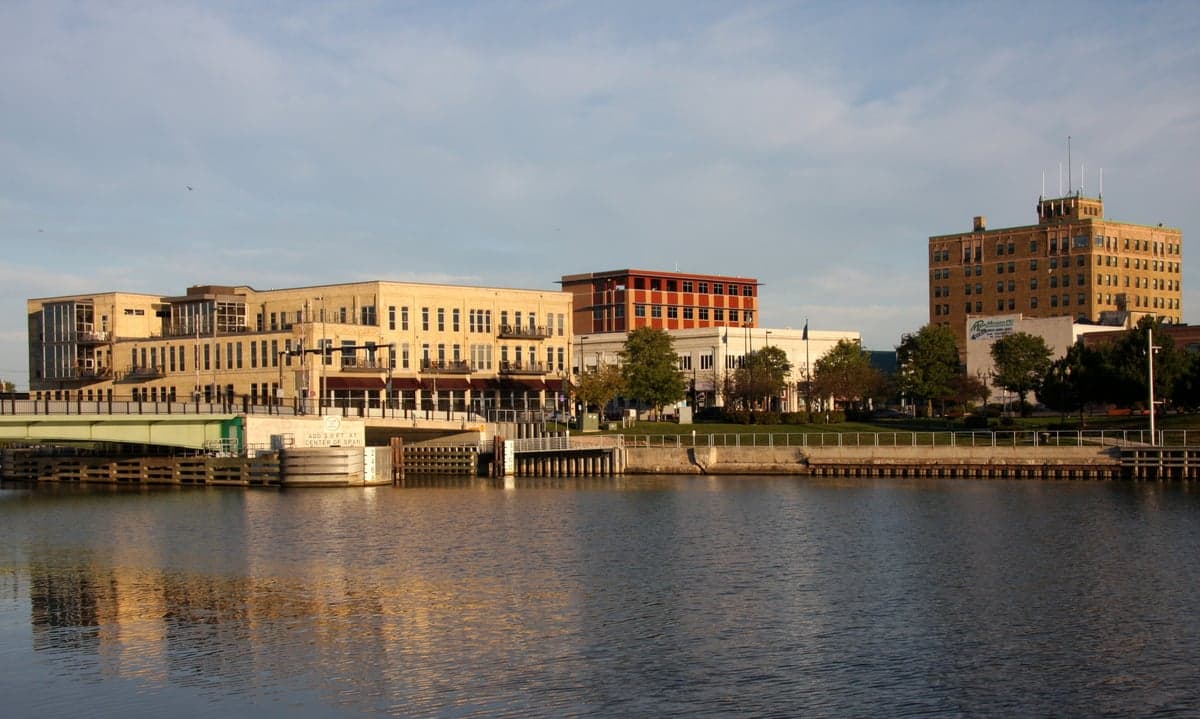
The population of Manitowoc is heading toward continued slow decline and modest diversification. The white population is aging and shrinking, with a median age of 42.5, well above the national average. The Hispanic and Hmong communities are younger and have higher birth rates, so their shares will likely grow to 8–9% and 6–7% respectively over the next 20 years. However, the city lacks the economic pull to attract large new immigrant waves; the manufacturing base has stabilized but is not expanding. The Downtown district is seeing some reinvestment in loft apartments and riverfront condos, drawing a small number of remote workers from Milwaukee and Green Bay, but this is a trickle, not a tide. The city is not tribalizing into distinct ethnic enclaves; rather, the older white population is dispersing into the surrounding rural towns, while the newer minority groups are consolidating in the Southwest Side and Silver Creek areas. The overall character will remain overwhelmingly white and culturally conservative, but with a slowly growing Hispanic and Hmong presence that is largely assimilating into the local workforce and school system.
For someone moving in now, Manitowoc offers a stable, safe, and affordable community where the population is not growing but is also not in crisis. The city is becoming slightly more diverse, but at a pace that will not disrupt its fundamental character for at least another generation. The key trade-off is between low housing costs and a limited job market, with the demographic future pointing toward a smaller, older, and gradually more multicultural city that retains its German-Polish cultural core.

* Values derived from national, state, county, city and local statistics and may differ in a specific area. Last updated: 2026-04-21T10:20:37.000Z
Narrative content on this page is AI-generated and may contain mistakes. Verify any details that matter before acting on them.
ReloMaps may earn a commission from affiliate links at no extra cost to you.

