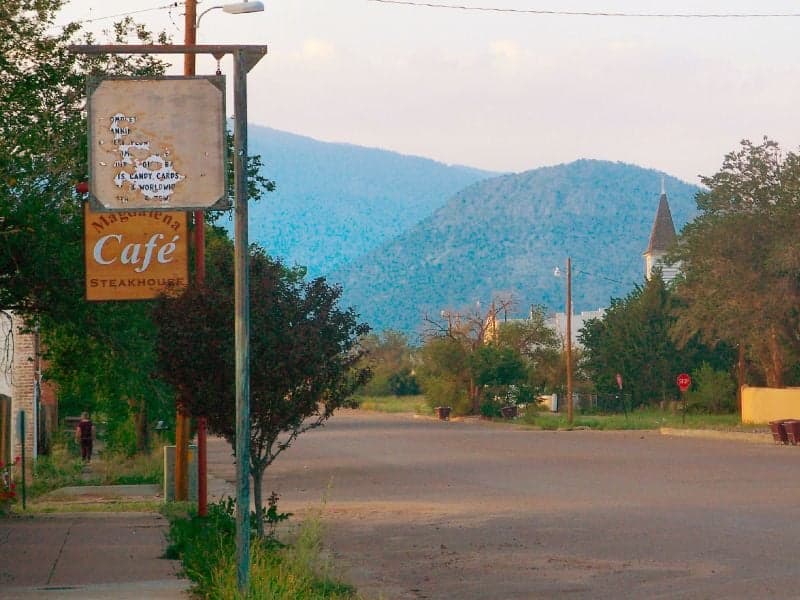
Photo: Wikipedia
Political ClimatePolitical Climate in Magdalena, NM
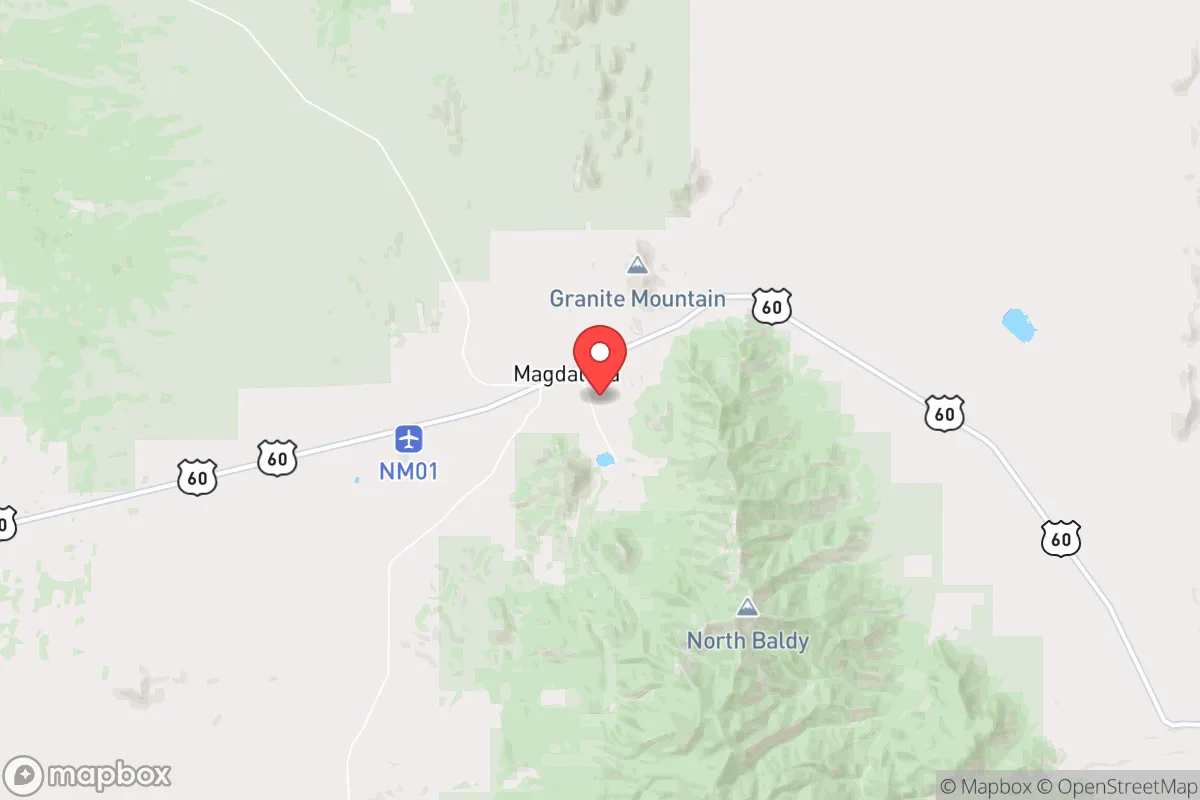
District shown is the primary district for this city’s centroid. Cities may span multiple districts.
Local Political AnalysisPolitical Analysis of Magdalena, NM
Magdalena sits in a political sweet spot that’s rare in New Mexico: a Cook PVI of EVEN, meaning the town votes almost exactly in line with the national average. That’s a sharp contrast to the state as a whole, which leans Democratic by a D+3 margin. If you’ve lived here a while, you’ve seen the balance shift slowly—Magdalena used to be reliably red, but over the last decade, a mix of newcomers, remote workers, and retirees from places like Albuquerque and Santa Fe have nudged it toward the center. The result is a community where neither party can take a win for granted, and local elections often come down to a few dozen votes.
How it compares
Drive 30 minutes east to Socorro, and you’ll find a similar EVEN lean, but with a more pronounced Democratic tilt in the city limits thanks to New Mexico Tech’s faculty and student population. Head north to Datil or west to Pie Town, and the politics turn reliably conservative—those are ranching and hunting communities where the Cook PVI would likely be R+10 or more. The real contrast is with Albuquerque, 90 miles north, where the Cook PVI is D+10 and progressive policies dominate city council debates. Magdalena’s EVEN rating means it’s a bellwether: when the state swings blue, Magdalena stays close; when the national mood shifts red, it follows. In 2024, the county (Socorro County) voted about 52% Republican for president, while the state went 52% Democratic—a perfect illustration of the town’s split personality.
What this means for residents
For conservative residents, the practical reality is that you’re not outnumbered. Local government, the school board, and the county commission often have a conservative majority, so property taxes stay low, gun rights are respected, and there’s little appetite for progressive social experiments. You can fly a Trump flag on your porch without getting side-eye. For liberal residents, the upside is that you’re not isolated—there’s a visible, if smaller, progressive community centered around the arts scene and the few coffee shops on Main Street. You’ll find allies at the library and in the volunteer fire department. The trade-off is that both sides have to compromise: a proposal to expand solar energy on county land passed only after conservative commissioners secured a guarantee that it wouldn’t interfere with grazing leases. That’s Magdalena in a nutshell—every policy debate is a negotiation, not a victory lap.
Culturally, the EVEN lean shapes daily life in subtle ways. The annual Magdalena Days festival features both a gun raffle and a vegan potluck, and nobody thinks twice. The local newspaper, the El Defensor Chieftain, covers county commission meetings with equal weight given to ranchers complaining about elk overpopulation and environmentalists pushing for dark-sky ordinances. The biggest policy distinction from the rest of New Mexico is the town’s fierce independence from state mandates: Magdalena was one of the last communities in the state to adopt a formal land-use plan, and it only did so after a federal grant required it. That independent streak, born from a century of ranching and mining, is what keeps the politics here grounded. It’s not about red or blue—it’s about whether the decision makes sense for a town of 900 people where everyone knows your truck. If you’re moving here, expect to be asked your opinion at the post office, and expect it to matter. That’s the real political climate: small, engaged, and stubbornly even.

State Political ClimatePolitical Climate in New Mexico
State Political AnalysisPolitical Environment in the State
New Mexico is a classic swing state that leans blue on paper but feels purple in practice, with a Cook PVI of D+3 that masks a deeply divided electorate. The Democratic advantage is driven almost entirely by Bernalillo County (Albuquerque) and Santa Fe County, while the rest of the state—especially the oil-rich southeast and rural northern counties—votes reliably Republican. Over the last 20 years, the state has drifted left on social and environmental policy, but it remains far more moderate than coastal blue states, with a strong independent streak and a live-and-let-live attitude that surprises many newcomers.
Urban vs. rural divide
The political map of New Mexico is essentially a tale of two islands of blue in a sea of red. Albuquerque and Santa Fe account for roughly 45% of the state's population and deliver the Democratic margins that decide statewide elections. Bernalillo County went +15 for Biden in 2020, while Santa Fe County hit +40. Drive 30 minutes outside either city, and you're in deep red territory. Las Cruces in Doña Ana County is a swing area that leans slightly Democratic, but the surrounding Mesilla Valley has conservative pockets. The eastern plains—Roswell, Clovis, Hobbs, Carlsbad—are solidly Republican, with oil and gas jobs driving a pro-business, anti-regulation ethos. The northwest corner around Farmington is also reliably red, tied to the Four Corners energy economy. What makes New Mexico unusual is that the rural areas are not just conservative but often libertarian-leaning, skeptical of both parties but especially of federal overreach.
Policy environment
New Mexico's tax structure is relatively moderate compared to other blue-leaning states. The state has a graduated income tax with a top rate of 5.9%, no state-level estate tax, and a gross receipts tax (essentially a sales tax) that varies by locality but averages around 7-8%. Property taxes are among the lowest in the nation, typically 0.5% to 0.8% of assessed value, which is a major draw for conservative families. The regulatory posture is mixed: environmental regulations are stricter than Texas or Oklahoma, especially around oil and gas permitting, but the state is still a major energy producer. Education policy has shifted left in recent years, with the 2023 passage of a constitutional amendment allowing the legislature to tap the Land Grant Permanent Fund for early childhood education, effectively raising the tax burden on extractive industries. Healthcare is a Democratic priority—Medicaid expansion was adopted early, and the state operates a public health insurance option (the Health Insurance Alliance). Election laws are relatively accessible: same-day voter registration, no-excuse absentee voting, and automatic voter registration at the DMV. There is no voter ID law requiring a photo, which is a point of contention for conservative transplants.
Recent policy direction
The last five years have seen a clear leftward shift on several fronts, but with notable exceptions. Gun laws: In 2021, the state passed a red-flag law (extreme risk protection orders) and a background-check requirement for private sales, but concealed carry remains shall-issue, and there is no ban on common semi-automatic rifles. Parental and education rights: The 2023 "Know Your Rights" law requires schools to notify parents of curriculum changes, but it also prohibits schools from outing LGBTQ+ students to parents without the student's consent—a flashpoint for conservative families. Medical and bodily autonomy: Abortion remains legal with no gestational limit, and the 2023 Reproductive Health Care Act codified protections for providers and patients traveling from other states. Property rights: The state has strong water rights protections (prior appropriation doctrine) but has tightened groundwater regulations in the Middle Rio Grande region. Taxation: The 2024 tax reform package cut the corporate income tax rate from 5.9% to 4.9% and expanded the child tax credit, a bipartisan compromise. Voting and ballot access: The 2023 Voting Rights Act (the first state-level version of the John Lewis Act) expanded early voting and mail-in ballot access, but also created a preclearance system for counties with a history of discrimination, which rural counties argue is federal-style overreach. The net effect is a state that is more permissive on personal liberties than Texas or Arizona but more regulated than a place like Wyoming.
Civil unrest & political movements
New Mexico has a history of low-boil political tension rather than explosive unrest. The 2020 protests in Albuquerque and Santa Fe over police brutality were large but largely peaceful, with property damage concentrated downtown. The Otero County standoff in 2021—where county commissioners refused to certify election results based on debunked fraud claims—was a national flashpoint, but it fizzled after the state Supreme Court intervened. Immigration politics are a constant undercurrent: the state has a "sanctuary" law (the 2019 New Mexico Law Enforcement Protection Act) that limits local police from cooperating with federal immigration enforcement, which is popular in Santa Fe and Albuquerque but deeply unpopular in the southern border counties like Hidalgo and Luna. The secessionist "New Mexico Republic" movement is a fringe online phenomenon with no real political traction. More visible is the water rights activism in the Middle Rio Grande, where farmers and acequia associations have clashed with state environmental agencies over irrigation curtailments. Election integrity remains a live issue: the 2022 secretary of state race was won by a Democrat who had been a target of conspiracy theories, and the state's automatic voter registration system is a frequent target of Republican criticism. A new resident will notice that political signs and bumper stickers are common, but actual street-level conflict is rare—most people just avoid talking politics with neighbors.
Projection
Over the next 5-10 years, New Mexico is likely to remain a D+3 to D+5 state, but the margin could narrow if in-migration patterns continue. The state is seeing an influx of remote workers from California and Colorado, who tend to be liberal-leaning and settle in Santa Fe, Albuquerque, and Las Cruces. At the same time, the oil and gas counties in the southeast are growing faster than the state average, driven by the Permian Basin boom, which adds Republican voters. The wildcard is Hispanic voter realignment: New Mexico's Hispanic population (48% of the state) has historically leaned Democratic, but younger Hispanic voters in rural areas are shifting right on economic and energy issues. If that trend accelerates, the state could become a true toss-up by 2032. The policy trajectory will likely be a slow leftward drift on social issues (more gun control, expanded abortion access) but a pragmatic center on taxes and energy—the state cannot afford to alienate the oil and gas industry, which funds 40% of the general fund. A conservative moving in now should expect that the state will not become Texas, but it will also not become California. The practical reality is that local control matters more than state law: live in Hobbs or Carlsbad, and you'll experience a conservative community; live in Santa Fe, and you'll experience a progressive one.
For a new resident, the bottom line is that New Mexico offers a genuine middle ground that is increasingly rare in the United States. You can find low property taxes, a shall-issue concealed carry permit, and a strong energy economy in the southeast, or you can find progressive social policies and a thriving arts scene in the north. The state's political climate is not for someone who wants ideological purity on either side—it's for someone who values the ability to choose their own community within a state that mostly leaves you alone. If you're conservative, you'll appreciate the low taxes and gun-friendly laws, but you'll need to accept that the state government in Santa Fe will be run by Democrats for the foreseeable future. If you're liberal, you'll appreciate the social safety net and environmental protections, but you'll need to accept that much of the state is deeply conservative and that the oil and gas industry remains king. That tension is what makes New Mexico work—and what makes it a genuinely interesting place to live.
* Values derived from national, state, county, city and local statistics and may differ in a specific area. Last updated: 2026-10-17T03:56:18.000Z
Narrative content on this page is AI-generated and may contain mistakes. Verify any details that matter before acting on them.
ReloMaps may earn a commission from affiliate links at no extra cost to you.

