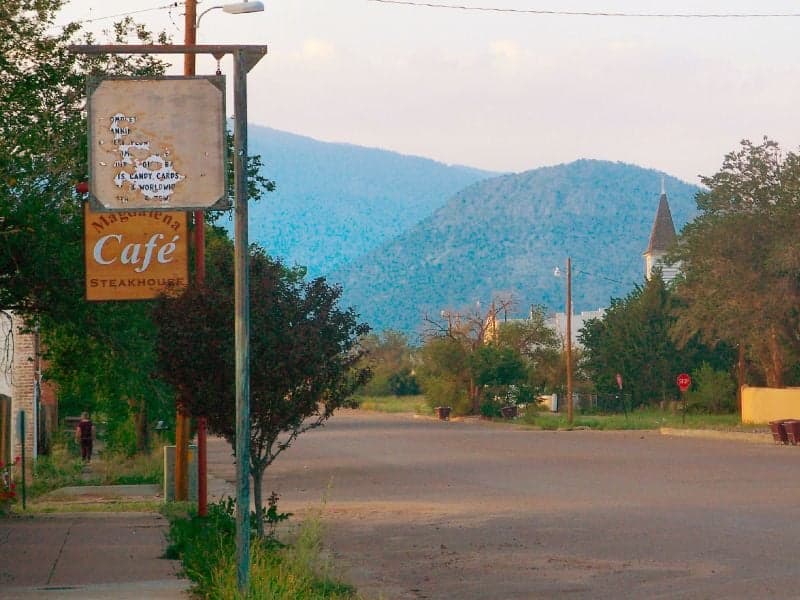
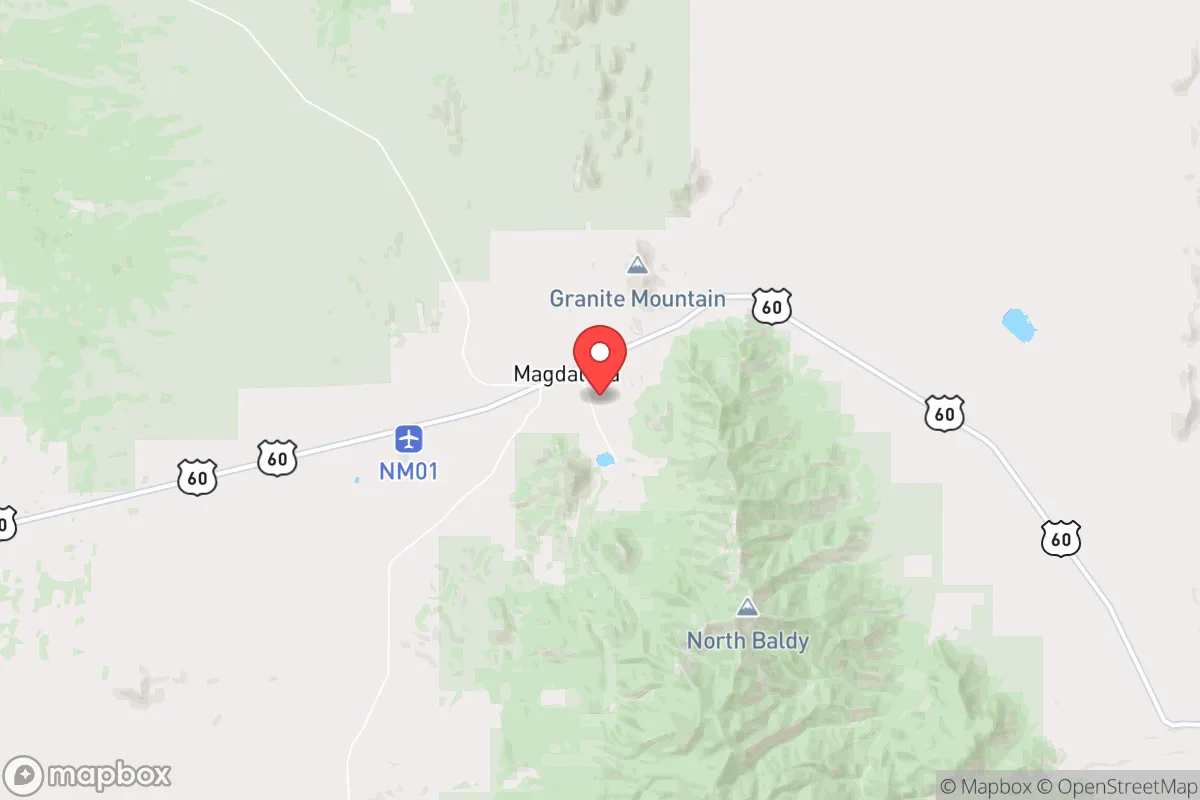
Photo: Wikipedia
Demographics of Magdalena, NM
Affluence Level in Magdalena, NM
A middle-class area roughly in line with national averages across income, home values, education, and employment.
People of Magdalena, NM
Magdalena, New Mexico, is a small, tight-knit village of 764 residents where Hispanic and White populations form the entirety of the community, with no foreign-born residents and a notably low college attainment rate of 14.4%. The population is overwhelmingly native-born, with a character shaped by generations of ranching, mining, and railroad families who have deep roots in the surrounding Socorro County landscape. Distinctive identity markers include a strong sense of local independence, a reliance on the village’s historic core for civic life, and a demographic stability that sets it apart from faster-growing parts of the state.
How the city was settled and grew
Magdalena’s human history begins not with Spanish colonization but with the arrival of the railroad in the 1880s, which transformed a remote ranching outpost into a bustling shipping hub for cattle, sheep, and ore from nearby mines. The original population was drawn by the Atchison, Topeka and Santa Fe Railway, which built a depot and stockyards that made Magdalena the “Cowboy Capital of New Mexico” by the early 1900s. The first wave of settlers—primarily Anglo-American ranchers and Hispanic families from surrounding land grant communities—established homes in what is now the Historic District along First and Second Streets, where many original adobe and frame buildings still stand. A second wave arrived during the mining booms of the 1910s and 1920s, when the Kelly Mine and other operations brought workers to the Kelly area just north of town, a neighborhood that once housed a mix of Anglo, Hispanic, and a small number of European immigrant miners. By the 1930s, the village’s population peaked near 4,000, but the decline of mining and the shift to trucking gradually reduced the town to its current size.
Modern era (post-1965)
After the 1965 Immigration and Nationality Act, Magdalena saw virtually no new foreign-born influx—the 2020 data shows a 0.0% foreign-born population—and the demographic story since then has been one of slow, natural change rather than immigration-driven diversification. The Hispanic share has grown from roughly 45% in 1970 to 56.3% today, driven by higher birth rates and the out-migration of some Anglo families seeking jobs in larger cities like Albuquerque or Socorro. The White population, now 43.7%, has aged in place, with many descendants of the original railroad and ranching families still living in the West End neighborhood, a quieter area of newer manufactured homes and older ranch-style houses west of the railroad tracks. The East Side, near the old school and community center, has become a predominantly Hispanic area where multigenerational households are common, reflecting the village’s enduring family-oriented character. No Black, Asian, or Indian subcontinent populations are recorded, making Magdalena one of the least ethnically diverse municipalities in New Mexico.
The future
Magdalena’s population is projected to remain stable or decline slightly over the next 10–20 years, as the village lacks the economic drivers—new industry, major employers, or commuter-friendly infrastructure—that attract newcomers. The Hispanic share is likely to continue its gradual increase, while the White population will shrink further as older residents pass away and younger adults leave for educational or employment opportunities elsewhere. New residential development is concentrated in the Mountain View Estates subdivision, a small cluster of lots on the village’s southern edge where a handful of retirees and remote workers have built homes since 2020, but this influx is too small to alter the overall demographic trajectory. The cultural identity remains firmly rooted in ranching and local traditions, with the annual Magdalena Days celebration and the historic Rodeo Grounds serving as anchors for community life. For someone moving in now, the village offers a stable, low-diversity environment where nearly everyone is native-born and where social networks are built on generations of shared history rather than new arrivals.
Magdalena is becoming a smaller, more Hispanic, and more insular community—a place where the population is aging and young people leave, but where those who stay value deep roots and a quiet, self-reliant way of life. For a relocating family or individual seeking a tight-knit, low-cost, and culturally homogeneous setting with strong ties to the land, Magdalena offers a rare continuity in a rapidly changing state.

* Values derived from national, state, county, city and local statistics and may differ in a specific area. Last updated: 2026-10-17T03:56:18.000Z
Narrative content on this page is AI-generated and may contain mistakes. Verify any details that matter before acting on them.
ReloMaps may earn a commission from affiliate links at no extra cost to you.

