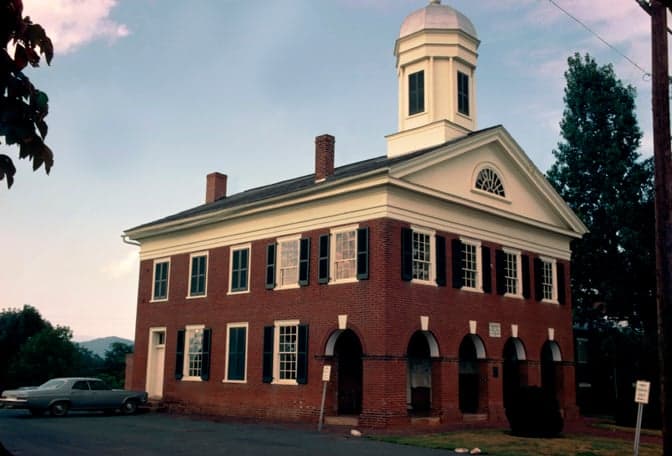
Photo: Wikipedia
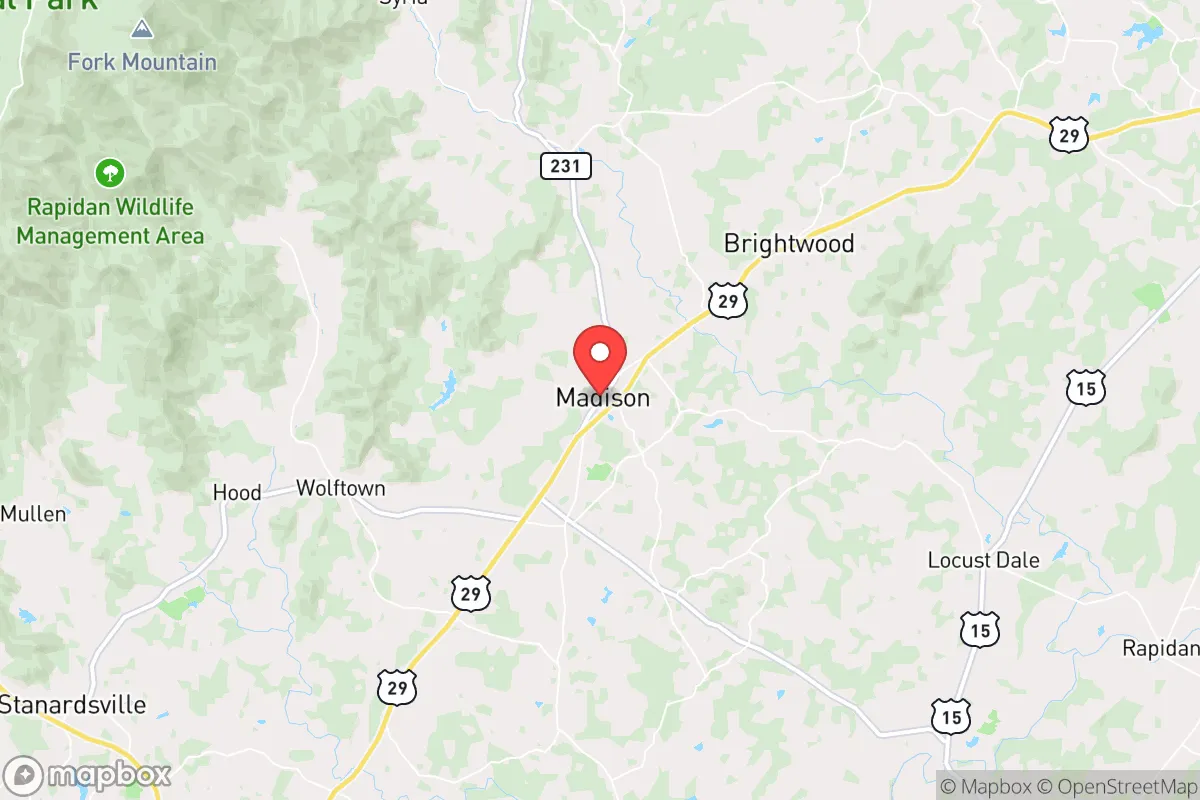
Personal Sovereignty in Madison, VA
Viable for self-reliance. Generally workable, though some barriers may limit total independence.
What does Personal Sovereignty tell us?
Personal Sovereignty measures your capacity for self-reliance and independence with minimal government friction. Higher scores mean fewer barriers between you and the way you want to live... but it assumes you have the space you need and good neighbors.
What does this tell us?
Personal Sovereignty measures your capacity for self-reliance and independence with minimal government friction. Higher scores mean fewer barriers between you and the way you want to live... but it assumes you have the space you need and good neighbors.
State Policy
Energy independence: Importer (32% of energy produced in-state)
Personal Liberty
Homesteading

Personal Liberty Analysis
Madison, Virginia offers a notably high degree of personal sovereignty, rooted in Virginia’s status as a Dillon’s Rule state but tempered by the county’s rural character, low population density, and limited local government footprint. For individuals and families who prioritize autonomy—whether in daily life, self-defense, or economic independence—Madison provides a permissive environment where formal restrictions are minimal and informal community norms often carry more weight than bureaucratic oversight. The trade-off is that residents must be self-reliant for many services and protections that more urbanized areas provide as a matter of course, but for those seeking to minimize external control, this is generally seen as a feature rather than a bug.
Tax burden and regulatory posture in Madison County
Madison County’s tax burden is moderate by Virginia standards, with a real property tax rate of approximately $0.56 per $100 of assessed value as of 2025—well below the state average and significantly lower than neighboring counties like Albemarle (home to Charlottesville) at roughly $0.85. Personal property taxes on vehicles and business equipment are also levied, but the county’s lack of a local income tax or meals tax keeps the overall burden manageable. The regulatory posture is light-touch: there is no county-wide zoning ordinance for agricultural and rural residential uses, meaning that on parcels of 20 acres or more, landowners can generally build, farm, or operate home-based businesses without seeking conditional use permits. The county does enforce building codes for new construction, but inspections are handled by a small, accessible department where direct communication with officials is the norm. For those who value minimal government interference in property use, Madison’s regulatory environment is among the most permissive in the Piedmont region.
Self-defense and gun law specifics in Madison
Virginia is a shall-issue state for concealed handgun permits, and Madison County’s circuit court processes applications with no additional local restrictions beyond state law. Open carry is legal without a permit for anyone 18 or older who may lawfully possess a firearm. The county has not adopted any local ordinances restricting firearms in public parks or government buildings beyond what state law mandates, and there are no “red flag” or extreme risk protection orders enacted at the county level (though the state’s 2020 ERPO law remains in effect statewide). Madison is also home to several private shooting ranges and gun clubs, and the rural landscape allows for safe recreational shooting on private property, provided it is done at least 100 yards from any occupied dwelling. For self-defense in the home, Virginia law provides a strong presumption of reasonableness for the use of deadly force against an intruder, and Madison’s sheriff’s office is known for a pro-Second Amendment stance, with deputies routinely issuing permits and providing guidance on compliance. The combination of permissive carry laws, minimal local restrictions, and a supportive law enforcement culture makes Madison a strong choice for those who prioritize firearm rights.
Self-reliance and homesteading viability in Madison County
Madison County’s rural zoning and land use policies are highly favorable to homesteading and self-reliant living. Parcels as small as 2-5 acres are common for residential use, and the county does not require a minimum lot size for agricultural activities on land zoned A-1 (Agricultural). Raising livestock, keeping bees, and growing food for personal consumption or limited sale are explicitly permitted without special permits, provided basic health and nuisance standards are met. Off-grid living is feasible: while the county requires connection to an approved water source (well or public supply) and a septic system for wastewater, there are no mandates for grid-tied electricity. Solar panels, wind turbines, and generator systems are common, and the county’s building department does not impose additional permitting for renewable energy installations beyond standard electrical work. Rainwater collection is unrestricted, and the county’s average annual rainfall of 40 inches makes it a viable primary water source for those willing to manage storage and filtration. The main constraint is that the county does not have a formal “off-grid” exemption for building codes, so new dwellings must meet Virginia’s Uniform Statewide Building Code, but this is generally not a barrier for those building conventional structures. For families seeking to reduce dependence on supply chains and utilities, Madison offers one of the most accommodating environments in central Virginia.
Personal liberties: parental rights, medical autonomy, speech, and property
Madison County’s school board has maintained a policy of parental transparency, with curriculum materials available for review and a formal opt-out process for sex education and certain health modules. The county has not adopted any local mask or vaccine mandates for schools, and the sheriff’s office has publicly stated it will not enforce state-level public health orders that conflict with constitutional rights—a stance that has drawn both support and criticism but reflects the local emphasis on individual choice. Medical autonomy is generally respected: there are no county-level restrictions on alternative or complementary medicine, and the nearest major hospital (UVA Health in Charlottesville) is 30 minutes away, so residents often rely on telemedicine and local practitioners for routine care. Freedom of speech and assembly are protected under standard First Amendment jurisprudence, and the county’s small population means that public meetings and board of supervisors sessions are intimate affairs where citizens can directly address officials. Property rights are robust: the county’s comprehensive plan explicitly supports “the right of private property owners to use their land as they see fit, subject only to reasonable regulation,” and eminent domain actions are rare and politically contentious. For those who value the ability to make decisions for their family without government interference, Madison’s local culture and policies align closely with a high-sovereignty lifestyle.
Overall, Madison, Virginia offers a level of personal sovereignty that is notably higher than in the state’s urban crescent (Northern Virginia, Richmond, Hampton Roads) and competitive with the most freedom-oriented rural counties in the Southeast. The combination of low taxes, minimal zoning, permissive gun laws, and a culture of self-reliance creates an environment where individuals and families can largely chart their own course. The trade-offs—limited public services, longer travel times for specialized healthcare, and a slower pace of life—are inherent to the rural setting, but for those who prioritize autonomy over convenience, Madison represents a strong, stable choice in a state where regulatory pressures are increasing elsewhere.

* Values derived from national, state, county, city and local statistics and may differ in a specific area. Last updated: 2026-11-23T12:57:01.000Z
Narrative content on this page is AI-generated and may contain mistakes. Verify any details that matter before acting on them.
ReloMaps may earn a commission from affiliate links at no extra cost to you.

