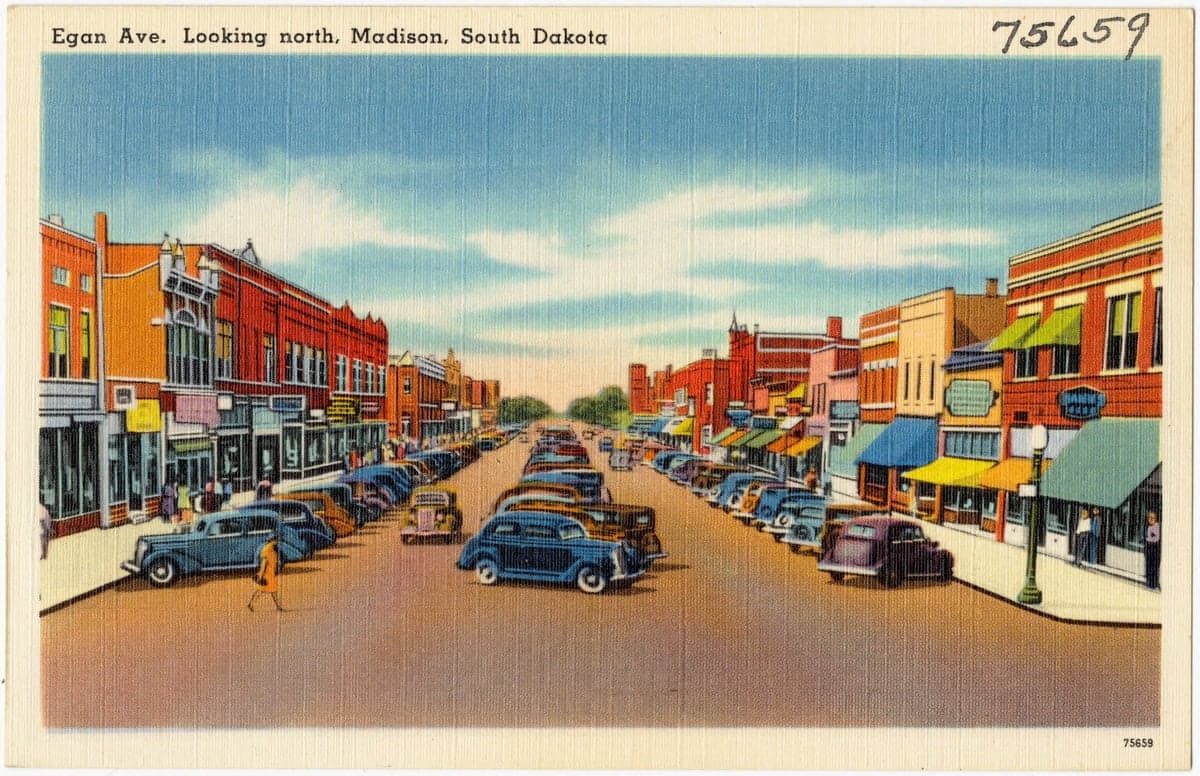
Photo: Wikipedia
Political ClimatePolitical Climate in Madison, SD
District shown is the primary district for this city’s centroid. Cities may span multiple districts.
Inherited from parent state — no local data available.
Local Political AnalysisPolitical Analysis of Madison, SD
Madison, South Dakota, is about as solidly conservative as it gets, with a Cook PVI of R+15 that tells you everything you need to know about the political lean of the area. For generations, this has been a place where folks value personal responsibility, limited government, and the freedom to live life without a bunch of bureaucratic red tape. The local culture is deeply rooted in agriculture, small business, and a strong sense of community, and that’s reflected in how people vote—overwhelmingly Republican, with a healthy skepticism of any politician who talks too much about expanding government programs. While you’ll find a few more moderate voices in town, especially among newer residents or those working at Dakota State University, the overall trajectory here has been steady and conservative, with no real signs of a major shift leftward.
How it compares
Compared to the rest of Lake County, Madison is the political anchor, but drive just 20 minutes north to Brookings and you’ll feel a noticeable difference. Brookings, home to South Dakota State University, leans more moderate and has a younger, more transient population that occasionally votes for Democrats in local races. It’s a stark contrast—Madison feels like the kind of place where people wave from their pickup trucks and know their neighbors, while Brookings has a bit more of that college-town, “let’s try something new” energy. Head west to Sioux Falls, and you’ll see a similar dynamic: a bigger city with more diversity of thought, but still nowhere near as progressive as Minneapolis or Sioux City. For a long-time resident, the difference is clear: Madison is a refuge from the kind of government overreach you see in larger cities, where mask mandates, zoning overhauls, and tax hikes seem to pop up every election cycle.
What this means for residents
For the people who live here, the political climate means a lot of practical freedom. You’re not going to get a knock on the door from a code enforcement officer for having a slightly overgrown lawn, and the local school board isn’t pushing critical race theory or gender ideology into the curriculum. Property taxes are low, and the state’s lack of an income tax means you keep more of what you earn. That said, there’s a growing concern among longtime residents about the encroachment of federal mandates and the slow creep of progressive policies from the coasts. The recent push for electric vehicle mandates and ESG investing in state pension funds has raised eyebrows, and there’s a quiet worry that if Madison grows too fast, it might attract the kind of people who want to “fix” things that aren’t broken. For now, though, the local government remains hands-off, and the community is fiercely protective of its Second Amendment rights and property freedoms.
One thing that sets Madison apart culturally is its strong sense of self-reliance. You won’t find a lot of people here looking to the government for solutions—they’d rather handle things themselves, whether it’s starting a small business, organizing a community event, or dealing with a tough winter. The local churches and civic groups are the real backbone of the town, not any political party. If you’re thinking about moving here, just know that the political climate is a feature, not a bug: it’s a place where you can live your life without a lot of interference, and where the biggest political debate is usually about how much to spend on the new fire truck. That’s the kind of stability that’s getting harder to find, and it’s worth holding onto.

State Political ClimatePolitical Climate in South Dakota
State Political AnalysisPolitical Environment in the State
South Dakota is a deeply red state, with a Republican lean that has only intensified over the past two decades. The state hasn't voted for a Democratic presidential candidate since 1964, and in 2024, Donald Trump carried it by over 30 points. The dominant political coalition is a mix of rural conservatives, libertarian-leaning ranchers, and a growing number of out-of-state transplants fleeing blue states. The trajectory over the last 10-20 years has been a steady march rightward, with the state legislature passing some of the most aggressive pro-freedom legislation in the country, particularly on gun rights, school choice, and tax cuts. However, there are subtle undercurrents—especially in the Black Hills and the eastern corridor—that a new resident should watch.
Urban vs. rural divide
The political map is stark. The vast, sparsely populated western half of the state—places like Rapid City and the ranching counties around Sturgis and Spearfish—is reliably deep red, often voting 70-80% Republican. The eastern side is more nuanced. Sioux Falls, the state's largest city and economic engine, is a conservative stronghold but with a growing libertarian and even moderate Republican wing, driven by a booming tech and healthcare sector. Minnehaha County (Sioux Falls) still votes red, but the margins have tightened slightly as the city attracts younger professionals. The real outlier is Brookings, home to South Dakota State University, which has a noticeable progressive student and faculty presence, though it's still a Republican-leaning county overall. The rural counties in between—like Hutchinson and Turner—are rock-ribbed conservative, with little to no Democratic infrastructure. The divide isn't really urban vs. rural in the national sense; it's more about the intensity of the conservatism. The western ranching counties are libertarian-conservative, while the eastern farming counties are more traditional social conservatives.
Policy environment
South Dakota's policy environment is a dream for a conservative moving in. There is no state income tax, no corporate income tax, and no personal property tax on vehicles or business equipment. The sales tax is 4.5%, and local options can push it to 6.5% in places like Sioux Falls. The regulatory posture is aggressively pro-business—permitting for a new home or business is often measured in weeks, not months. On education, the state passed a universal school choice program in 2024, allowing any family to use state funds for private or homeschool expenses. Healthcare is a mixed bag: the state did expand Medicaid under Trump-era waivers, but the system is still largely free-market, with a high number of direct-pay clinics and a strong telehealth network. Election laws are among the most secure in the nation—voter ID is required, same-day registration is not allowed, and the state uses paper ballots. There is no mail-in voting unless you have a valid excuse. The legislature also passed a law in 2023 banning ranked-choice voting statewide, a preemptive strike against progressive electoral reforms.
Trajectory & freedom
South Dakota is becoming more free, not less, and that's a big reason people are moving here. In 2023, Governor Kristi Noem signed a package of bills that eliminated the state's permit requirement for concealed carry (constitutional carry), banned any future vaccine mandates by private employers, and prohibited the enforcement of any federal gun laws that don't exist in state statute. The state also passed a "Parents' Bill of Rights" in 2022, giving parents explicit authority over their children's medical decisions, curriculum access, and library materials. On medical autonomy, South Dakota was one of the first states to ban COVID-19 vaccine passports and to prohibit mask mandates in schools. Property rights were strengthened with a 2024 law that limits the use of eminent domain for carbon pipeline projects—a direct response to the controversial Summit Carbon Solutions pipeline. The only area where freedom has been curtailed is on abortion: the state has a near-total ban, with exceptions only for the life of the mother. That's a bright line that won't change anytime soon.
Civil unrest & political movements
South Dakota is remarkably stable. There have been no major protests or civil unrest in the last decade, outside of a few small, isolated demonstrations in Sioux Falls and Rapid City during the 2020 BLM summer, which fizzled quickly. The most visible political movement is the Wetlands Rebellion—a grassroots, property-rights movement of farmers and ranchers fighting federal overreach on wetland designations. It's not a left-right issue; it's a local vs. federal issue. Immigration politics are a non-factor here; the state has a tiny foreign-born population, and there are no sanctuary policies. There was a brief flashpoint in 2022 when the state legislature considered a bill to nullify federal gun laws, but it was watered down to a resolution. The biggest ongoing controversy is the Carbon Pipeline fight, which has pitted libertarian-leaning ranchers against the state government and corporate interests. It's a classic South Dakota political battle: property rights vs. economic development. A new resident will notice that most people are armed, polite, and deeply skeptical of any government—local, state, or federal—that tries to tell them what to do.
Projection
Over the next 5-10 years, South Dakota will likely become even more conservative, but with a libertarian flavor. The in-migration is heavily from California, Illinois, and Minnesota—people who are fleeing high taxes and overreach but who also bring some cultural baggage. They tend to be pro-gun, pro-school choice, and anti-tax, but they are less socially conservative on issues like marijuana (the state has a medical program but no recreational) and land use. The demographic shift is real: Sioux Falls is growing at 2-3% annually, and Rapid City is seeing a boom from remote workers. This will likely push the state toward more economic freedom but could soften the hard edge on social issues. The state GOP is currently dominated by the "Freedom Caucus" wing, which is more libertarian than traditional. Expect more school choice expansion, further tax cuts, and a continued push to nullify federal authority on guns and environmental regulations. The only wild card is the Native American vote, which is about 8% of the population and reliably Democratic, but it's concentrated on reservations and has low turnout. A new resident moving in now should expect to find a state that is aggressively protecting individual liberty, but with a growing tension between the old-school social conservatives and the new-wave libertarian transplants.
Bottom line for a new resident: If you value low taxes, minimal government, and the ability to live your life without interference, South Dakota is one of the best bets in the country. You'll find a state that is actively expanding freedom, not retreating from it. The political climate is stable, the people are armed and polite, and the trajectory is firmly conservative. Just be prepared for cold winters and a state government that is more interested in protecting your rights than in managing your life.
* Values derived from national, state, county, city and local statistics and may differ in a specific area. Last updated: 2026-04-30T02:04:53.000Z
Narrative content on this page is AI-generated and may contain mistakes. Verify any details that matter before acting on them.
ReloMaps may earn a commission from affiliate links at no extra cost to you.

