
Photo: Wikipedia
Demographics of Tangipahoa County
Affluence Level in Tangipahoa County
A below-average socioeconomic profile. Incomes, home values, and educational attainment trail the U.S., with higher poverty and unemployment.
People of Tangipahoa County
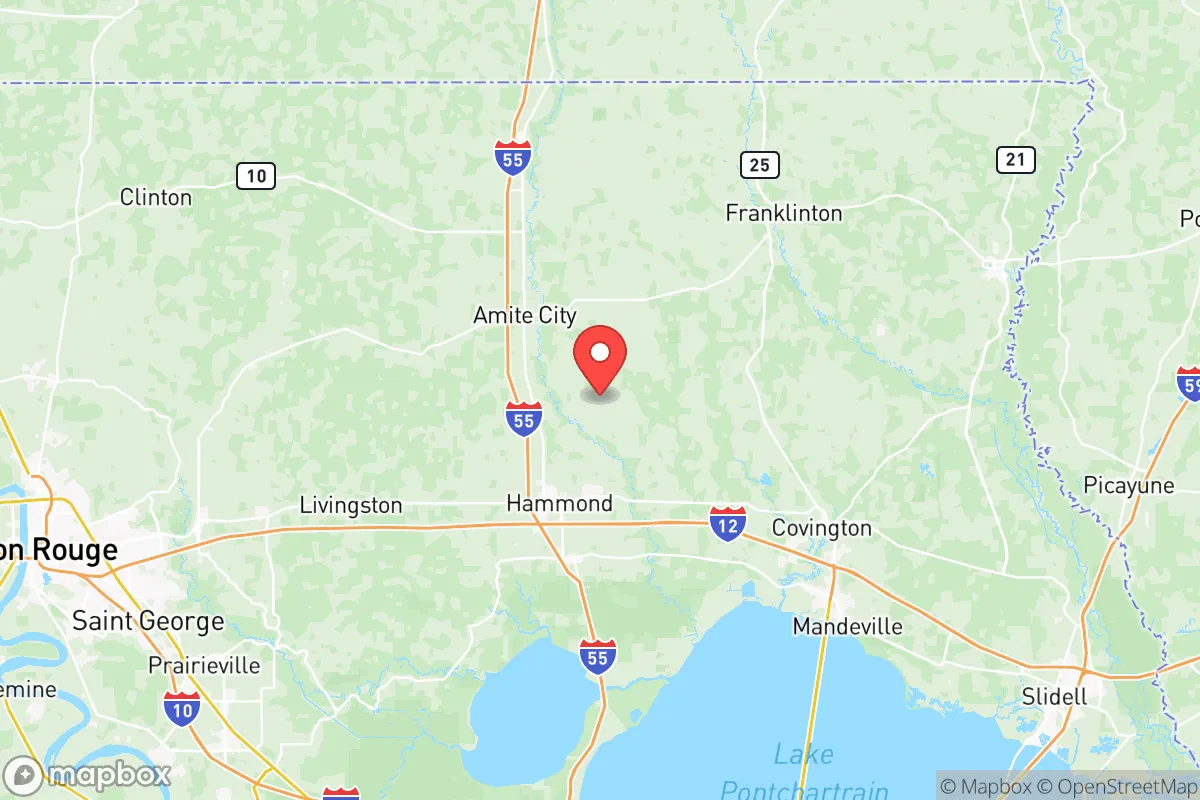
Tangipahoa County today is a predominantly rural and small-town parish of 135,218 residents, where 60.9% of the population identifies as White and 29.6% as Black, with a small but growing Hispanic community at 5.6%. The county's identity is rooted in its history as part of the Florida Parishes, with a strong sense of local heritage and a slower pace of life. Only 1.6% of residents are foreign-born, and 22.2% hold a college degree, reflecting a population that values practical skills and community ties over urban cosmopolitanism. The county's character is defined by its agricultural past, its railroad towns, and its position along the I-12 corridor between Baton Rouge and New Orleans.
Settlement & growth (pre-1960)
Long before European contact, the region was home to the Tangipahoa Native American tribe, a Muskogean-speaking people whose name means "those who gather corn" or "corncob people." They lived along the Tangipahoa River and its tributaries, leaving behind burial mounds and shell middens. French and Spanish explorers passed through the area in the 17th and 18th centuries, but the region remained sparsely populated under Spanish control as part of West Florida. The first permanent European-descended settlers arrived after the West Florida Rebellion of 1810, when the area was annexed by the United States. These early American settlers were primarily of Scots-Irish and English stock, moving south from the Carolinas and Georgia. They established small farms and trading posts in what would become Amite City, Ponchatoula, and Hammond, clearing land for cotton and timber.
The arrival of the Illinois Central Railroad in the 1850s transformed the county. The railroad connected the region to New Orleans and Chicago, making it a hub for timber and agricultural products. After the Civil War, freed African Americans remained in the area, working as sharecroppers and laborers on cotton and strawberry farms. They concentrated in communities such as Kentwood, Roseland, and Tickfaw, where they built churches, schools, and mutual aid societies. The strawberry boom of the late 19th and early 20th centuries brought a new wave of immigrants: Italians, primarily from Sicily and southern Italy, who arrived between 1880 and 1920. They settled in Independence, Hammond, and Ponchatoula, where they established strawberry farms and truck gardens. The Italian community in Independence remains one of the most distinctive ethnic enclaves in Louisiana, with the annual Italian Festival celebrating that heritage. A smaller number of German and Irish immigrants also arrived during this period, working as merchants and craftsmen in the growing railroad towns.
By

* Values derived from national, state, county, city and local statistics and may differ in a specific area. Last updated: 2026-09-29T18:28:21.000Z
Narrative content on this page is AI-generated and may contain mistakes. Verify any details that matter before acting on them.
ReloMaps may earn a commission from affiliate links at no extra cost to you.

