
Photo: Wikipedia
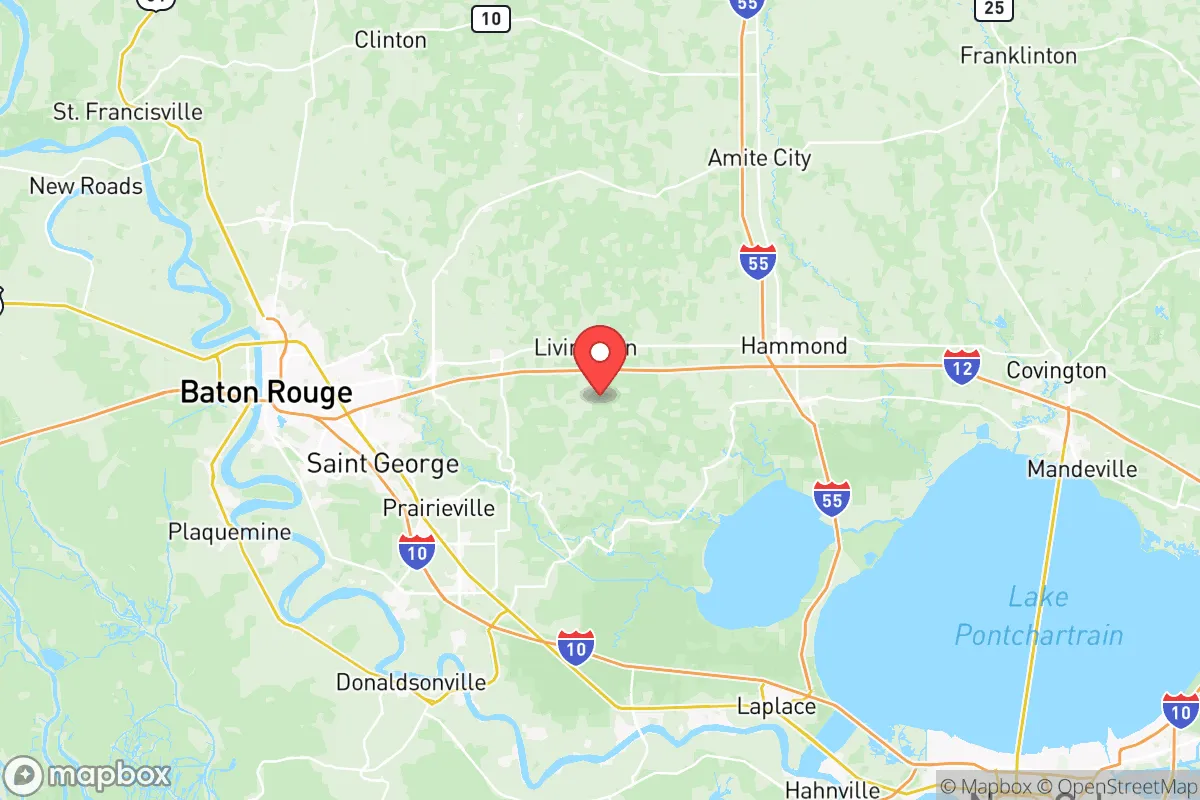
Personal Sovereignty in Livingston County
Strong independent fundamentals that actively favor personal liberty and low regulation.
What does Personal Sovereignty tell us?
Personal Sovereignty measures your capacity for self-reliance and independence with minimal government friction. Higher scores mean fewer barriers between you and the way you want to live... but it assumes you have the space you need and good neighbors.
What does this tell us?
Personal Sovereignty measures your capacity for self-reliance and independence with minimal government friction. Higher scores mean fewer barriers between you and the way you want to live... but it assumes you have the space you need and good neighbors.
State Policy
Energy independence: Net exporter (280% of energy produced in-state)
Personal Liberty
Homesteading

Personal Liberty Analysis
Livingston Parish, Louisiana, offers a notably high degree of personal sovereignty compared to much of the suburban South, with a local government culture that leans heavily toward minimal interference in daily life. The parish’s regulatory posture is distinctly hands-off, particularly in unincorporated areas like Walker, Holden, and the rural stretches around Springfield, where property rights and personal choices are broadly respected. This environment appeals strongly to individuals and families who prioritize autonomy over convenience, as the trade-off for fewer rules is often less government-provided infrastructure and services.
Tax burden and regulatory posture: how light is the touch?
Livingston Parish is one of the most tax-friendly areas in Louisiana, itself a low-tax state. The parish levies a combined sales tax rate of approximately 9.45% (state plus local), but there is no parish-wide property tax for general operations, and homestead exemptions are generous. The regulatory environment is characterized by minimal zoning in unincorporated areas; for example, rural tracts near French Settlement and Killian often have no formal zoning ordinances, allowing property owners to use land for agriculture, small-scale commerce, or residential purposes with few bureaucratic hurdles. Building permits are required for new construction, but enforcement is generally described as practical rather than punitive. This light-touch approach extends to business licensing, which is straightforward and inexpensive, making the parish attractive for entrepreneurs and tradespeople who want to operate without excessive red tape.
Self-defense and gun law specifics: what can you legally do?
Louisiana is a "shall-issue" state for concealed carry permits, and Livingston Parish is among the most gun-friendly jurisdictions in the state. The parish sheriff's office processes permits efficiently, and there is strong local support for the constitutional carry law (Act 35) enacted in 2024, which allows permitless carry for anyone 18 or older who can legally possess a firearm. Open carry is legal without a permit. The parish has no additional local firearm restrictions beyond state law, and Denham Springs and Walker have explicitly affirmed Second Amendment sanctuary resolutions. Stand-your-ground and castle doctrine laws are fully in effect, providing broad legal protection for self-defense in the home, vehicle, or any place where a person has a right to be. Gun ranges and firearms retailers are common, and the culture strongly supports responsible gun ownership as a personal right and practical necessity.
Self-reliance and homesteading viability: lot sizes, zoning, and off-grid feasibility
Livingston Parish is one of the best areas in the Baton Rouge region for homesteading and self-reliant living. Unincorporated areas have no minimum lot size requirements in many zones, and parcels as small as one acre can support a garden, chickens, and a small orchard. In rural Holden and the northern reaches near the Tickfaw River, five- to ten-acre tracts are common and affordable, often with existing wells and septic systems. Off-grid living is legally feasible: rainwater collection is unrestricted, solar panels require no special permits beyond standard electrical work, and composting toilets are allowed under state health regulations if properly installed. The parish does not enforce restrictive covenants on agricultural animals in unincorporated areas, so goats, pigs, and even small livestock are common. The main constraint is proximity to Baton Rouge commuter zones; properties closer to Denham Springs and Watson tend to have more subdivision-style restrictions, while deeper rural areas offer near-total freedom.
Personal liberties: parental rights, medical autonomy, speech, and property
Livingston Parish has a strong reputation for protecting parental rights in education and healthcare decisions. The school board has consistently resisted federal overreach, and local parents have significant influence over curriculum and policies. Medical autonomy is generally respected, with no local mandates for vaccines or medical procedures beyond state requirements. Free speech is robustly protected, and the parish has no local ordinances restricting political or religious expression on private property. Property rights are treated as paramount: there are no county-wide rental restrictions, short-term rental bans, or overly burdensome land-use regulations. In Port Vincent and Killian, for example, property owners can build, fence, and use their land with minimal interference. The legal climate strongly favors the landowner in disputes, and the local courts are known for upholding traditional property rights.
Overall, Livingston Parish ranks among the most sovereignty-friendly areas in Louisiana for those who value personal independence over government-provided amenities. The combination of low taxes, minimal zoning, strong gun rights, and a culture of self-reliance creates an environment where individuals and families can live largely on their own terms. Compared to the more regulated environments of East Baton Rouge Parish or Orleans Parish, Livingston offers a distinctly lighter regulatory touch, making it a top choice for conservative-leaning relocators seeking genuine personal freedom without sacrificing proximity to a major metropolitan area.

* Values derived from national, state, county, city and local statistics and may differ in a specific area. Last updated: 2026-08-08T17:10:30.000Z
Narrative content on this page is AI-generated and may contain mistakes. Verify any details that matter before acting on them.
ReloMaps may earn a commission from affiliate links at no extra cost to you.

