Photo: Wikipedia
Political ClimatePolitical Climate in Jefferson Davis County
Showing district-level results — no local-only data available.
Local Political AnalysisPolitical Analysis of Jefferson Davis County
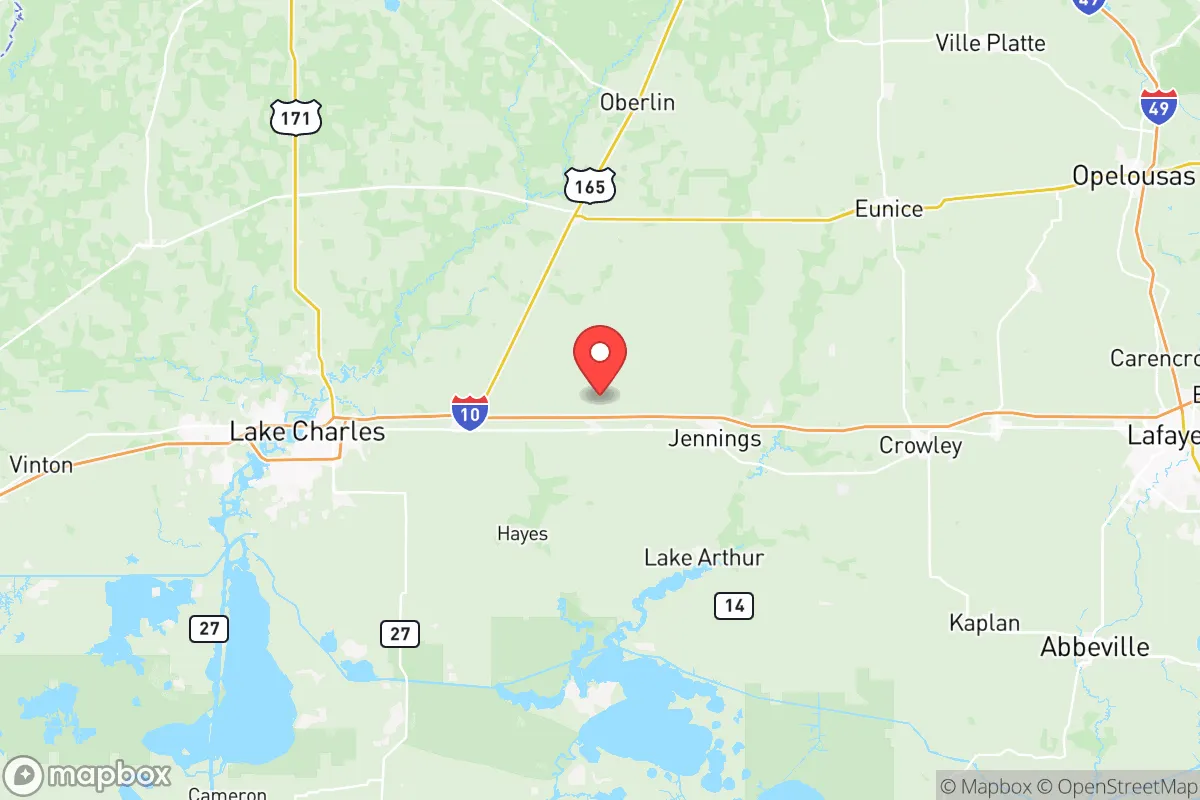
Jefferson Davis County is a deeply conservative corner of Louisiana, anchored by a Cook Partisan Voting Index of R+22 that makes it one of the most reliably Republican parishes in the state. The county has shifted rightward over the past decade, following a broader trend across rural Louisiana, but its political identity has always been rooted in traditional values, agriculture, and a strong sense of local autonomy. The county seat, Jennings, is the political and cultural hub, and it leans heavily red, while smaller communities like Welsh and Lake Arthur show even more pronounced Republican margins. The only real pockets of blue are in the precincts around Jennings' historic downtown, where a mix of public-sector workers and younger professionals occasionally vote Democratic, but these are small and shrinking.
How it compares
Compared to Louisiana as a whole, Jefferson Davis County is significantly more conservative. The state's Cook PVI is unknown, but statewide elections in Louisiana have been competitive in recent cycles—John Bel Edwards won the governor's mansion as a Democrat in 2015 and 2019, while Donald Trump carried the state by 19 points in 2020. Jefferson Davis County, by contrast, gave Trump over 75% of the vote in 2020, and local races for sheriff, school board, and parish council are almost always decided in the Republican primary. The county's R+22 rating puts it in the same league as neighboring Acadia and Vermilion parishes, but it's notably redder than more urbanized areas like Lafayette Parish (R+11) or the New Orleans metro area (D+18). The political divide here isn't between red and blue—it's between shades of red, with the most conservative voters concentrated in the rural farming communities west of Jennings, and slightly more moderate Republicans in the town itself.
What this means for residents
For conservative residents, Jefferson Davis County offers a political environment where their values are reflected in local policy, from low taxes to limited regulation. The county commission and school board are dominated by Republicans, and issues like gun rights, energy development, and religious freedom are rarely contested. For liberal residents, the reality is more isolating. There is no organized Democratic Party presence in the parish, and progressive candidates rarely appear on the ballot. Socially, it can be difficult to find like-minded neighbors, though the Jennings area has a small but active group of moderates who focus on local issues like infrastructure and education rather than national politics. The county's political homogeneity means that elections are often decided in the primary, and general elections are largely ceremonial—a fact that can feel disenfranchising for the minority of Democratic voters.
Culturally, Jefferson Davis County's politics are intertwined with its Cajun and Creole heritage, though this influence is waning as the population ages and younger residents move to cities like Lafayette or Baton Rouge. The county's strong Republican lean is also reflected in its policy priorities: the parish government has consistently opposed new state-level environmental regulations on oil and gas, and local schools emphasize vocational training over college prep. There's a palpable sense of pride in the area's independence, but also a quiet acknowledgment that the county's political isolation can make it feel out of step with the rest of the state. For anyone moving here, understanding that the political climate is not just conservative but overwhelmingly so—and that it shapes everything from tax policy to social norms—is essential to fitting in.

State Political ClimatePolitical Climate in Louisiana
State Political AnalysisPolitical Environment in the State
Louisiana has been a reliably Republican state in presidential elections for over two decades, but it retains a uniquely complex political character that defies simple red-state labels. The state voted for Donald Trump by about 19 points in 2020 and 16 points in 2024, yet it simultaneously elects Democrats to statewide office and maintains some of the most robust civil law traditions in the country. Over the last 10-20 years, the trajectory has been a slow but steady rightward shift, driven by the exodus of moderate white Democrats from the party and the growing influence of the state's conservative, often evangelical, base. However, the state's political culture remains deeply personal, patronage-driven, and less ideologically rigid than many of its Deep South neighbors.
Urban vs. rural divide
The political map of Louisiana is a stark study in contrasts. The two major urban centers, New Orleans and Baton Rouge, are Democratic strongholds, with New Orleans consistently delivering 80%+ of its vote to Democratic presidential candidates. Baton Rouge, while more moderate, still leans heavily blue, driven by its large African American population and the state university's influence. The state's third-largest city, Shreveport, in the northwest, is also a Democratic bastion, though its surrounding Caddo Parish is more competitive. The rest of the state is overwhelmingly Republican. The suburban ring around New Orleans, particularly Jefferson Parish and St. Tammany Parish (home to the North Shore suburbs like Covington and Mandeville), are some of the most reliably Republican areas in the country. The rural Acadiana region, including Lafayette and Lake Charles, is also deeply conservative, though with a distinct Cajun cultural flavor that can sometimes buck national party lines. The Mississippi River parishes, like Plaquemines and St. Bernard, have flipped from solidly Democratic to solidly Republican over the past two decades, mirroring the national realignment of white working-class voters.
Policy environment
Louisiana's policy environment is a mix of low-tax conservatism and a heavy-handed, often inefficient, state bureaucracy. The state has no personal income tax on Social Security benefits and a relatively low flat income tax rate of 4.25% (as of 2025), but it makes up for it with some of the highest combined state and local sales tax rates in the nation, often exceeding 10% in many parishes. Property taxes are among the lowest in the country, thanks to the homestead exemption, which is a major draw for homeowners. The regulatory posture is generally business-friendly, particularly for the oil and gas industry, which dominates the state's economy. Education policy is a perennial battleground; the state has a robust school voucher program and a growing charter school sector, especially in New Orleans, which has one of the most market-based public school systems in the country. Healthcare is a mixed bag: the state expanded Medicaid under the Affordable Care Act, a move that was championed by then-Governor John Bel Edwards (a Democrat), but the state consistently ranks near the bottom in health outcomes. Election laws are relatively straightforward, with no-excuse absentee voting and early voting, though the state has a history of election administration controversies, particularly in the New Orleans area.
Recent policy direction
The last few years have seen Louisiana move decisively in a conservative direction on a broad range of issues. In 2024, the state passed a near-total abortion ban, with very limited exceptions, aligning with the post-Dobbs landscape. On gun rights, Louisiana is a "constitutional carry" state, meaning no permit is required to carry a concealed firearm, and it has strong Stand Your Ground laws. The state has also been a leader in parental rights in education, passing laws that require schools to notify parents of any changes to a student's mental or physical health and banning discussion of sexual orientation and gender identity in public schools (the "Don't Say Gay" bill). On the privacy front, the state has a relatively weak data privacy law, but it has been active in restricting surveillance by local governments, particularly in the wake of Hurricane Katrina. Property rights are generally strong, though the state's unique "code Napoleon" civil law system can create complications for property titles and inheritance. On taxation, the trend has been toward further cuts, with the state legislature passing a series of income tax rate reductions in 2024 and 2025. Voting access remains a point of contention; while early voting is popular, the state has tightened voter ID requirements and has been a battleground over redistricting, with a federal court ordering the creation of a second majority-Black congressional district in 2024.
Civil unrest & political movements
Louisiana has a long and fraught history of civil unrest, from the 1811 German Coast slave revolt to the 1973 police strike in New Orleans. In recent years, the most visible flashpoints have been around police brutality and racial justice, particularly in New Orleans and Baton Rouge. The 2016 shooting of Alton Sterling in Baton Rouge sparked large protests and a subsequent ambush that killed three police officers. The Black Lives Matter movement has a strong presence in the state's urban centers, while the conservative side is dominated by the Louisiana Family Forum, a powerful evangelical lobbying group, and the state's chapter of the NRA. Immigration politics are less heated than in border states, but there is a growing tension in the southwestern part of the state, where the oil and gas industry relies heavily on immigrant labor. There is no sanctuary city policy in Louisiana; in fact, the state passed a law in 2024 requiring local law enforcement to cooperate with federal immigration authorities. Secessionist rhetoric is virtually nonexistent, but there is a strong strain of "nullification" sentiment, particularly around federal environmental regulations that impact the oil and gas industry. Election integrity controversies have been relatively muted compared to other states, though the 2020 election saw some localized disputes in St. Tammany Parish.
Projection
Over the next 5-10 years, Louisiana is likely to become even more Republican, but with a growing internal tension between the business-friendly, pro-growth wing of the party and the more populist, culturally conservative wing. The state's population is aging and slowly declining, with young people leaving for Texas and other Sun Belt states. The in-migration that does occur is largely from other conservative states, which will reinforce the rightward trend. The Democratic Party's base will remain strong in New Orleans and Baton Rouge, but it will become increasingly reliant on African American voters and a shrinking number of white liberals. The biggest wildcard is the impact of climate change and coastal erosion, which could reshape the state's economy and demographics in unpredictable ways. A new resident moving in now should expect to find a state that is culturally conservative, low-tax, and business-friendly, but also one that is grappling with deep structural challenges: a fragile coastline, a struggling public education system, and a health care system that is underfunded and overburdened.
For a new resident, the bottom line is this: Louisiana offers a genuinely low cost of living, a unique and vibrant culture, and a political environment that is broadly friendly to conservative values, particularly on taxes, guns, and education. However, it is not a libertarian paradise; the state government is deeply involved in people's lives, from the state-run alcohol control board to the powerful insurance commissioner. Liberal residents will find a welcoming community in New Orleans and Baton Rouge, but they will be swimming against a strong statewide current. The state's politics are personal, not ideological, and a newcomer's experience will depend more on their parish and their neighbors than on any statewide label. If you value low taxes, strong gun rights, and a hands-off approach to property, you'll feel at home. If you're looking for a place with robust public services, a strong social safety net, or a progressive cultural environment outside of the cities, you may find Louisiana a frustrating place to live.
* Values derived from national, state, county, city and local statistics and may differ in a specific area. Last updated: 2026-07-18T19:46:25.000Z
Narrative content on this page is AI-generated and may contain mistakes. Verify any details that matter before acting on them.
ReloMaps may earn a commission from affiliate links at no extra cost to you.

