
Photo: Wikipedia
Strategic Assessment of Beauregard County
Workable tactical position. Some exposure to population density or targets, but generally defensible in a crisis.
What does the Strategic Assessment tell us?
Our Strategic Assessment grades tactical survivability of an area. Major population centers, military targets, fallout zones, natural disasters, and border exposure all drive risk — lower exposure means a more defensible position in a crisis.
This is heavily inspired by Joel Skousen's Strategic Relocation book. Highly recommended you checkout the book ($)What does this tell us?
Our Strategic Assessment grades tactical survivability of an area. Major population centers, military targets, fallout zones, natural disasters, and border exposure all drive risk — lower exposure means a more defensible position in a crisis.
This is heavily inspired by Joel Skousen's Strategic Relocation book. Highly recommended you checkout the book ($)Strategic Pillars

Key Distances
Strategic Assessment Analysis
Beauregard Parish, Louisiana, offers a strategic mix of geographic isolation and practical resource access that appeals to relocation-minded readers focused on resilience and self-sufficiency. Located in the southwestern corner of the state, the parish sits roughly 60 miles north of the Louisiana Gulf Coast and about 90 miles east of the Texas border, placing it outside the immediate blast or fallout zones of Houston's petrochemical corridor, the Port of Lake Charles, and the major military installations in the region. Its low population density—approximately 38,000 residents spread over 1,160 square miles—means fewer people competing for resources in a crisis, while the parish's timber-rich pine forests and rolling hills provide natural cover and defensibility that open farmland in the Delta does not. For a single individual or family weighing long-term preparedness, Beauregard Parish stands out as a quiet, overlooked pocket with a solid baseline for weathering both natural disasters and larger societal disruptions.
Geographic position and natural advantages: What makes Beauregard Parish a strategic location
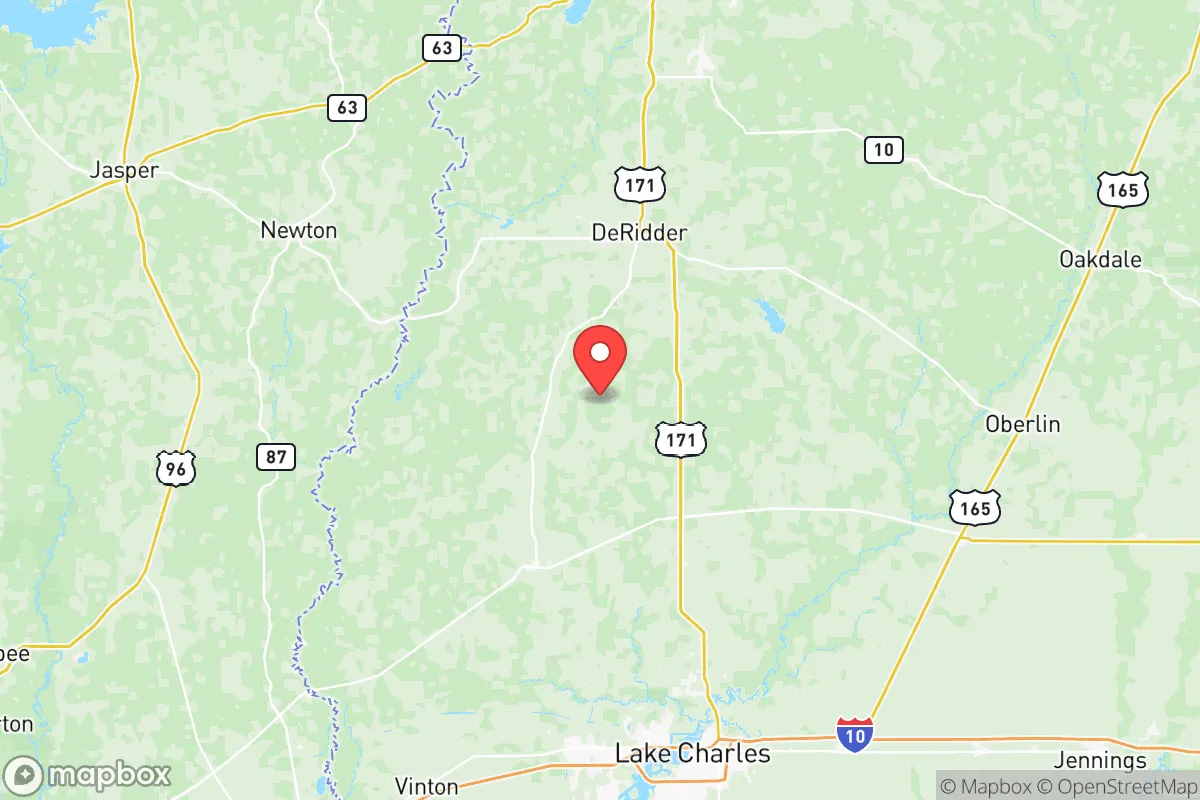
Beauregard Parish sits in the heart of a region often called "No Man's Land" by local preppers—a term that speaks to its separation from major population centers and high-value targets. The parish seat, DeRidder, is roughly 40 miles north of the heavily industrialized Lake Charles area, home to the Citgo refinery and Port of Lake Charles, a major LNG export hub that could be a secondary fallout or disruption point in a conflict or accident. To the east, Alexandria lies about 70 miles, with its England Airpark (former Air Force base) and regional transportation nodes. To the west, the Texas border brings you within 100 miles of the Beaumont-Port Arthur refinery complex, one of the largest in the nation. While none of these are within a lethal blast radius from a modern nuclear weapon, they are close enough that fallout drift patterns—particularly with prevailing winds from the south and southwest—could theoretically impact the parish's eastern and northern fringes. However, the parish's interior is heavily forested with mixed pine and hardwood, offering some natural shielding against airborne particulates and providing ample cover for movement and concealment. The terrain is gently rolling, not flat, which aids both water drainage and defensibility; there are no major rivers or lakes on the parish's central axis, but the Sabine River forms the western border with Texas and can serve as a natural barrier or water source in a prolonged emergency. The climate is humid subtropical, with average rainfall of about 55 inches per year, meaning drought is rarely a concern for food production or water collection.
Risks, exposures, and proximity to fallout-relevant landmarks in the region
No assessment of resilience is complete without a sober look at the man-made risks within striking distance. Beauregard Parish's biggest exposure is its proximity to the energy and refining infrastructure along the Gulf Coast. The Houston Ship Channel, the largest petrochemical complex in the United States, lies roughly 140 miles southwest—outside the immediate danger zone for a strike or industrial accident, but close enough that a major incident could send a plume of toxins or particulates northward under a south wind. The Fort Polk military installation (now the Joint Readiness Training Center) is about 60 miles northeast in Vernon Parish, a major Army training center that could be a target in wartime but also offers a potential rally point or resource base for prepared civilians. Inside the parish itself, the most notable infrastructure is the DeRidder Army Airfield, a small municipal airport that also sees military traffic, and the local timber and paper mills that dot Highway 171. None of these are prime targets on a national scale. For a relocator, the key takeaway is that Beauregard is isolated enough to avoid the worst of both natural and man-made disasters, but still within a day's drive of critical supplies and medical care from either Lake Charles (level II trauma center) or Alexandria (level III). The primary natural risk is hurricanes and their remnants: while the parish is well inland, it can still see tropical storm-force winds and flooding from stalled systems, as witnessed during Hurricane Laura in 2020 when parts of DeRidder lost power for over a week. Tornado risk is present but lower than in the Plains states, with an average of 3-5 touchdowns per year in the region.
Practical resilience for a relocator: Food, water, energy, and defensibility in Beauregard Parish
When you drill into the day-to-day factors that matter for a family or individual moving here with self-sufficiency in mind, Beauregard delivers on several fronts. Water access is strong: the parish sits atop the Chicot Aquifer, one of the largest freshwater aquifers in the South, and private wells are common in rural areas. Many properties already have cisterns or rainwater catchment systems due to the area's history of periodic droughts. Food production potential is high because the growing season runs from March to November, and the sandy loam soil drains well enough for vegetable gardens, fruit trees (figs, muscadines, persimmons), and small livestock like goats or chickens. The parish has over 800 farms, mostly small operations, meaning local knowledge and seed stock are available. Energy independence is feasible: the region gets about 210 sunny days per year, enough for solar panels to be practical, though battery storage is recommended due to the threat of hurricane-related grid outages. Wood heat is the standard backup fuel—most rural homes have wood stoves or fireplaces, and firewood is abundant from the parish's 1.5 million+ acres of commercial timber. Defensibility is where Beauregard really shines for a resilience-minded relocator. The parish has only two primary north-south routes (US 171 and LA 27) and two east-west connectors (US 190 and LA 112), meaning you can control or monitor access points if needed. The pine forests provide natural cover for a homestead, and the low population density means you can find 5-20 acre parcels with no close neighbors. That said, it's not a prepper paradise in the wilderness sense—you're still within 20-30 minutes of a Walmart or grocery store in DeRidder, and cell service is spotty outside town, which is a trade-off for those who want full isolation. Crime is low (the parish's violent crime rate is roughly half the national average), and the local sheriff's office has a reputation for being responsive but not over-policing, which aligns with a conservative outlook on personal liberty and firearms ownership.
The overall strategic picture for Beauregard Parish is one of moderate resilience with practical trade-offs. It is not a remote Montana compound, but it offers a realistic middle ground: close enough to major resources to sustain a modern lifestyle, far enough from high-value targets to avoid being a primary fallout zone. For a conservative-leaning family or individual who values self-sufficiency, low taxes (the parish has no property tax on vehicles and a homestead exemption for owner-occupied homes), and a community that largely keeps to itself, it is a solid contender. The biggest strategic gaps are healthcare—there is no trauma center in the parish, and the nearest level II is 45 minutes away in Lake Charles—and the lack of a major public transit or rail network for redistribution in a crisis. If you're willing to drill a well, install solar panels, stockpile a few months of supplies, and learn to garden in sandy soil, Beauregard will give you a defensible base without requiring you to become a full-time survivalist. It is an area that rewards preparation without punishing those who make minor mistakes.

* Values derived from national, state, county, city and local statistics and may differ in a specific area. Last updated: 2026-06-19T20:39:08.000Z
Narrative content on this page is AI-generated and may contain mistakes. Verify any details that matter before acting on them.
ReloMaps may earn a commission from affiliate links at no extra cost to you.

