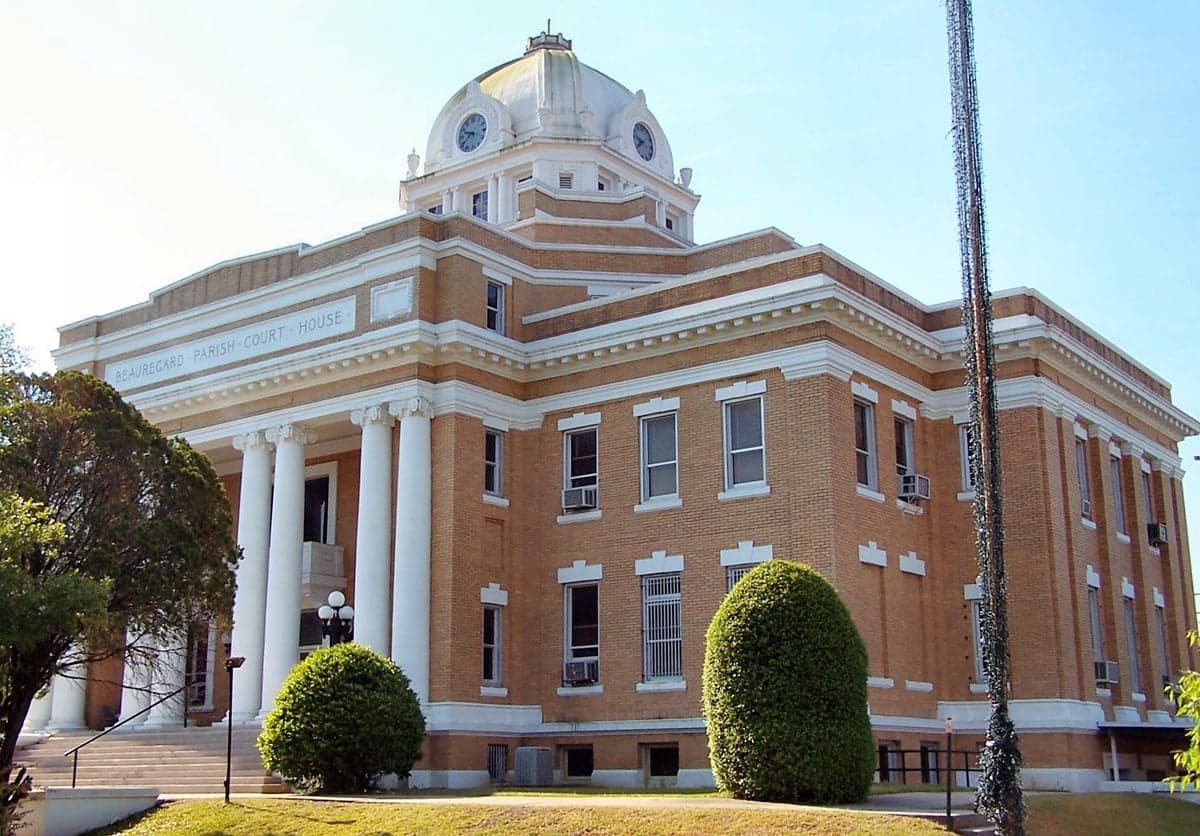
Photo: Wikipedia
Political ClimatePolitical Climate in Beauregard County
Showing district-level results — no local-only data available.
Local Political AnalysisPolitical Analysis of Beauregard County
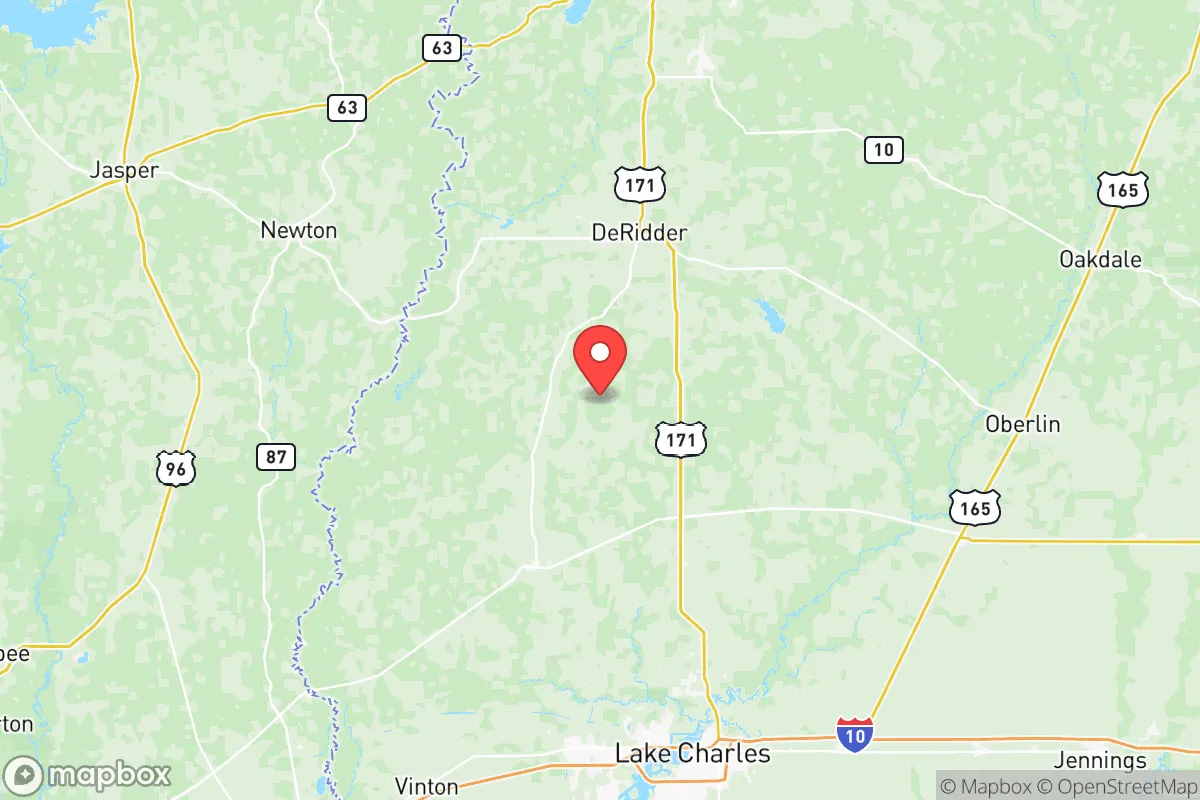
Beauregard County, Louisiana, is one of the most reliably Republican-voting counties in the entire Deep South, anchored by a Cook Partisan Voting Index (PVI) of R+26, meaning it votes 26 percentage points more Republican than the nation as a whole. That’s a full 16 points redder than Louisiana’s statewide PVI of R+10, a gap that translates into landslide margins in every recent presidential and statewide election. In 2020, Donald Trump carried the county with over 80% of the vote, and Democratic candidates rarely break 18% in any competitive race. This deep-red lean has been stable for decades—the county last voted for a Democratic presidential candidate in 1964—and the trajectory shows no sign of shifting, as in-migration from nearby Lake Charles and Houston tends to reinforce existing political patterns rather than challenge them.
How Beauregard County compares to Louisiana, LA
The difference between Beauregard County and Louisiana’s statewide average isn't just a number; it's a lived reality in voting behavior and political culture. While Louisiana as a whole is a reliably red state with a PVI of R+10, it still contains competitive pockets—New Orleans and Baton Rouge have Democratic strongholds, and statewide races for governor or senator have seen close margins (like John Bel Edwards’ 2019 win). Beauregard County, by contrast, is overwhelmingly and uniformly conservative across nearly every precinct. For example, the town of DeRidder, the county seat, consistently delivers around 78-82% Republican votes, while smaller communities like Merryville and Singer push that number into the mid-80s. The only precincts that occasionally show slightly softer Republican numbers—say, 65-70%—are in the Fields area near the Texas line, where a few more moderate-leaning rural landowners live, but these still have no Democratic tilt. In the statewide context, Beauregard County operates as a hyper-conservative anchor, amplifying the state’s red majority, while Louisiana’s overall PVI is dragged slightly leftward by urban centers and the Bayou region’s Cajun-Democratic legacy.
What this means for residents
For conservative residents, the political climate in Beauregard County is a comfortable fit: local elected officials are almost entirely Republican, and policy debates at county commission and school board levels align with national GOP priorities on taxes, guns, and religious freedom. Liberal-leaning residents—a small minority—face a social and political environment where their views are rarely represented in local government or widely discussed in public settings. There are no organized Democratic clubs or visible progressive advocacy groups in DeRidder or elsewhere in the county. In practice, this means that attending a city council meeting or county committee hearing feels like a unified front for most participants, but it can be isolating for anyone who questions the consensus. On the upside, the lack of political friction often means lower-key administrative decisions, as major ideological battles seen in more purple parts of Louisiana are absent; for instance, the school district rarely faces heated debates over curriculum or library books compared to parishes like Ouachita or Livingston.
One cultural and policy distinction worth noting: Beauregard County’s deep-red lean directly influences local tax policy and public funding priorities. The county consistently votes against property tax increases for schools and infrastructure, relying heavily on state and federal grants—a dynamic that contributes to lower mill rates (around 30-40% below the Louisiana average) but also slower road improvements and rural internet expansion. Conversely, the county has a robust firearms culture with no meaningful gun control ordinances, and churches play a prominent role in community life, with many holding voter registration drives that exclusively promote Republican candidates. For both conservative and liberal residents, the takeaway is that Beauregard County’s politics are not just about voting—they shape everyday decisions about where tax dollars go, what public services look like, and how easy it is to hold a differing political opinion in public. That stability has its trade-offs, but for now, the R+26 index spells a future that looks a lot like the past.

State Political ClimatePolitical Climate in Louisiana
State Political AnalysisPolitical Environment in the State
Louisiana is a solidly red state with a Cook PVI of R+10, but don't let that single number fool you — its politics are far more layered than a simple "R" stamp. The state has been reliably Republican in presidential elections since 2000, but with a uniquely Louisiana flavor: a populist, culturally conservative tilt that coexists with a deep-seated suspicion of both Washington and Baton Rouge. Over the past 20 years, the shift has been dramatic — Democrats once held every statewide office and controlled the legislature; today, Republicans hold a supermajority in both chambers and all but a handful of statewide posts. Yet the state's politics remain a battlefield between reform-minded conservatives, old-guard Democratic holdouts in New Orleans, and a Cajun-country GOP that is less focused on libertarian economics than on cultural identity and energy policy.
Urban vs. rural divide
The political geography of Louisiana is a textbook case of urban-rural polarization. New Orleans (Orleans Parish) and Baton Rouge (East Baton Rouge Parish) are the two main Democratic strongholds. New Orleans voted 82% for Joe Biden in 2020 and is a deep-blue enclave dominated by Black voters and white liberals. Baton Rouge is more mixed but leans blue in its urban core, driven by the state capital's government workforce and Louisiana State University. Outside those two cities, the map is overwhelmingly red. The Acadiana region — Lafayette, Lake Charles, and the surrounding parishes — votes Republican by huge margins, fueled by the oil and gas industry and a strong Cajun cultural conservatism. The "Florida Parishes" north of Lake Pontchartrain, including fast-growing suburbs like Mandeville and Covington, have shifted from swing to solid red over the last decade. Shreveport in the northwest is a notable exception: it's a Democratic-leaning city in an otherwise deep-red region, powered by its Black majority and a large medical-education sector. Rural parishes like Franklin, Tensas, and East Carroll routinely vote 75-80% Republican, though these are also the poorest and most depopulated areas of the state.
Policy environment
Louisiana's policy environment is defined by a low-tax, low-service model that appeals to conservative relocators. There is no state income tax on corporate or personal income — instead, the state relies on a 4.45% personal income tax (phased down from 6% over the past decade), a 9.5% corporate income tax, and some of the highest sales taxes in the country (state rate 4.45%, with local add-ons that can push totals above 10% in New Orleans and Baton Rouge). Property taxes are among the nation's lowest, thanks to the homestead exemption that shields the first $75,000 of a home's value from assessment. Education policy is a mixed bag: Louisiana has one of the largest school-choice programs in the South (the Louisiana Scholarship Program) and a proliferation of charter schools, especially in New Orleans, which gave up its traditional district after Katrina. However, public school performance remains near the bottom nationally. Healthcare policy is also distinct: the state expanded Medicaid under the Affordable Care Act in 2016 (a decision made by a Democratic governor at the time, John Bel Edwards), and as of 2026, nearly 40% of residents are on Medicaid — a figure that surprises many new arrivals from redder states. Election laws are restrictive by national standards: Louisiana has a closed primary system (only registered party members can vote in party primaries) and no-excuse absentee voting, though early voting is widely available (7 days, plus the Saturday before Election Day). Voter ID is required, with a strict photo-identification law that the legislature tightened further in 2024.
Recent policy direction
Over the past two legislative sessions, Louisiana has moved decisively to the right on multiple fronts. On gun and self-defense law, the state passed a constitutional carry law in 2024, allowing any adult who can legally possess a firearm to carry it concealed without a permit. Castle doctrine and stand-your-ground protections are already on the books. On parental and education rights, a 2023 law (Act 245) requires schools to notify parents if a child requests a change in name or pronouns, and a 2024 law bans classroom instruction on sexual orientation and gender identity in grades K-12. The state also passed a comprehensive school-voucher expansion in 2025, making nearly all families eligible for education savings accounts. On abortion and bodily autonomy, Louisiana has a near-total ban with limited exceptions (rape, incest, life of the mother) that took effect in 2022 via a trigger law; it also passed a law in 2024 classifying abortion pills as controlled substances, making possession without a prescription a crime. On property rights, Louisiana maintains strong property protections, though it still grapples with legacy issues like the "Notice of Lis Pendens" system that can gum up real estate transactions. On taxation, the trend is toward cuts: the personal income tax rate dropped from 4.75% to 4.45% in 2025, and there is serious talk of eliminating it entirely by 2030. On privacy and surveillance, Louisiana is one of several states that has restricted the use of facial recognition by law enforcement, but it also has a broad third-party doctrine that allows police to obtain digital records without a warrant.
Civil unrest & political movements
Louisiana has a history of political heat that is quieter today than in the 2010s. The largest recent protests were in the summer of 2020, following the police killing of George Floyd, when Baton Rouge and New Orleans saw sustained demonstrations; Baton Rouge's were particularly charged given the 2016 killing of Alton Sterling by police. By 2024-2025, those movements have largely subsided, replaced by a different kind of activism on the right. The state has become a battleground for anti-crime and anti-"woke" movements, with conservative groups successfully pushing for tougher sentencing laws and the rollback of 2010s-era criminal justice reforms (like the 2017 "Justice Reinvestment" package that reduced prison sentences). Immigration politics are also a flashpoint: Louisiana is not a border state, but Governor Jeff Landry (R) has deployed state National Guard troops to Texas under Operation Lone Star and pushed for a state law requiring local law enforcement to cooperate with ICE — a bill that passed in 2024. There is no sanctuary city in Louisiana; New Orleans' more lenient approach to undocumented residents has been curtailed by state preemption laws. Secession rhetoric is rare but not absent — a 2021 state representative introduced a "Second Louisiana Purchase" resolution that went nowhere. Election integrity controversies are muted compared to other Southern states: Louisiana's machine-based voting system (without paper trails) was a source of concern after 2020, but the legislature passed a 2024 law requiring paper ballot backups by 2028.
Projection
Over the next 5-10 years, Louisiana is likely to become even more Republican, though the pace will be uneven. The biggest demographic factor is out-migration: Louisiana has lost population every year since 2020, with the biggest losses in rural parishes and parts of New Orleans. Those leaving tend to be younger, more educated, and more liberal — a steady bleed that will continue to shrink the Democratic base. Meanwhile, in-migration is modest but growing, with the fastest growth in the Florida Parishes (St. Tammany Parish) and the Lafayette area, drawing people from Texas, California, and the Northeast who are specifically seeking a low-tax, culturally conservative environment. The political implications are clear: Baton Rouge and New Orleans will remain blue islands, but their share of statewide votes will keep shrinking. The legislature will likely stay under a Republican supermajority, and the governorship is firmly in GOP hands after the term-limited John Bel Edwards era ended in 2024. A serious push to eliminate the personal income tax entirely — and replace that revenue with higher sales taxes or spending cuts — is the next big policy fight. For relocators, the practical takeaway is that Louisiana will remain a state where conservative values dominate the public square, but with enough local variation that a liberal family in New Orleans can find community, while a conservative family in Mandeville or Broussard will feel entirely at home in the political culture.
The bottom line for anyone moving to Louisiana: if you're conservative, you're moving into a state where your values are reflected in law and local culture, from the school system to the gun laws to the tax code. If you're liberal, you'll find your political home in New Orleans or Baton Rouge, but you'll need to accept that your state government will not be on your side on most issues. Either way, the state's biggest challenges — crumbling infrastructure, high crime rates in some metro areas, and economic dependence on fossil fuels — are not partisan problems, and they will affect your daily life regardless of how you vote.
* Values derived from national, state, county, city and local statistics and may differ in a specific area. Last updated: 2026-06-19T20:39:08.000Z
Narrative content on this page is AI-generated and may contain mistakes. Verify any details that matter before acting on them.
ReloMaps may earn a commission from affiliate links at no extra cost to you.

