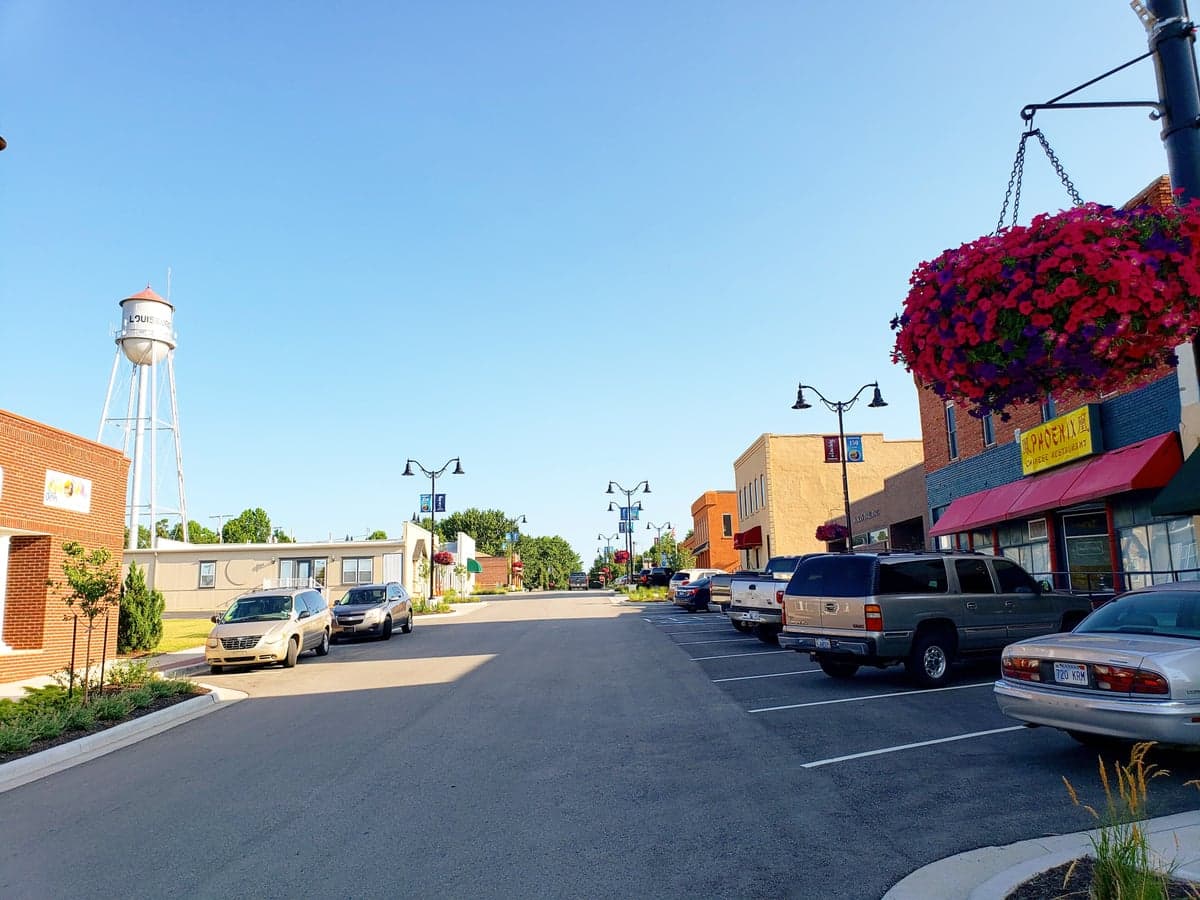
Photo: Wikipedia
Political ClimatePolitical Climate in Louisburg, KS
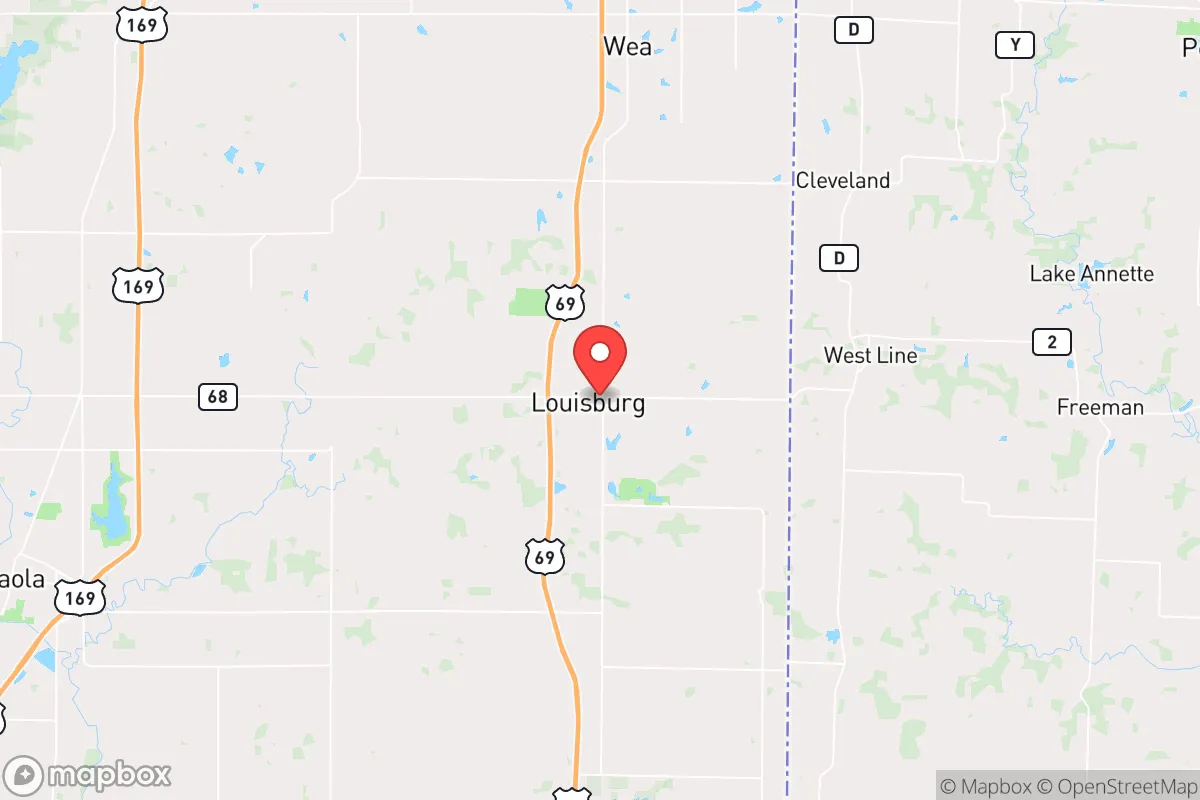
District shown is the primary district for this city’s centroid. Cities may span multiple districts.
Local Political AnalysisPolitical Analysis of Louisburg, KS
Louisburg is one of those places in Kansas that feels like it’s caught between two worlds politically. The town itself leans slightly Democratic, with a Cook PVI of D+2, but that’s a pretty narrow margin in a state that’s solidly Republican at R+9. What that means on the ground is that you’ll see a fair number of Harris-Walz yard signs in some neighborhoods, but you’re just as likely to spot Trump flags on the outskirts. The real story is the trajectory: as the Kansas City metro sprawl pushes south, Louisburg is getting more purple, not redder. Ten years ago, this was a reliably conservative farm town; now, with new subdivisions and remote workers moving in from Overland Park and Leawood, the local elections are starting to get competitive.
How it compares
The contrast between Louisburg and the rest of Kansas is stark. The state as a whole is R+9, meaning a Republican candidate typically wins by about 9 points statewide. But Louisburg’s D+2 rating puts it in a tiny minority of Kansas communities that lean blue. To get a sense of the difference, drive 15 minutes west to Paola — that’s Miami County’s seat, and it votes closer to the state average, solidly red. Head north toward Spring Hill or Gardner, and you’ll find a similar mix of exurban conservatism. The real outlier is Louisburg itself, which benefits from its proximity to the Kansas City suburbs. It’s not a liberal stronghold by any stretch — think of it as a blue dot in a red county, where the local school board and city council races often hinge on growth and development issues rather than national partisan fights.
What this means for residents
For conservative residents, Louisburg is still a comfortable place to live. The county-level politics are reliably Republican, and you won’t feel out of place at the grocery store or the high school football game. The local Republican party is active, and conservative candidates often win city council seats, just by narrower margins than in neighboring towns. For liberal residents, the D+2 lean means you’re not alone — there’s a visible Democratic presence, especially among newer arrivals. You’ll find a small but active local Democratic group, and the city’s growth has brought in younger families who tend to vote more progressively. The practical effect is that both sides have to work for it. No one takes Louisburg for granted, which keeps local politics more civil and issue-focused than in deeply partisan areas.
Culturally, Louisburg still holds onto its small-town Kansas roots — the annual Louisburg Ciderfest is a big deal, and the town’s identity is tied to its agricultural history. But the policy distinctions are real. The city has been more open to zoning changes that allow for mixed-use development and smaller lot sizes, which appeals to younger families but frustrates longtime residents who want to preserve the rural character. The school district, Louisburg USD 416, has managed to avoid the kind of culture-war blowups seen in larger districts, partly because the community is small enough that people know each other personally. Looking ahead, if the metro growth continues, Louisburg could become a genuine swing town within a decade — not quite Johnson County liberal, but far from the deep-red Kansas stereotype.

State Political ClimatePolitical Climate in Kansas
State Political AnalysisPolitical Environment in the State
Kansas is a solidly Republican state with a Cook PVI of R+9, but calling it a simple red state misses the intense internal battles that define its politics. Over the last 20 years, the state has shifted from a moderate, pragmatic Republicanism—think Bob Dole and Nancy Kassebaum—to a much more conservative, often libertarian-leaning posture, driven by a powerful grassroots movement. The real story isn't Democrat vs. Republican; it's the civil war within the GOP between the traditional business-friendly wing and the more populist, anti-tax, and socially conservative faction, with the latter holding the upper hand in recent cycles.
Urban vs. rural divide
The political map of Kansas is a textbook study in the urban-rural split. The entire state's Democratic vote is concentrated in just two counties: Wyandotte (Kansas City) and Douglas (Lawrence). Johnson County, the wealthy, sprawling suburb of Kansas City, is the state's true political battleground. Once reliably Republican, it has been trending blue in presidential years—Hillary Clinton won it in 2016, and Joe Biden carried it in 2020—driven by college-educated professionals moving into places like Overland Park, Leawood, and Olathe. This shift is why statewide races are sometimes competitive. Meanwhile, the rest of the state is deeply red. Sedgwick County (Wichita) leans Republican but is more moderate than the rural areas. Drive an hour west of Wichita, and you hit counties like Ellis (Hays) and Finney (Garden City), where Republican margins routinely exceed 70%. The rural west and central plains are the engine of the state's conservative majority, with voters who feel culturally and economically distant from the Kansas City metro.
Policy environment
Kansas's policy environment is defined by a low-tax, low-service model, but with a unique twist. The state has a flat income tax rate of 5.7% after the 2024 tax cuts, and the sales tax is high—around 6.5% state-level, with local add-ons pushing it past 10% in some cities. Property taxes are a perennial complaint, funding local schools and services. The regulatory posture is light: Kansas is a right-to-work state, has no state-level occupational licensing for many trades, and has a strong "at-will" employment doctrine. Education policy is a flashpoint. The state has a robust school choice program, including tax-credit scholarships and open enrollment, but teacher pay remains below the national average. On healthcare, Kansas did not expand Medicaid under the Affordable Care Act, leaving a coverage gap for about 150,000 low-income adults. Election laws are moderately restrictive: voter ID is required, and the state purges inactive voters from rolls, but same-day registration is not available. The state also has a constitutional amendment explicitly stating there is no right to abortion, passed by voters in 2022.
Recent policy direction
The last five years have seen Kansas lurch rightward on a broad front. On gun rights, the state is a constitutional carry state since 2015, with no permit required to carry a concealed firearm. In 2023, the legislature passed a "Second Amendment Preservation Act" that attempts to nullify federal gun laws, though its enforceability is questionable. Parental rights were supercharged in 2021 with a law requiring schools to notify parents of any changes to a student's "services or monitoring related to the student's mental, emotional, or physical health," effectively targeting transgender students. Medical and bodily autonomy is sharply restricted: abortion is banned at 22 weeks, and after the 2022 "Value Them Both" amendment vote, the legislature has been passing incremental restrictions, including a ban on medication abortion via telehealth. Property rights are strong, with no state income tax on Social Security benefits and a homestead exemption for seniors. Voting access tightened in 2021 with a law banning ballot drop boxes and shortening the mail-in ballot request window. On privacy and surveillance, Kansas has no broad data privacy law, but it does have a biometric privacy law that has spawned class-action lawsuits. The overall direction is toward maximum individual liberty in economic and gun matters, combined with significant government intervention in social and medical decisions.
Civil unrest & political movements
Kansas has a history of intense, organized political activism, particularly from the right. The Kansas Republican Assembly and the Kansas Policy Institute (a free-market think tank) have been hugely influential in pushing the tax-cutting agenda and primarying moderate Republicans. The most visible flashpoint in recent memory was the 2022 abortion amendment vote, which saw massive turnout and a surprising defeat of the anti-abortion measure—a sign that the state's conservative lean has limits on social issues. On the left, the Kansas People's Action and local Indivisible chapters organize around Medicaid expansion and public education funding. Immigration politics are less volatile than in border states, but Garden City and Dodge City have large immigrant populations working in meatpacking, and local law enforcement generally cooperates with ICE. There have been no serious secession or nullification movements, though the "Second Amendment Preservation Act" flirts with nullification rhetoric. Election integrity controversies flared after 2020, with the state's Republican Secretary of State, Scott Schwab, defending the state's election system as secure, even as some local GOP activists pushed for audits. A new resident in Lawrence will see a very different political culture than one in Colby—the former is a college town with visible progressive activism, the latter is a deeply conservative farming community where politics is less visible but deeply felt.
Projection
Over the next 5-10 years, Kansas is likely to remain a solidly Republican state, but the internal GOP civil war will intensify. The key demographic driver is the continued growth of Johnson County, which is becoming more diverse, more educated, and more Democratic-leaning. If Johnson County continues its blueward shift, it could eventually make statewide races competitive for Democrats, but the rural vote is so lopsided that it would take a massive shift to flip the state. The in-migration pattern is modest—Kansas isn't a boom state like Texas or Florida—but the people moving in tend to be either retirees seeking low taxes or remote workers drawn to the low cost of living in places like Manhattan (home to Kansas State University) or the Kansas City suburbs. The most likely scenario is a continuation of the current trajectory: a state that is culturally conservative on social issues, economically libertarian, and increasingly polarized between the urban core and the rural expanse. A new resident moving to Topeka or Emporia should expect a stable, low-tax environment with limited public services, a strong gun culture, and a political climate where local elections are often more consequential than national ones.
For a new resident, the bottom line is this: Kansas offers a predictable, low-regulation environment for those who value economic freedom and gun rights, but it comes with trade-offs. Public schools are underfunded, healthcare access is limited for low-income residents, and social policies are increasingly restrictive. If you're a conservative family looking for a place where your values are reflected in state law and your taxes are low, Kansas is a strong fit. If you're a liberal or moderate, you'll find a comfortable enclave in Lawrence or parts of Johnson County, but you'll be living in a state where your vote has limited impact on statewide policy. The state's political trajectory is stable, not volatile—what you see now is largely what you'll get for the next decade.
* Values derived from national, state, county, city and local statistics and may differ in a specific area. Last updated: 2026-10-06T20:35:14.000Z
Narrative content on this page is AI-generated and may contain mistakes. Verify any details that matter before acting on them.
ReloMaps may earn a commission from affiliate links at no extra cost to you.

