Photo: Wikipedia
Demographics of Louisburg, KS
Affluence Level in Louisburg, KS
A middle-class area roughly in line with national averages across income, home values, education, and employment.
People of Louisburg, KS
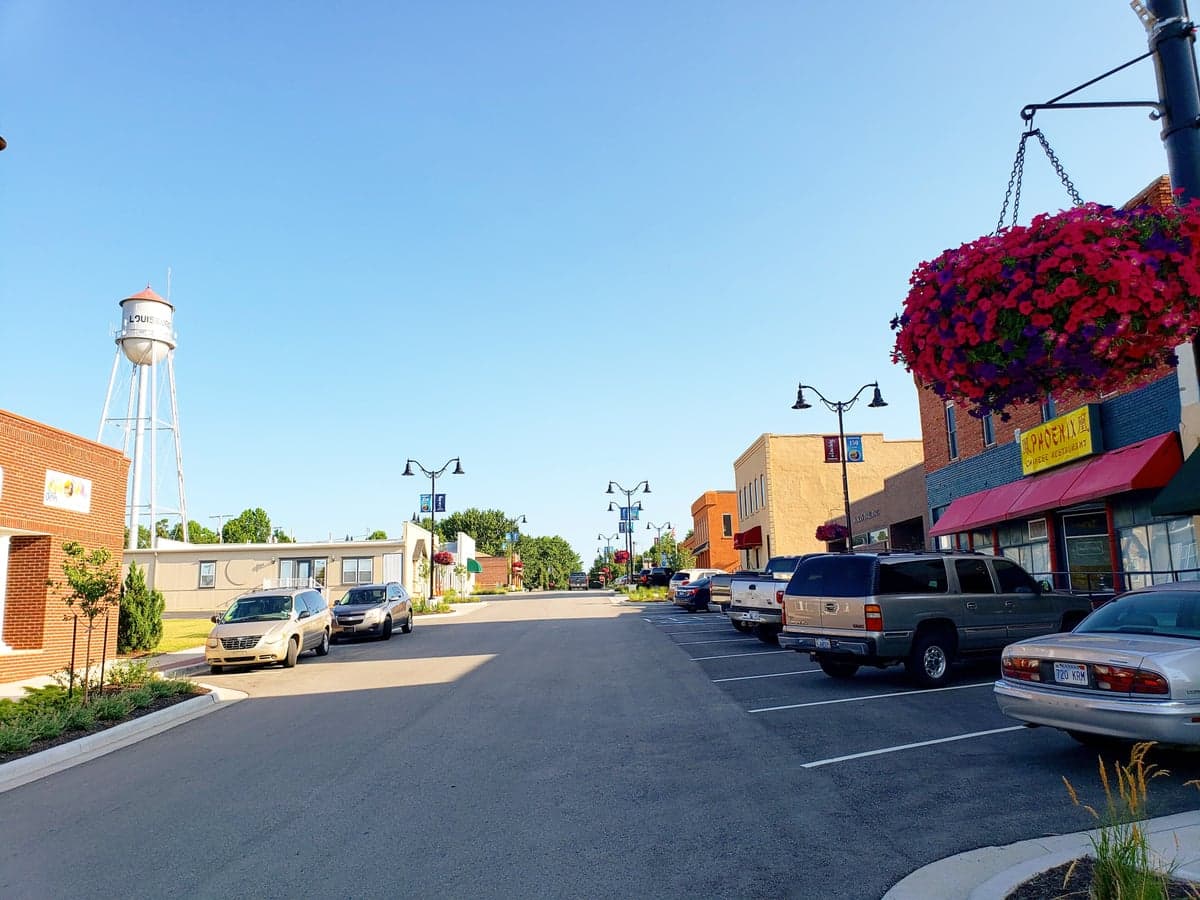
The people of Louisburg, Kansas, today number 5,034 and form a predominantly white, family-oriented community with a strong small-town identity. The city’s population is 95.2% White, with a Hispanic share of 2.0% and a foreign-born population of just 0.5%, reflecting a remarkably homogeneous demographic profile. Nearly one-third of adults (32.3%) hold a college degree, a rate that supports a stable, middle-class character centered on local schools, churches, and civic organizations. Louisburg’s identity is rooted in its agricultural and railroad history, and its residents today value quiet, safe neighborhoods and a slower pace of life.
How the city was settled and grew
Louisburg’s original population arrived in the 1850s and 1860s, drawn by the promise of fertile prairie land and the construction of the Missouri River, Fort Scott & Gulf Railroad. The town was platted in 1855 and named after a local landowner, Louisburg’s first settlers were primarily Anglo-American farmers from Kentucky, Tennessee, and Missouri, who established homesteads along the Marais des Cygnes River valley. The earliest residential cluster, now known as Old Town Louisburg, grew around the railroad depot and Main Street, where merchants, blacksmiths, and millers served the surrounding agricultural community. By the 1880s, a second wave of German and Irish immigrants arrived, many working as railroad laborers or tenant farmers; they settled in the North Side neighborhood, near the grain elevators and stockyards. The town’s population remained under 1,000 until the mid-20th century, sustained by dairy farming, corn and soybean production, and a small but steady trade in livestock.
Modern era (post-1965)
After the 1965 Immigration and Nationality Act, Louisburg saw virtually no influx of new foreign-born populations—the foreign-born share today is just 0.5%, and the Black, Asian, and Indian-subcontinent populations are each at 0.0%. Instead, the city’s modern growth has come entirely from domestic in-migration, primarily from the Kansas City metropolitan area, which lies about 35 miles north. Beginning in the 1990s, families seeking larger lots, lower crime rates, and good schools began moving into newer subdivisions on the city’s southern and eastern edges. The Prairie View Estates neighborhood, developed in the early 2000s, attracted many of these newcomers—mostly white, middle-class families with children—while Sunset Ridge, a slightly older subdivision, became home to empty-nesters and retirees. The Hispanic population, though small at 2.0%, is concentrated in a handful of rental properties near the Industrial Park on the west side, where a few light-manufacturing and food-processing plants employ seasonal workers. Overall, the city’s racial and ethnic composition has remained nearly static since 2000, with White share fluctuating between 94% and 96%.
The future
Louisburg’s population is projected to grow modestly—perhaps reaching 5,500 to 6,000 by 2040—driven by continued spillover from the Kansas City suburbs. However, the demographic profile is unlikely to diversify significantly. The city’s housing stock, dominated by single-family homes on large lots, and its lack of rental or multi-family developments limit affordability for lower-income or immigrant households. New construction is concentrated in the Meadowlark Addition and Fox Run subdivisions on the east side, both of which are marketed to families and are overwhelmingly white. The Hispanic share may inch upward as service-sector jobs in nearby Louisburg’s small retail corridor attract some workers, but the foreign-born population will likely remain below 2%. The city’s cultural identity—rooted in conservative, church-going, family-centric values—is expected to persist, with little pressure for change from outside groups.
For someone moving to Louisburg now, the city offers a stable, safe, and culturally cohesive environment where neighbors know each other and community events like the annual Louisburg Ciderfest draw nearly everyone together. It is not a place of rapid demographic change or urban energy, but rather a deliberately quiet, family-first community where the population is slowly aging and slowly growing—and where the people who live there largely share the same background and values. New arrivals will find a welcoming but homogeneous town, one that rewards participation in local institutions and values continuity over change.

* Values derived from national, state, county, city and local statistics and may differ in a specific area. Last updated: 2026-10-06T20:35:14.000Z
Narrative content on this page is AI-generated and may contain mistakes. Verify any details that matter before acting on them.
ReloMaps may earn a commission from affiliate links at no extra cost to you.

