Photo: Wikipedia
Demographics of Lead, SD
Affluence Level in Lead, SD
A middle-class area roughly in line with national averages across income, home values, education, and employment.
People of Lead, SD
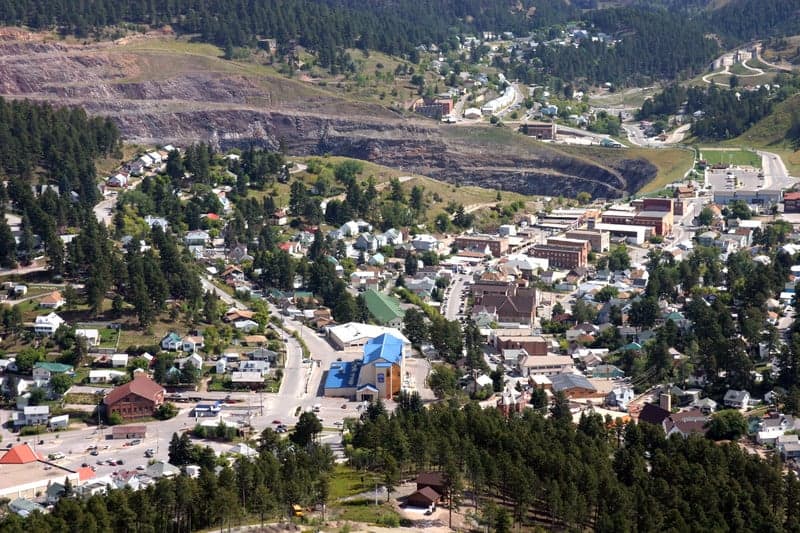
The people of Lead, South Dakota, today form a small, tight-knit community of roughly 3,000 residents, overwhelmingly white (95.2%) and native-born, with zero foreign-born population reported. The city’s character is defined by its historic mining roots, a blue-collar work ethic, and a notably older demographic profile — only 19.8% of adults hold a college degree, reflecting a population that has long prioritized practical trades over higher education. Lead is not a place of rapid change or ethnic diversity; it is a stable, culturally homogeneous town where family ties to the Homestake Mine run deep and where the population has been slowly declining for decades.
How the city was settled and grew
Lead’s human history begins with the discovery of gold in the Black Hills in 1876, which triggered a rush of prospectors, miners, and speculators. The city was officially founded in 1876 as a company town for the Homestake Mine, which would become the largest and deepest gold mine in the Western Hemisphere. The original population was almost entirely white, drawn from other mining regions of the United States — notably Cornish miners from Michigan’s Upper Peninsula, Irish immigrants from the East Coast, and Scandinavian laborers from the Upper Midwest. These groups settled in distinct neighborhoods that still bear their names today. “Cornish Row” in the upper part of town housed the skilled Cornish miners who brought deep-shaft mining expertise, while “Swede Alley” and “Finn Town” clustered Scandinavian families who worked the surface operations and timbering. By 1900, Lead’s population had surged past 8,000, making it one of the largest cities in the Dakota Territory. The mine’s dominance meant that nearly every resident worked for Homestake, and the company built housing, schools, and churches that reinforced a tight, company-controlled social structure. The city’s population peaked around 8,500 in the 1910s and then began a long, slow decline as mining mechanization reduced labor needs.
Modern era (post-1965)
The post-1965 era in Lead was defined not by immigration — the city’s foreign-born share has remained at or near zero for decades — but by domestic out-migration and demographic aging. The Homestake Mine, which had employed generations of Lead families, began scaling back operations in the 1970s and 1980s, triggering a steady population decline from roughly 4,000 in 1970 to 3,000 by 2000. The mine finally closed in 2002, a seismic event that forced many younger families to leave for work in Rapid City or out of state. The neighborhoods that once housed dense, multi-generational mining families — “Deadwood Gulch” along the southern edge of town and “Central Lead” around the historic Main Street — saw homes empty out as the workforce shrank. The city’s racial composition remained virtually unchanged during this period: white share stayed above 95%, with no significant growth in Hispanic, Black, or Asian populations. The small Hispanic population (1.7% today) is largely composed of a few families who moved in during the 1990s to work in the mine’s final years or in tourism-related services. Today, the most stable residential area is “North Lead,” a newer subdivision built in the 1980s and 1990s that houses the remaining middle-class families, many of whom commute to jobs in Deadwood or Rapid City.
The future
Lead’s demographic future points toward continued slow decline and homogenization. The city’s population has fallen from 3,027 in 2010 to 2,997 in 2020, and projections suggest it could dip below 2,800 by 2035. The zero foreign-born share means there is no immigrant influx to offset natural decrease (more deaths than births). The white share is likely to remain above 90% for the foreseeable future, as the city attracts almost no domestic migration from diverse urban areas. The Hispanic share may grow slightly — perhaps to 3-4% by 2040 — as a few families move in for service jobs tied to the Black Hills tourism economy, but this will not fundamentally change the city’s character. The most likely scenario is that Lead becomes an even older, more retirement-oriented community, with younger adults leaving for college or jobs and returning only to visit aging parents. The neighborhoods of “Upper Lead” (the historic mining district) and “Lower Lead” (near the former mine entrance) will continue to see population loss, while “North Lead” may hold steady as a bedroom community for Deadwood workers.
For someone moving in now, Lead offers a quiet, safe, and deeply rooted community where nearly everyone shares a common background and a connection to the mining past. It is not a place of demographic change or cultural diversity — it is a place where the population is slowly aging in place, and where new residents will likely be retirees or remote workers seeking low costs and a slower pace. The city’s future is not one of growth or transformation, but of preservation and gradual contraction.

* Values derived from national, state, county, city and local statistics and may differ in a specific area. Last updated: 2026-04-30T12:57:47.000Z
Narrative content on this page is AI-generated and may contain mistakes. Verify any details that matter before acting on them.
ReloMaps may earn a commission from affiliate links at no extra cost to you.

