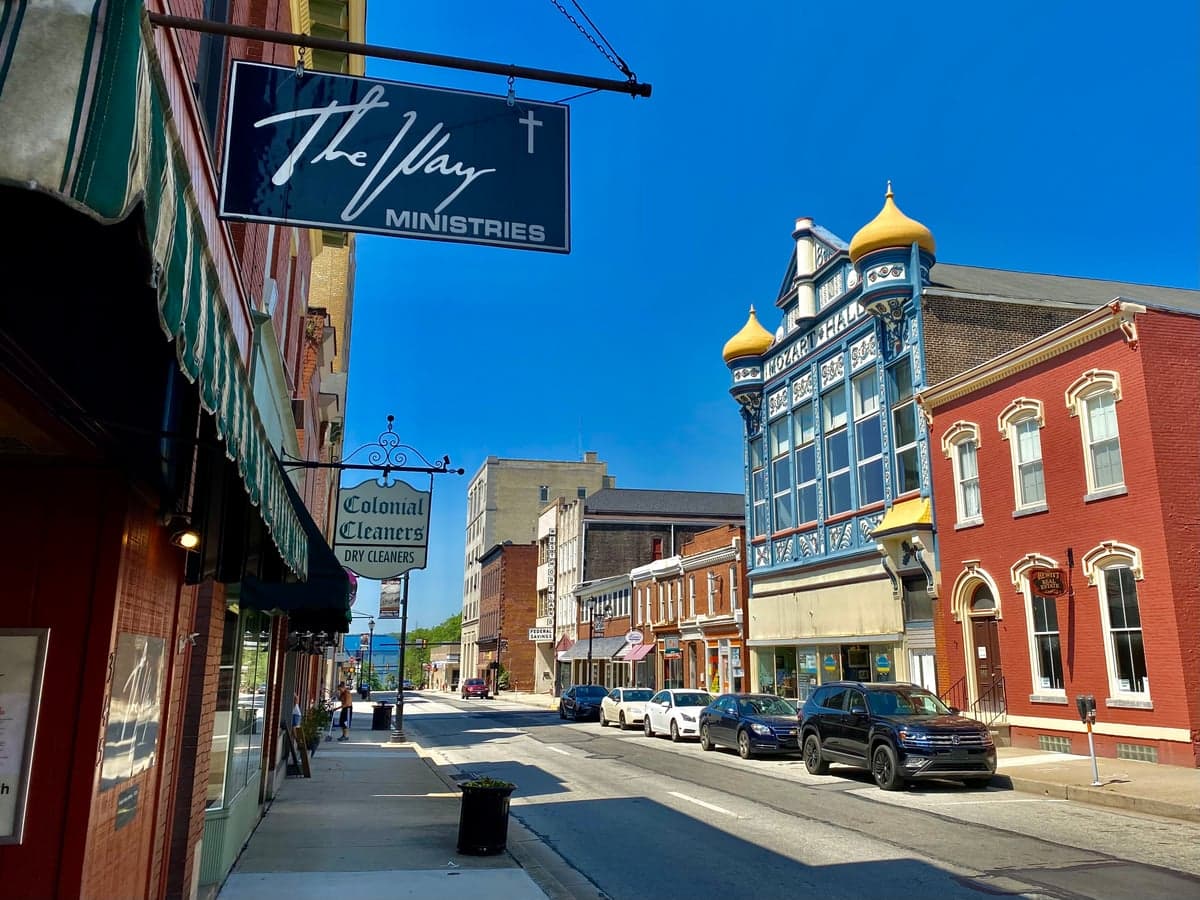
Photo: Wikipedia
Demographics of Latrobe, PA
Affluence Level in Latrobe, PA
A below-average socioeconomic profile. Incomes, home values, and educational attainment trail the U.S., with higher poverty and unemployment.
People of Latrobe, PA
The people of Latrobe, Pennsylvania, today number 8,002, forming a predominantly white (92.6%) community with a very small foreign-born population (0.4%). The city retains a distinctively rooted, working-class character, shaped by generations of European immigrant families who arrived for industrial jobs and stayed. With a college attainment rate of 27.4%, Latrobe is a place where local identity is tied to family history, Catholic parish life, and the legacy of manufacturing, rather than to rapid demographic change or new migration.
How the city was settled and grew
Latrobe’s population history begins with its founding in 1851 as a railroad and industrial hub along the Pennsylvania Railroad’s main line. The earliest settlers were of German and Scotch-Irish stock, drawn by the promise of work in the region’s burgeoning coal, iron, and glass industries. The first major wave of immigrants arrived between 1880 and 1920, overwhelmingly from Southern and Eastern Europe. Italian, Polish, Slovak, and Croatian families poured in to work at the Latrobe Steel Company (later Kennametal) and the Latrobe Brewing Company. These groups settled in distinct, tight-knit neighborhoods. Italian immigrants concentrated in the “Little Italy” district around St. John the Evangelist Church, while Polish and Slovak families built their community around St. Mary’s Church in the “Polish Hill” area. A smaller but notable wave of Greek immigrants established businesses along Main Street, forming a commercial corridor that still bears their influence. By 1930, the city’s population peaked near 11,000, and the ethnic parishes—St. Vincent’s, St. John’s, St. Mary’s—served as the social and cultural anchors of each neighborhood.
Modern era (post-1965)
After the 1965 Immigration and Nationality Act, Latrobe saw virtually no new international migration. The foreign-born share today is just 0.4%, one of the lowest in Pennsylvania. Instead, the post-1965 story is one of domestic out-migration and suburbanization. As the steel and manufacturing sectors contracted in the 1970s and 1980s, many younger families left for larger cities or Sun Belt states. Those who remained were largely the descendants of the original European immigrant groups. The city’s racial composition has remained extremely stable: 92.6% white, with a Black population of 1.4% and an East/Southeast Asian population of 0.8%. The small Black community is concentrated in the “West Side” area near the former Latrobe Steel plant, a legacy of the limited African American migration during the World War II labor shortages. The tiny East/Southeast Asian presence (0.8%) is scattered, with no distinct ethnic enclave. The Indian-subcontinent population is effectively zero (0.0%). Suburbanization pulled many middle-class families to outlying townships like Unity and Derry, leaving Latrobe’s historic neighborhoods—particularly the older, denser blocks near the downtown—with an aging population and a higher proportion of rental housing.
The future
Latrobe’s population is projected to continue a slow decline, mirroring broader southwestern Pennsylvania trends. The city has lost roughly 15% of its population since 2000, and the median age is rising. There is no evidence of significant new immigration or domestic in-migration from diverse groups. The small Hispanic population (0.1%) and Black population (1.4%) are not growing. The most likely demographic future is a continuation of the status quo: an older, predominantly white population with a stable but very small minority presence. New residents who do arrive are typically retirees returning to family roots or remote workers attracted by low housing costs in neighborhoods like “Derry Street” and “Latrobe Heights”, where older homes are affordable. The cultural identity remains strongly tied to local institutions—Saint Vincent College, the Latrobe Art Center, and the annual Great Race—rather than to any new wave of diversity.
For someone moving in now, Latrobe offers a stable, low-cost, and culturally cohesive environment where the population is not changing rapidly. The city is becoming quieter and older, but it retains a strong sense of place rooted in its European immigrant past. New arrivals should expect a community that values tradition, local history, and neighborly familiarity, with little of the demographic churn found in larger metropolitan areas.

* Values derived from national, state, county, city and local statistics and may differ in a specific area. Last updated: 2026-08-24T07:10:29.000Z
Narrative content on this page is AI-generated and may contain mistakes. Verify any details that matter before acting on them.
ReloMaps may earn a commission from affiliate links at no extra cost to you.

