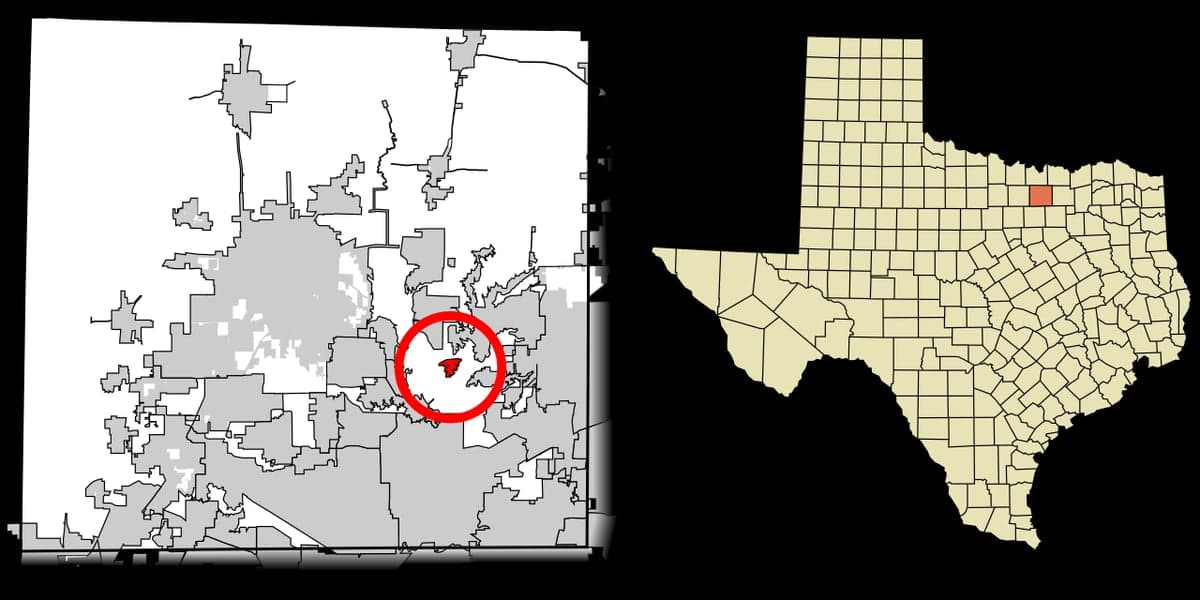


Photo: Wikipedia
Demographics of Lakewood Village, TX
Affluence Level in Lakewood Village, TX
An upper-middle-class area. Household wealth, education levels, and homeownership run ahead of national benchmarks.
People of Lakewood Village, TX
Today, Lakewood Village is a small, tight-knit community of 784 residents, characterized by its predominantly White (72.4%) and Hispanic (17.2%) population, with a notable East/Southeast Asian presence (6.8%) and a small Indian subcontinent community (1.4%). The city is a quiet, family-oriented enclave in Denton County, with a relatively high college education rate of 37.5% and an exceptionally low foreign-born share of just 0.3%, reflecting a population that is largely native-born and rooted in the region. Its identity is shaped by a blend of longtime rural families and newer suburbanites seeking space and lower density, with a distinctly conservative-leaning character that aligns with the broader North Texas exurban trend.
How the city was settled and grew
Lakewood Village was incorporated in 1968, making it a product of the late-20th-century suburban expansion rather than a historic settlement. The land was originally part of the Peters Colony land grants in the 1840s, which drew Anglo-American settlers from the Upper South and Midwest to farm cotton and raise cattle. These early families—names like the Bakers and the Cokers—established homesteads along what is now FM 423 and around the area that would become Lakewood Village Estates, the city's original residential core. For over a century, the population remained sparse, consisting of a few dozen farming and ranching households. The construction of Lake Lewisville in the 1950s, which created the lake that gives the city its name, began to attract weekend cottagers and fishermen, but the area remained largely rural through the 1960s.
Modern era (post-1965)
The city's modern population boom began in the 1970s and accelerated through the 1990s as Dallas-Fort Worth's northern suburbs pushed outward. The incorporation in 1968 allowed residents to control development, and the city grew slowly by design, attracting families who wanted a rural feel within commuting distance of DFW. The Lakewood Village Shores neighborhood, developed in the 1980s along the lake's edge, drew middle-class White families seeking waterfront lots and a recreational lifestyle. In the 1990s and 2000s, the Oak Creek and Pecan Creek subdivisions brought a wave of domestic in-migrants—primarily White and Hispanic families from within Denton County and the Dallas metro—who were priced out of Frisco and Little Elm. The Hispanic share grew from a negligible base to 17.2% today, concentrated in the Pecan Creek area and along the FM 423 corridor, where smaller, more affordable homes were built. The East/Southeast Asian community (6.8%) arrived primarily in the 2010s, drawn by the area's good schools (Little Elm ISD) and proximity to tech jobs in Plano and Frisco, settling in the newer Lakewood Village North section near the city's northern boundary. The Indian subcontinent community (1.4%) is a very recent addition, mostly professionals who moved into custom-built homes in the Lakewood Village Shores expansion lots after 2020.
The future
Lakewood Village's population is projected to grow modestly, likely reaching 900–1,000 by 2035, as remaining vacant lots are developed. The city's strict lot-size minimums (typically 1 acre) and lack of apartment zoning will keep density low and growth slow. The population is becoming slightly more diverse, with the Hispanic and East/Southeast Asian shares expected to rise to around 20% and 8% respectively, while the White share declines to near 68%. New construction is concentrated in the Lakewood Village North and Oak Creek extensions, where younger families—many with children in Little Elm ISD—are replacing aging original homeowners. The Indian subcontinent community is likely to remain small but stable, as the city's limited housing stock and higher price points ($500,000+) attract only upper-income buyers. Culturally, the city is evolving from a purely Anglo-Texan rural enclave into a more multiethnic but still conservative exurb, where the dominant identity remains family-oriented, property-rights-focused, and politically red.
For someone moving in now, Lakewood Village offers a stable, low-density community with a clear trajectory: slow, controlled growth, a rising but still modest level of diversity, and a culture that prizes privacy, local governance, and traditional family structures. It is not a place of rapid change or urban energy, but rather a deliberate, quiet corner of North Texas where the population is gradually becoming more varied while holding onto its small-town, conservative roots.

* Values derived from national, state, county, city and local statistics and may differ in a specific area. Last updated: 2026-07-24T16:09:56.000Z
Narrative content on this page is AI-generated and may contain mistakes. Verify any details that matter before acting on them.
ReloMaps may earn a commission from affiliate links at no extra cost to you.

