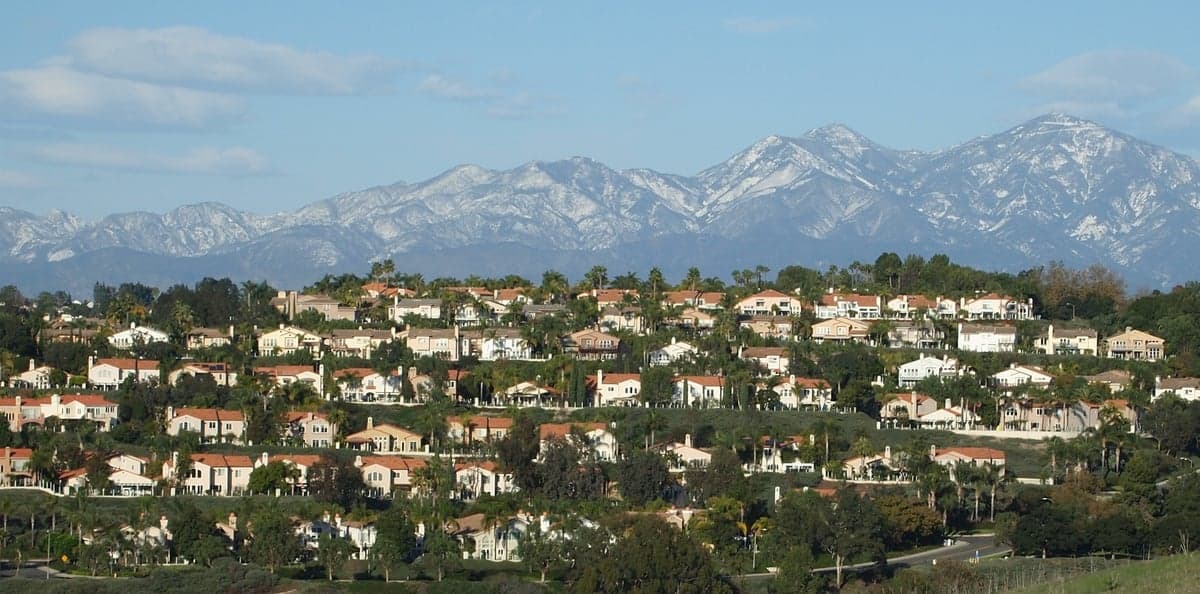
Photo: Wikipedia
Personal Sovereignty in Laguna Niguel, CA
Viable for self-reliance. Generally workable, though some barriers may limit total independence.
What does Personal Sovereignty tell us?
Personal Sovereignty measures your capacity for self-reliance and independence with minimal government friction. Higher scores mean fewer barriers between you and the way you want to live... but it assumes you have the space you need and good neighbors.
What does this tell us?
Personal Sovereignty measures your capacity for self-reliance and independence with minimal government friction. Higher scores mean fewer barriers between you and the way you want to live... but it assumes you have the space you need and good neighbors.
State Policy
Energy independence: Importer (33% of energy produced in-state)
Personal Liberty
Homesteading

Personal Liberty Analysis
Laguna Niguel offers a constrained but functional environment for personal sovereignty, where California’s heavy state-level regulatory framework is partially offset by local fiscal discipline and a culture of self-reliance. Residents here navigate a high-cost, high-tax state, but the city itself maintains a relatively light touch on property rights and daily life compared to neighboring coastal enclaves like Irvine or Dana Point. For the freedom-minded individual or family, the trade-off is clear: you gain access to strong public safety, excellent schools, and a stable community, but you must accept significant state-level limitations on gun rights, medical autonomy, and off-grid living.
Tax burden and regulatory posture in Orange County
California’s tax burden is among the highest in the nation, and Laguna Niguel residents feel it directly. The state’s top marginal income tax rate of 13.3% applies to high earners, and sales tax in Orange County sits at 7.75%. Property taxes, however, are a relative bright spot due to Proposition 13, which caps annual increases at 2% of the assessed value. For a home purchased in Laguna Niguel—where the median price hovers around $1.2 million—the effective property tax rate is roughly 1.1% of the purchase price, or about $13,200 annually. This predictability is a major draw for families who want to avoid the tax spikes common in states without such caps. The city’s regulatory posture is moderate: zoning is enforced, but the city does not impose rent control or overly burdensome business licensing. The California Environmental Quality Act (CEQA) can slow development projects, but Laguna Niguel’s built-out nature means fewer new large-scale projects trigger it. For a small business owner or homeowner, the main friction comes from state-level energy mandates (like Title 24 building codes) and labor laws, not from city ordinances.
Self-defense and gun law specifics in California
California has some of the strictest gun laws in the nation, and Laguna Niguel residents must comply fully. The state requires a 10-day waiting period, a Firearm Safety Certificate, and a background check for all purchases. Concealed carry permits (CCWs) are issued by the Orange County Sheriff’s Department, and since the Bruen decision in 2022, the county has moved to a “shall-issue” standard. As of 2025, the approval rate for CCW applications in Orange County exceeds 85%, though applicants must complete a 16-hour training course and demonstrate “good cause” (which is now broadly interpreted). Magazine capacity is limited to 10 rounds, and assault weapons—defined by a feature-based ban—are effectively prohibited. For home defense, handguns and shotguns are the most practical options. Stand-your-ground laws do not exist in California; the state imposes a “duty to retreat” in public spaces before using deadly force, unless you are in your home (Castle Doctrine applies). This legal landscape means that while self-defense is legally possible, it requires more planning and training than in states like Texas or Florida. For the freedom-oriented reader, this is a significant constraint, but Orange County’s sheriff is relatively pro-2A compared to coastal counties like Los Angeles or San Francisco.
Self-reliance and homesteading viability in a suburban setting
Laguna Niguel is a master-planned suburb with typical lot sizes ranging from 5,000 to 10,000 square feet in single-family neighborhoods. Homesteading in the traditional sense—raising livestock, keeping chickens, or growing substantial crops—is limited by city zoning. The city’s municipal code allows up to four hens (no roosters) on lots of 6,000 square feet or more, but prohibits goats, pigs, or other farm animals. Beekeeping is permitted with a registration fee and setback requirements. Off-grid living is effectively impossible: all homes must connect to municipal water and sewer, and solar panels require permits and grid interconnection. Rainwater harvesting is legal but restricted to 5,000 gallons of storage without a permit, and graywater systems must meet state plumbing codes. For the self-reliant individual, the focus shifts to smaller-scale activities: vegetable gardening, composting, and energy efficiency upgrades. The Mediterranean climate allows year-round growing of tomatoes, peppers, citrus, and herbs, and many homeowners install drip irrigation to reduce water use. The city’s recycling and green waste programs are robust, but the regulatory environment discourages any deviation from the suburban norm. If your vision of self-reliance includes a large garden, a few chickens, and solar panels, Laguna Niguel can accommodate it—but if you want to raise goats or live off-grid, you’ll need to look inland to unincorporated areas like Trabuco Canyon or farther east to Riverside County.
Personal liberties: parental rights, medical autonomy, speech, and property
California’s state-level policies heavily shape personal liberties in Laguna Niguel. Parental rights are a contentious area: the state mandates that public schools provide LGBTQ+ inclusive curriculum and allow students to change their gender identity records without parental consent (under the SAFETY Act). This has led some conservative families to opt for private or charter schools—Laguna Niguel has several, including St. Anne’s School and the Orange County School of the Arts—or to homeschool, which is legal but requires filing a private school affidavit with the state. Medical autonomy is similarly constrained: California has strict vaccine mandates for school attendance (though medical and personal belief exemptions exist for some vaccines), and the state’s health department tightly regulates alternative treatments. Initiative 23, a 2024 ballot measure that would have expanded medical freedom, failed to pass, so the status quo remains. Free speech is protected under the First Amendment, and Laguna Niguel has not enacted any local ordinances restricting public assembly or protest. Property rights are generally respected, but the California Coastal Commission has jurisdiction over development near the coast, which can affect homes in the Niguel Shores or Monarch Beach areas. The city does not have rent control, and short-term rentals (like Airbnb) are permitted with a business license and occupancy limits. For the property owner, the main threat to autonomy is the state’s ability to impose new regulations—such as the 2025 law requiring all new homes to have electric vehicle charging infrastructure—rather than any local overreach.
Overall, personal sovereignty in Laguna Niguel is a study in trade-offs. You get a safe, well-run city with predictable property taxes, a pro-2A sheriff, and a climate that supports modest self-reliance—but you must accept California’s heavy state-level hand on guns, medical choices, and parental rights. Compared to a state like Texas or Arizona, the autonomy ceiling is lower; compared to San Francisco or Los Angeles, it is notably higher. For the conservative-leaning family or individual who values community stability and fiscal predictability over maximal freedom, Laguna Niguel offers a livable middle ground. If your priority is absolute self-determination—in your home, your healthcare, and your defense—you will find the state’s constraints frustrating. But if you can work within the system, the city itself will not stand in your way.

* Values derived from national, state, county, city and local statistics and may differ in a specific area. Last updated: 2026-06-08T04:43:35.000Z
Narrative content on this page is AI-generated and may contain mistakes. Verify any details that matter before acting on them.
ReloMaps may earn a commission from affiliate links at no extra cost to you.

