Photo: Wikipedia
Demographics of Laguna Niguel, CA
Affluence Level in Laguna Niguel, CA
A wealthy area with high-earning, well-educated households. Incomes, home values, and educational attainment meaningfully outpace national averages.
People of Laguna Niguel, CA
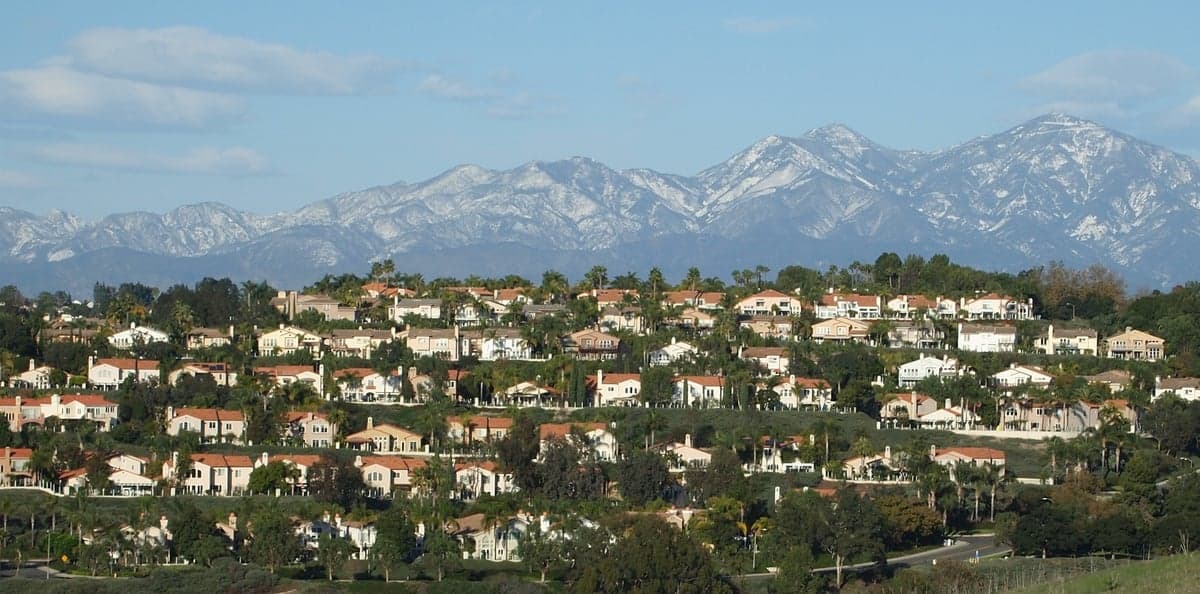
The people of Laguna Niguel today form a predominantly white, highly educated, and family-oriented community of 64,023 residents, with a notably low foreign-born share of 5.8% that reflects its character as an established, primarily domestic-magnet suburb. The city is marked by a distinctly upper-middle-class profile—59.3% of adults hold a college degree—and a population that is 64.3% white, 15.4% Hispanic, 10.1% East/Southeast Asian, 1.7% Black, and 1.4% Indian (subcontinent). Residents identify strongly with their specific neighborhoods, from the master-planned tracts of Niguel Summit to the coastal-adjacent enclaves of Monarch Beach, and the city’s identity is one of planned order, scenic hillsides, and a deliberate, quiet prosperity.
How the city was settled and grew
Laguna Niguel is a genuinely post-1900, master-planned suburb with no colonial-era settlement. Its human history begins with the 1846 Rancho Niguel land grant, which passed through a handful of ranching families—most notably the Moulton family—who grazed cattle and sheep across the 13,000-acre tract well into the 20th century. The area remained sparsely populated, with fewer than 200 residents as late as 1950, consisting almost entirely of ranch hands and their families living in scattered homesteads near what is now Crown Valley Parkway. The first major population wave arrived after 1959, when the Mission Viejo Company acquired the land and began master-planning a series of residential villages. The earliest neighborhoods—Aliso Creek and Glenwood—were built in the mid-1960s and attracted young white families from Los Angeles and Orange County’s older coastal cities, drawn by affordable new homes on large lots and the promise of good schools in a controlled suburban environment. These original residents were overwhelmingly native-born, middle-class, and employed in aerospace, defense, and emerging tech sectors in nearby Irvine and Santa Ana.
Modern era (post-1965)
The post-1965 era saw Laguna Niguel’s population surge from roughly 4,000 in 1970 to over 60,000 by 2000, driven almost entirely by domestic in-migration from other parts of California and the western United States. The 1965 Immigration Act had little direct effect here—the foreign-born share remains low—but the city did absorb a modest wave of East/Southeast Asian families (now 10.1% of the population) who moved into neighborhoods like Ocean Ranch and Bear Brand Ranch during the 1980s and 1990s, drawn by the same school quality and safety that attracted white families. Hispanic residents (15.4%) are concentrated in older, more moderately priced areas such as La Playa and parts of Niguel Shores, many working in service, construction, and hospitality in nearby Dana Point and Laguna Beach. The Indian-subcontinent community (1.4%) is small but visible in professional fields, with households clustered in newer infill developments near the Laguna Niguel Regional Park area. The city’s Black population (1.7%) remains very small and is dispersed without a distinct neighborhood concentration. Throughout this period, the city’s character has been defined by its planned villages—each with its own architectural guidelines and homeowners’ associations—which have reinforced a sense of orderly, homogeneous community life.
The future
Laguna Niguel’s population is slowly becoming more diverse, but the pace is measured. The white share has declined from roughly 78% in 2000 to 64.3% today, while the Hispanic and East/Southeast Asian shares have each grown by 3–5 percentage points over the same period. The foreign-born share, however, remains low at 5.8%, indicating that future growth will likely continue to come from domestic migration—particularly from younger families priced out of coastal Orange County cities like Newport Beach and Laguna Beach. Newer developments, such as the Marina Hills and Vantis neighborhoods, are attracting a slightly more diverse mix of professionals, including a growing number of East/Southeast Asian and Indian-subcontinent households. The city’s cultural identity is evolving from a purely white, upper-middle-class enclave toward a more multiethnic but still affluent suburb, though it remains far less diverse than neighboring Mission Viejo or Irvine. Over the next 10–20 years, the population is projected to plateau near 68,000 as buildable land runs out, with demographic change driven by generational turnover rather than new construction.
For someone moving in now, Laguna Niguel offers a stable, safe, and highly educated community where the population is gradually diversifying but remains overwhelmingly native-born and family-focused. The city is becoming slightly more multiethnic in its newer neighborhoods, but its core identity—planned, prosperous, and politically moderate-conservative—is unlikely to shift dramatically. It is a place for those who value predictability, good schools, and a low-crime environment over urban energy or rapid demographic change.

* Values derived from national, state, county, city and local statistics and may differ in a specific area. Last updated: 2026-06-08T04:43:35.000Z
Narrative content on this page is AI-generated and may contain mistakes. Verify any details that matter before acting on them.
ReloMaps may earn a commission from affiliate links at no extra cost to you.

