Photo: Wikipedia
Demographics of La Crosse, WI
Affluence Level in La Crosse, WI
A middle-class area roughly in line with national averages across income, home values, education, and employment.
People of La Crosse, WI
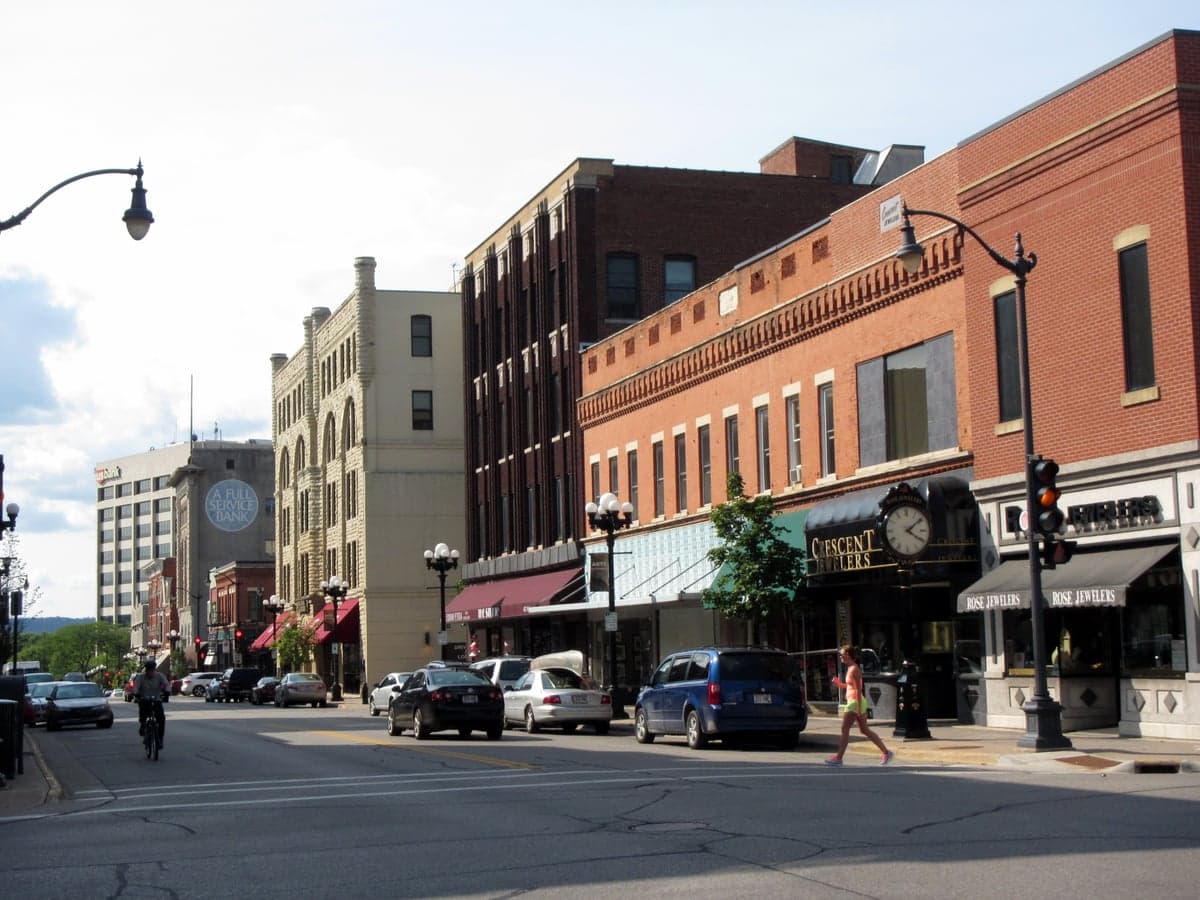
The people of La Crosse, Wisconsin, today number roughly 51,800, forming a predominantly white (87.2%) and college-educated (34.8%) population with a notably low foreign-born share of just 1.0%. The city’s identity is shaped by its role as a regional medical, educational, and manufacturing hub, anchored by the University of Wisconsin-La Crosse and major employers like Mayo Clinic Health System. Despite its modest size, La Crosse maintains a dense, walkable urban core with distinct neighborhoods that reflect the settlement patterns of 19th-century European immigrants and more recent, modest demographic shifts.
How the city was settled and grew
La Crosse was founded in the 1840s as a Mississippi River lumber and trading post, drawing its first major wave of settlers from New England and New York. The city’s explosive growth came after the Civil War, when German, Norwegian, and Irish immigrants arrived in large numbers to work in the sawmills, breweries, and rail yards. The Powell-Poage-Hamilton neighborhood, one of the city’s oldest, was originally a working-class German and Irish enclave, while the North Side became home to Norwegian immigrants who built St. John’s Lutheran Church and established tight-knit ethnic blocks. By 1900, La Crosse was a thriving river city of over 28,000, with the Grandview Heights area emerging as a middle-class district for second-generation European families. The city’s industrial base—lumber, brewing (G. Heileman Brewing Company), and later rubber and automotive parts—sustained these ethnic neighborhoods through the mid-20th century, with little non-European immigration until after 1965.
Modern era (post-1965)
Following the 1965 Hart-Cellar Act, La Crosse saw only a trickle of new immigration compared to larger Midwestern cities. The foreign-born population remains at just 1.0%, far below the national average. The most notable post-1965 shift has been the growth of East and Southeast Asian communities, primarily Hmong and Vietnamese families who arrived as refugees in the 1970s and 1980s. These groups concentrated in the Marsh Street corridor and parts of the South Side, where affordable housing and proximity to service jobs at Trane Technologies and local hospitals provided a foothold. Today, East/Southeast Asian residents make up 4.1% of the population, the largest non-white group. The Hispanic share (3.1%) and Black share (1.8%) remain small, with Hispanic families settling mostly in the Washburn neighborhood near industrial zones. The Indian subcontinent population is negligible at 0.4%, reflecting La Crosse’s limited draw for tech or professional migrants. Meanwhile, domestic in-migration from rural Wisconsin and Minnesota has kept the white population dominant, though the Powell-Poage-Hamilton neighborhood has seen some gentrification as young professionals and university faculty move into its historic housing stock.
The future
La Crosse’s population is projected to remain stable or decline slightly over the next decade, as the city’s birth rate lags and international immigration remains minimal. The white share is slowly eroding—down from over 92% in 2000—but the pace is glacial. The East/Southeast Asian community is plateauing, with younger generations assimilating and moving to suburbs like Onalaska or Holmen, while the Hispanic population is growing modestly through natural increase and some agricultural labor migration. The city is not tribalizing into distinct enclaves; rather, neighborhoods like the North Side and South Side are becoming more mixed, though still overwhelmingly white. The biggest demographic wildcard is the University of Wisconsin-La Crosse, which attracts a slightly more diverse student body—about 8% non-white—but most graduates leave for larger job markets. For the foreseeable future, La Crosse will remain a predominantly white, culturally homogenous city with a stable, aging population.
For someone moving in now, La Crosse offers a safe, affordable, and community-oriented environment with strong schools and outdoor recreation, but little racial or ethnic diversity. The city’s demographic trajectory suggests it will become neither a melting pot nor a collection of ethnic enclaves, but rather a quietly homogenizing Midwestern town where the biggest change is the gradual replacement of older white residents with younger white families and retirees. New arrivals should expect a welcoming but culturally uniform setting, with the most dynamic growth occurring in the surrounding suburbs rather than the city itself.

* Values derived from national, state, county, city and local statistics and may differ in a specific area. Last updated: 2026-04-21T10:34:26.000Z
Narrative content on this page is AI-generated and may contain mistakes. Verify any details that matter before acting on them.
ReloMaps may earn a commission from affiliate links at no extra cost to you.

