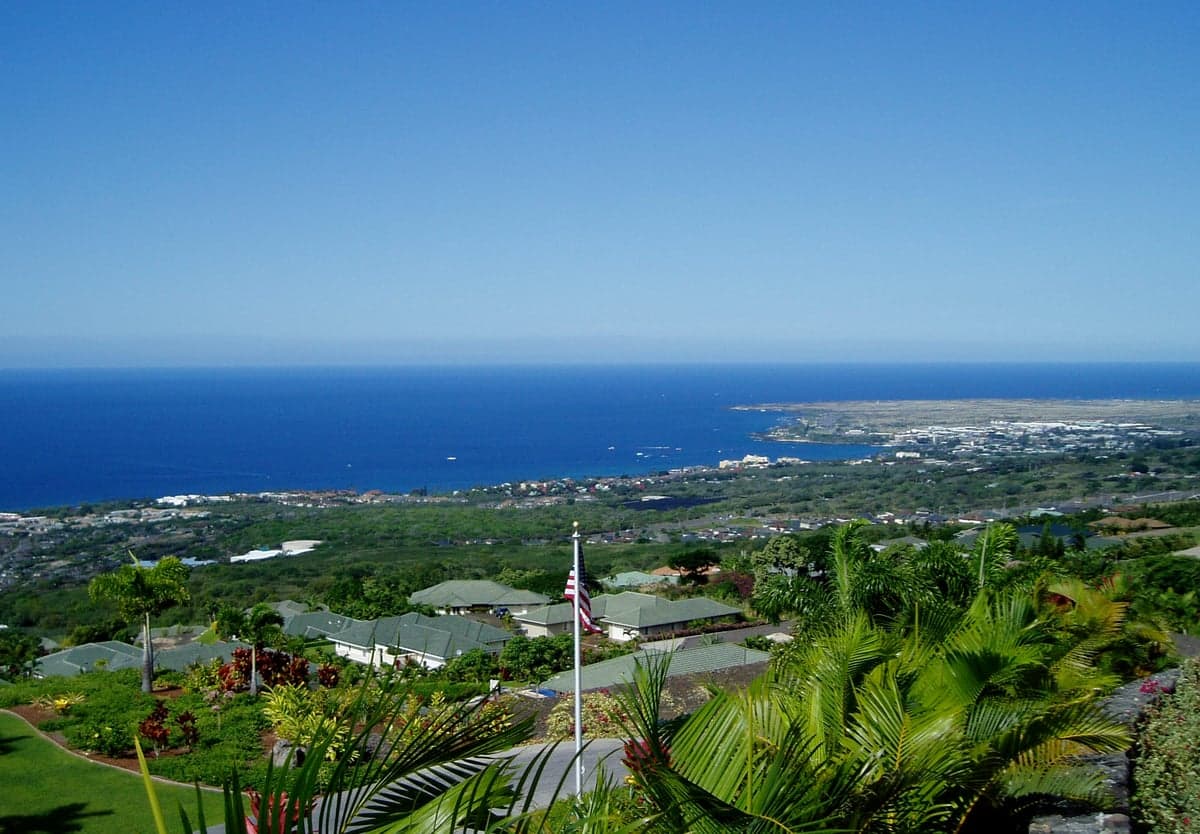
Photo: Wikipedia
Political ClimatePolitical Climate in Kona, HI
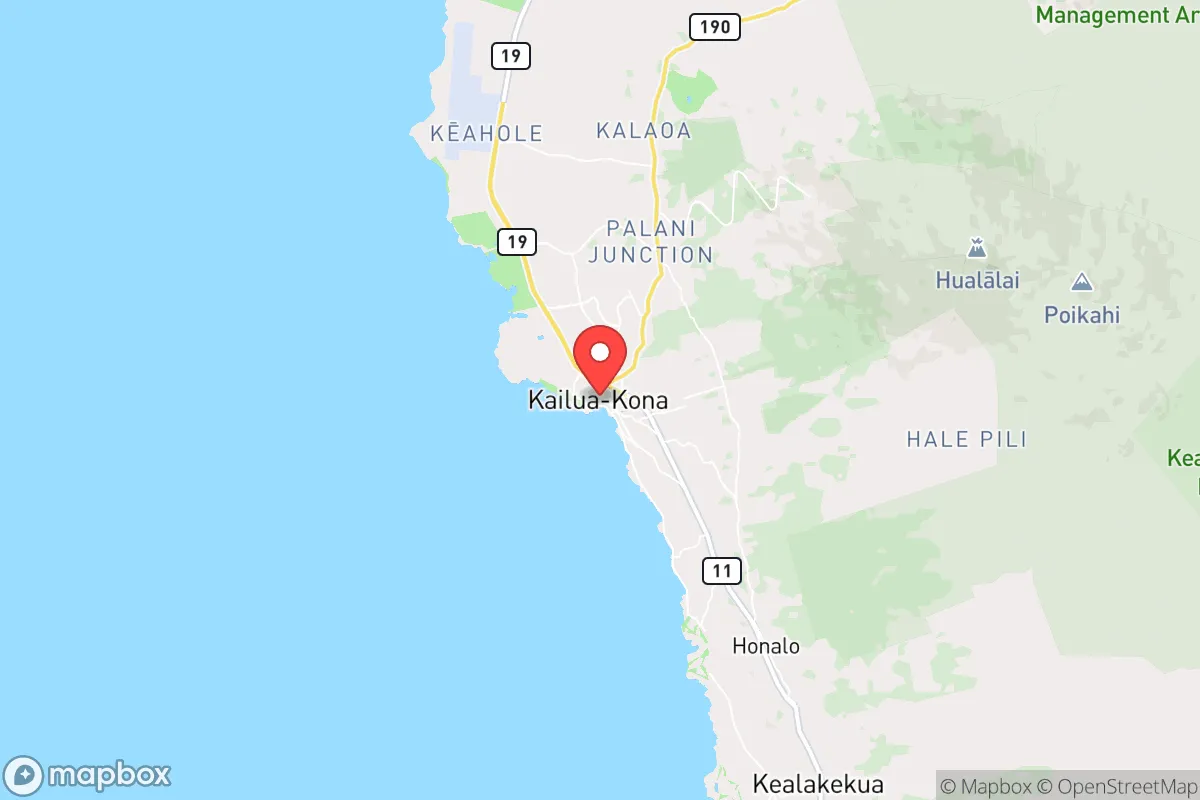
District shown is the primary district for this city’s centroid. Cities may span multiple districts.
Local Political AnalysisPolitical Analysis of Kona, HI
Kona, on the Big Island, leans solidly Democratic, with a Cook PVI of D+12, but that number doesn't tell the whole story of a place where politics is more about local issues than national party labels. The area has been shifting leftward over the past decade, driven largely by an influx of mainland transplants and a growing service economy, but it still retains a strong libertarian streak and a vocal conservative minority, especially among longtime ranching families and those in the construction trades. In the 2024 election, the precincts around Kailua-Kona voted roughly 60-40 for the Democratic candidate, while the more rural, upslope areas like Holualoa and Kealakekua were closer to a 50-50 split, reflecting a real divide between the coastal tourist zone and the agricultural interior.
How it compares
Compared to the rest of Hawaii County, Kona is actually more moderate than the reliably blue Hilo side, which often votes D+20 or higher. The contrast is stark when you drive 20 minutes north to the small town of Waimea, where the paniolo (cowboy) culture and large military presence at Pōhakuloa Training Area create a much more conservative vibe — Waimea precincts often vote Republican by 5-10 points. Meanwhile, the state of Hawaii as a whole is a deep blue stronghold, with no county voting Republican since 1984, but Kona's D+12 lean is noticeably less intense than Oahu's urban core (D+25) or Maui's central valley (D+18). The real political friction here isn't between Democrats and Republicans, but between "locals" (multi-generational families) and "newcomers" (mainland transplants), a divide that cuts across party lines and shows up in debates over vacation rentals, water rights, and development.
What this means for residents
For a liberal resident, Kona is comfortable but not a bubble — you'll encounter plenty of conservative voices at the grocery store or the hardware store, and the local Democratic party is more pragmatic than progressive, focused on affordable housing and infrastructure rather than social issues. A conservative resident won't feel isolated, but they will find that their views are a minority in local government, where the county council and state legislature are overwhelmingly Democratic. The practical effect is that property taxes remain low (Hawaii has one of the lowest effective property tax rates in the nation), but regulations on short-term rentals and building permits are tight, which frustrates both libertarian-leaning homeowners and environmentalist newcomers. Gun laws are strict by national standards, but enforcement is lax in the more rural parts of the district, and many locals quietly own firearms for hunting and protection.
The cultural distinction that defines Kona's politics is the tension between tourism-driven development and the preservation of rural, agricultural life. You'll see this play out in the annual debate over the Kona Coffee Festival, where some locals push for more commercialization while others fight to keep it a small-town event. The area's trajectory suggests it will continue to drift leftward as more mainlanders arrive, but the pace is slow enough that the old guard still has a real voice — and that mix is what keeps Kona from feeling like a political monoculture. If you're moving here, expect to navigate a community where your neighbor might be a vegan yoga instructor on one side and a cattle rancher on the other, and where the local politics are as layered as the lava rock under your feet.

State Political ClimatePolitical Climate in Hawaii
State Political AnalysisPolitical Environment in the State
Hawaii has been a solidly Democratic state for decades, with Democrats holding supermajorities in both legislative chambers and every statewide office since 2010. However, the state's political landscape is far more nuanced than a simple blue label suggests, with a strong independent streak and a unique blend of progressive and conservative values that often surprises newcomers. Over the past 10-20 years, the Democratic grip has tightened in terms of registration, but the actual voting behavior has become more volatile, with significant shifts in turnout and local races reflecting a growing frustration with the status quo, particularly around housing, cost of living, and tourism.
Urban vs. rural divide
The political map of Hawaii is a classic story of urban concentration versus rural dispersion, but with a twist. The overwhelming Democratic majority is driven by the city of Honolulu on Oahu, which contains roughly two-thirds of the state's population. The urban core of Honolulu, including neighborhoods like Waikiki and Kaimuki, consistently votes 70-80% Democratic. However, the suburban and exurban areas of Oahu, such as Kapolei and Ewa Beach, are more competitive, often splitting tickets between Democratic and Republican candidates, especially in local races. The real political divide is between Oahu and the Neighbor Islands. The Big Island (Hawaii County) is a fascinating battleground: the eastern side, including Hilo, is deeply progressive, while the western side, around Kailua-Kona and Waimea, leans more conservative, with a strong libertarian and ranching culture. Maui County, including Kahului and Kihei, is reliably Democratic but with a vocal minority of conservative-leaning farmers and retirees. Kauai is the most consistently Democratic of the Neighbor Islands, though its small population means local politics are intensely personal and less party-driven.
Policy environment
Hawaii's policy environment is a paradox. The state has the highest combined state and local tax burden in the nation, driven by a broad general excise tax (GET) that applies to nearly all goods and services, including business-to-business transactions. There is no state income tax on Social Security benefits, but income tax rates are progressive, topping out at 11% for high earners. Property taxes are relatively low compared to the mainland, but the cost of housing is astronomical. The regulatory posture is heavily interventionist, with strict land use laws, a powerful state-level zoning authority, and a notoriously slow permitting process for new construction. Education policy is a perennial flashpoint: the state has a single, centralized school district, the Hawaii Department of Education, which is often criticized for bureaucracy and underperformance. Healthcare is a mixed bag; the state has a strong safety net and a high rate of insured residents, but access to specialists is limited, especially on the Neighbor Islands. Election laws are relatively accessible, with universal mail-in voting and same-day registration, though voter turnout remains middling.
Recent policy direction
Recent legislation in Hawaii points in a distinctly progressive direction on social and environmental issues, but with a pragmatic, often conservative, bent on economic matters. In 2023, the state passed a comprehensive gun safety package that included a ban on carrying firearms in many public places, raising the purchase age to 21, and requiring liability insurance for gun owners. This was a direct response to the Supreme Court's Bruen decision and has been met with fierce opposition from gun rights advocates. On education, the state has expanded funding for early childhood education and teacher housing, but has resisted school choice measures like vouchers or charter school expansion. On medical and bodily autonomy, Hawaii has been a leader, with a 2023 law protecting access to abortion and gender-affirming care for out-of-state patients. On property rights, the state has taken a hard line against short-term rentals (like Airbnb) in residential neighborhoods, passing Act 46 in 2024 to crack down on illegal vacation rentals, a move popular with locals but controversial among property owners. On taxation, the state has not cut the GET, but has increased the Earned Income Tax Credit and created a child tax credit. On voting, the state has made mail-in voting permanent and expanded early voting, but has not implemented ranked-choice voting, which was rejected in a 2024 ballot measure.
Civil unrest & political movements
Hawaii has a long history of civil unrest, rooted in the legacy of the overthrow of the Hawaiian Kingdom in 1893. The sovereignty movement is a persistent and influential force, with groups like the Hawaiian Kingdom and the Office of Hawaiian Affairs (OHA) advocating for varying degrees of self-determination. Protests are common, particularly around land use and development. The most visible recent flashpoint was the Thirty Meter Telescope (TMT) protests on Mauna Kea in 2019, which drew thousands of Native Hawaiian activists and their allies, shutting down construction for months. This movement has evolved into a broader critique of tourism, development, and the state's political establishment. On the right, there is a small but active libertarian and conservative movement, focused on property rights, gun rights, and opposition to vaccine mandates. The 2020-2021 COVID-19 restrictions, which included some of the strictest travel quarantines in the nation, sparked significant backlash, with protests at the state capitol and a surge in support for anti-mandate candidates. Immigration politics are less contentious than on the mainland, as Hawaii has a large immigrant population from Asia and the Pacific, but there is tension around the influx of mainlanders driving up housing costs. There is no sanctuary city policy per se, but local law enforcement generally does not cooperate with federal immigration enforcement on routine matters. Election integrity controversies are minimal, with no major fraud allegations gaining traction.
Projection
Over the next 5-10 years, Hawaii's political trajectory is likely to be defined by a collision of demographic and economic pressures. The state is experiencing a slow but steady out-migration of native-born residents, particularly young families and working-age adults, who are leaving for lower-cost states like Nevada, Texas, and Idaho. This is being offset by an influx of wealthy mainlanders, many of whom are retirees or remote workers, who tend to be more moderate or conservative on economic issues but socially liberal. This demographic shift could make the state more competitive in statewide races, particularly for governor, but the Democratic supermajority in the legislature is likely to persist due to the concentration of voters in Honolulu. The biggest wildcard is the housing crisis: if the state fails to build more housing, the out-migration will accelerate, hollowing out the middle class and making the state even more polarized between a wealthy elite and a service-dependent underclass. A new resident moving in now should expect to find a state that is politically stable in its Democratic lean, but increasingly fractious and populist, with a growing divide between the "old Hawaii" of local families and the "new Hawaii" of transplants and investors.
For a new resident, the bottom line is this: Hawaii is a high-tax, high-regulation state with a strong social safety net and a deeply entrenched political establishment. If you are a conservative who values low taxes, gun rights, and school choice, you will find the state's policy environment frustrating. However, if you are a conservative who values community, environmental stewardship, and a slower pace of life, you may find common ground with many locals on issues like land use, tourism limits, and local control. For liberals, the state is a comfortable fit on social issues, but the high cost of living and bureaucratic inefficiency can be a shock. Regardless of your politics, the key to thriving in Hawaii is understanding that the political labels don't always map neatly onto the mainland's culture war. The real divide here is often between those who were born here and those who came later, and the most important political skill is listening to the local perspective.
* Values derived from national, state, county, city and local statistics and may differ in a specific area. Last updated: 2026-07-29T03:58:55.000Z
Narrative content on this page is AI-generated and may contain mistakes. Verify any details that matter before acting on them.
ReloMaps may earn a commission from affiliate links at no extra cost to you.

