
Photo: Wikipedia
Political ClimatePolitical Climate in Taylor County
Showing district-level results — no local-only data available.
Local Political AnalysisPolitical Analysis of Taylor County
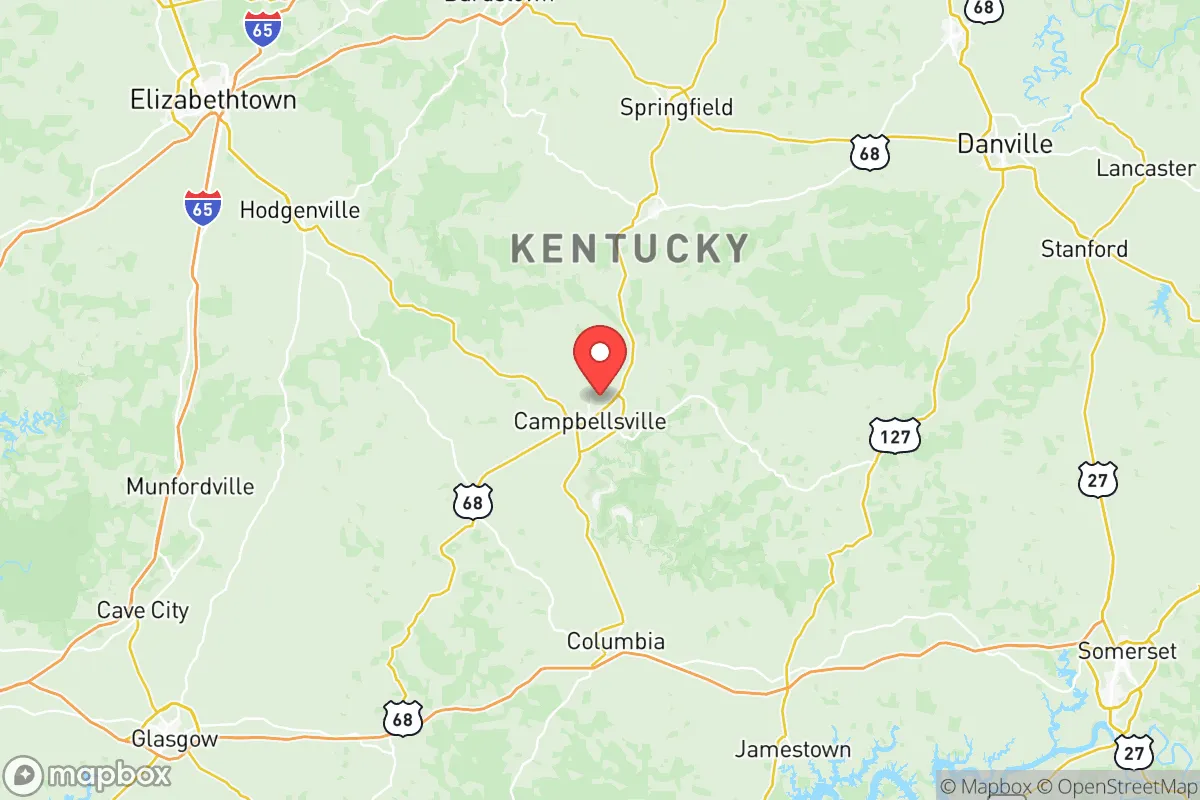
Taylor County, anchored by the city of Campbellsville, is one of the most reliably Republican counties in Kentucky, carrying a Cook Partisan Voting Index (PVI) of R+23. That’s a full eight points more conservative than the state of Kentucky as a whole, which sits at R+15. This isn’t a recent shift; the county has been trending red for decades, but the margin has widened noticeably since 2016. In the 2024 presidential election, Donald Trump pulled in over 75% of the vote here, a number that would have been unthinkable even in the Bush years. The local GOP apparatus is well-organized, and straight-ticket Republican voting is the norm in most precincts.
How it compares
To understand how deep the red runs in Taylor County, you have to look at the state-level numbers. Kentucky as a whole is solidly Republican, but it still has pockets of blue—Louisville, Lexington, and a few college towns like Morehead and Murray. Taylor County doesn’t have those. The only real variation is within the county itself. Campbellsville, home to Campbellsville University and a small but noticeable student population, is the closest thing to a moderate area. Precincts around the university campus and downtown sometimes run 5-10 points less Republican than the rural precincts. For example, in the 2022 Senate race, the precinct covering the university area gave Rand Paul about 62% of the vote, while precincts in the far eastern part of the county, around the small community of Mannsville, pushed him past 80%. The rural precincts around Elk Horn and the Green River Lake area are the most conservative, with turnout driven by gun rights, anti-abortion sentiment, and opposition to state-level tax increases. There are no swing precincts in the traditional sense—no area flips between parties—but the Campbellsville city precincts are where a Democrat would need to run up the score to have any chance, and even that is a long shot.
What this means for residents
For conservative residents, the political climate is comfortable and affirming. Local elected offices—county judge-executive, sheriff, school board—are held by Republicans, and the county’s legislative delegation in Frankfort is uniformly conservative. There’s little internal friction on cultural issues like gun policy or religious freedom. For liberal residents, the reality is more isolating. There’s no active Democratic Party infrastructure to speak of, and progressive viewpoints are rarely represented in local media or public forums. That said, the county is not hostile in a personal sense; people tend to be neighborly regardless of party affiliation. The practical effect is that liberal residents often keep their politics private or focus on national issues rather than local ones. The biggest policy distinction between Taylor County and the state as a whole is on taxation: the county has consistently voted against local option sales tax increases, even when neighboring counties like Adair and Green have approved them for specific projects.
Culturally, Taylor County is more insular than the state average. There’s less in-migration from out of state, so the political conversation stays local and personal. The county’s strong Baptist and Methodist church presence reinforces social conservatism in a way that feels organic rather than performative. If you’re looking for a place where politics is a background hum rather than a daily argument, this is it—but only if you’re on the same side as the majority. For someone moving here from a blue state, the adjustment is less about hostility and more about the absence of any countervailing political voice. The trajectory is clear: Taylor County will continue to drift rightward, even as Kentucky as a whole may moderate slightly due to growth in Louisville and Lexington. The gap between the county and the state is likely to widen, not narrow.

State Political ClimatePolitical Climate in Kentucky
State Political AnalysisPolitical Environment in the State
Kentucky is a deeply conservative state, with a Cook Partisan Voting Index of R+15, meaning it votes about 15 points more Republican than the national average in presidential elections. The state has shifted hard right over the past two decades — in 2000, it was a competitive lean-Republican state; by 2024, Donald Trump carried it by over 30 points. The dominant coalition is a mix of rural and small-town voters, evangelical Christians, and working-class whites, with the GOP holding supermajorities in both chambers of the General Assembly and every statewide office. For a relocator, this means a state where conservative values shape nearly every level of governance, from tax policy to education, but where the blue cities of Louisville and Lexington still provide a visible counterweight.
Urban vs. rural divide
The political map of Kentucky is a textbook study in the urban-rural split. The two major metros — Louisville (Jefferson County) and Lexington (Fayette County) — are the only reliably Democratic strongholds, each voting blue by 15-20 points in recent presidential cycles. Louisville, the state's largest city, is a union-heavy, racially diverse, and culturally moderate-to-liberal anchor; Lexington, home to the University of Kentucky, leans younger and more progressive. Outside these two islands, the state is overwhelmingly red. The suburbs of both cities are mixed: Oldham County (east of Louisville) is solidly Republican, while Boone County (part of the Cincinnati metro in northern Kentucky) has been trending redder. The eastern coalfields — places like Pikeville, Hazard, and Prestonsburg — are among the most Republican areas in the nation, routinely voting 80%+ for GOP candidates. Western Kentucky, including Owensboro and Paducah, is reliably conservative but less intensely so than the east. The rural-urban gap has widened sharply since 2010, as nationalized politics have pushed rural voters further right and urban voters further left.
Policy environment
Kentucky's policy environment is shaped by a Republican supermajority that has held power since 2017. The state has a flat income tax that is being phased down from 5% to 4% by 2026, with a goal of eventual elimination. There is no state-level property tax on vehicles, and property taxes on real estate are low by national standards. The regulatory posture is business-friendly, with right-to-work laws and a tort reform cap on non-economic damages. Education policy has been a flashpoint: the state passed a school choice bill in 2022 allowing charter schools, though none have opened yet, and a 2024 law expanded education savings accounts for private and homeschool expenses. Healthcare is a mixed picture — Kentucky expanded Medicaid under the Affordable Care Act, covering over 400,000 residents, but the state has also imposed work requirements (currently tied up in court). Election laws have tightened: a 2021 law shortened the absentee voting window, required photo ID, and limited drop boxes. The state does not have universal mail-in voting. On social issues, Kentucky is a trigger law state that banned abortion with no exceptions for rape or incest after the Dobbs decision, though a 2022 court ruling temporarily blocked enforcement; the law remains in legal limbo. The state also has a constitutional amendment defining marriage as between a man and a woman, though it is unenforceable under federal law.
Recent policy direction
Over the past five years, Kentucky has moved decisively in a conservative direction across multiple fronts. On gun and self-defense law, the state became a permitless carry (constitutional carry) state in 2019, and in 2023 it passed a law prohibiting local governments from enacting their own gun restrictions — overriding Louisville's attempt to ban assault weapons. On parental and education rights, a 2022 law banned the teaching of "divisive concepts" related to race and gender in public schools, and a 2024 law required schools to notify parents of any changes to a student's health or emotional well-being, effectively a "parental rights" bill. On speech and privacy, the state has not passed a broad online privacy law, but it did enact a 2023 law restricting TikTok on government devices. On medical and bodily autonomy, the near-total abortion ban remains the headline, but the state also passed a 2023 law banning gender-affirming care for minors, overriding a veto from Democratic Governor Andy Beshear. On property rights, Kentucky is a "Dillon's Rule" state, meaning local governments have only the powers explicitly granted by the state — a structure that limits local zoning and land-use control. On taxation, the phased income tax cut is the major story, alongside a 2022 law exempting military pensions from state income tax. On voting and ballot access, the 2021 law (SB 1) shortened early voting from three weeks to two, eliminated straight-ticket voting, and required a notarized application for absentee ballots — changes that disproportionately affect urban and Democratic-leaning voters.
Civil unrest & political movements
Kentucky has seen its share of political flashpoints. The 2020 protests in Louisville following the death of Breonna Taylor were among the largest and most sustained in the country, drawing national attention to police accountability and racial justice. The city saw months of demonstrations, a state of emergency, and the eventual passage of "Breonna's Law" banning no-knock warrants — though the law has been criticized as weak by activists. On the right, the state has a strong gun rights movement, with the Kentucky State Rifle and Pistol Association being a major lobbying force. Immigration politics are less heated than in border states, but there have been localized controversies over refugee resettlement in Louisville and the presence of immigrant workers in the bourbon industry. There is no significant secession or nullification movement in Kentucky, though rural counties have occasionally floated "sanctuary county" resolutions against federal gun or vaccine mandates. Election integrity has been a recurring theme: after the 2020 election, Republican lawmakers cited "trust" concerns to justify the voting restrictions in SB 1, though no widespread fraud was ever documented. A new resident would notice the political divide most visibly in yard signs, church parking lots, and the tone of local news coverage — Louisville's Courier-Journal is liberal-leaning, while the Lexington Herald-Leader is more centrist, and rural papers like the Owensboro Messenger-Inquirer are conservative.
Projection
Over the next 5-10 years, Kentucky is likely to become more Republican, not less. The demographic trends driving this are clear: rural and exurban areas are growing slowly or shrinking, but the voters who remain are becoming more conservative. The urban centers of Louisville and Lexington are growing, but not fast enough to offset the rural shift. In-migration is modest — Kentucky is not a major destination for out-of-state movers like Texas or Florida — and the people who do move in tend to be retirees or remote workers from the Midwest and South, who lean conservative. The Democratic Party in Kentucky is increasingly confined to the two major cities and a handful of college towns (Bowling Green, Richmond, Morehead). The GOP supermajority is unlikely to be seriously challenged in the next decade, meaning the policy direction — lower taxes, school choice, gun rights, social conservatism — will continue. The wild card is Governor Andy Beshear, a popular Democrat who won re-election in 2023 by running as a moderate focused on infrastructure and economic development, but his vetoes are routinely overridden by the legislature. A new resident moving in now should expect a state where conservative governance is the norm, but where the urban-rural cultural divide will remain sharp and occasionally contentious.
For a new resident, the bottom line is straightforward: if you align with conservative values on taxes, guns, education, and social issues, Kentucky will feel like a state that is moving in your direction. If you lean liberal, you will find a comfortable home in Louisville or Lexington, but you will be living in a state where your vote has limited impact on statewide policy. The practical takeaway is that Kentucky offers a low-cost, low-regulation environment with a strong sense of local community, but the political climate is increasingly polarized along geographic lines. Choose your county carefully — the difference between living in Jefferson County and Pike County is not just a difference in landscape, but a difference in the entire political and cultural experience of daily life.
* Values derived from national, state, county, city and local statistics and may differ in a specific area. Last updated: 2026-07-22T14:43:49.000Z
Narrative content on this page is AI-generated and may contain mistakes. Verify any details that matter before acting on them.
ReloMaps may earn a commission from affiliate links at no extra cost to you.

