
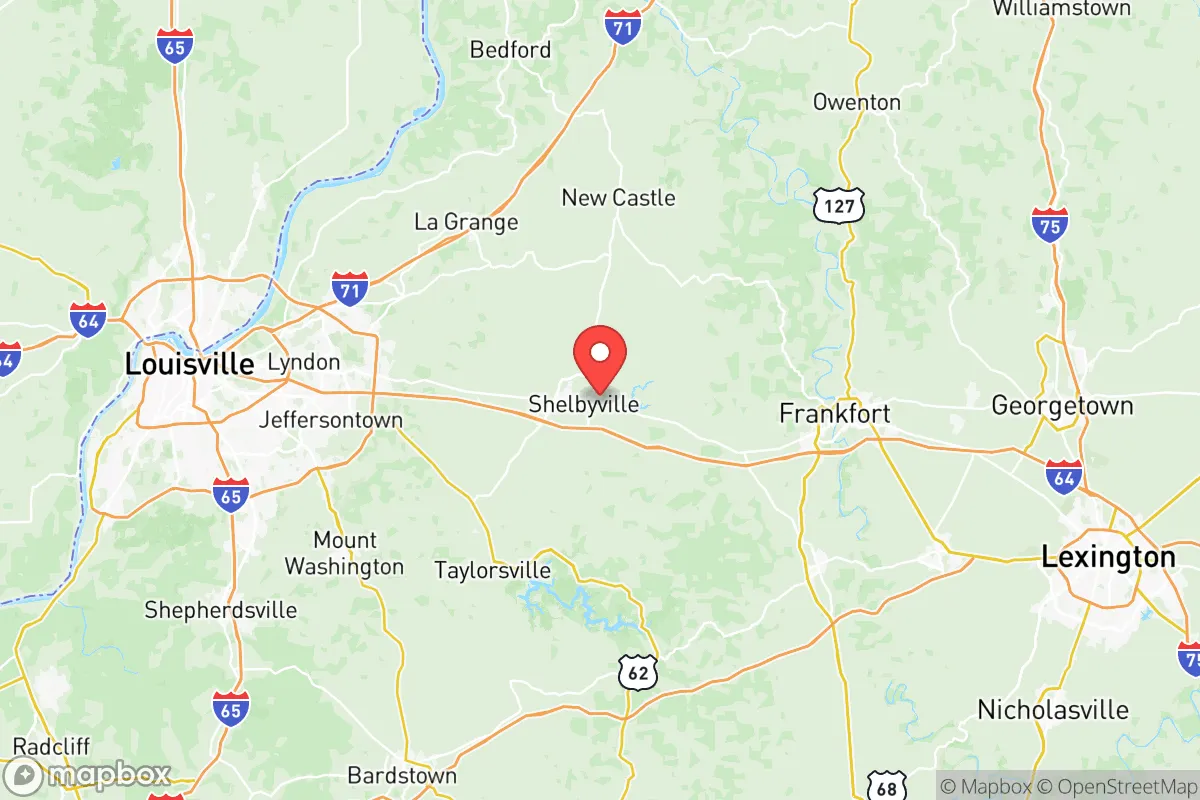
Photo: Wikipedia
Quality of Life in Shelby County
A livable area that tracks near national norms for affordability, walkability, and neighborhood health.
What does Quality of Life tell us?
Quality of Life measures an area by evaluating factors like cost of living, nearby amenities, country club access, airport proximity, socioeconomic signals and neighborhood character. For large states, this is a general average — quality of life can vary dramatically between metro areas, suburbs, and rural communities within the same state.
What does this tell us?
Quality of Life measures an area by evaluating factors like cost of living, nearby amenities, country club access, airport proximity, socioeconomic signals and neighborhood character. For large states, this is a general average — quality of life can vary dramatically between metro areas, suburbs, and rural communities within the same state.
Cost of Living
9% below national average
104%
The Real Cost of Living in Shelby County for 2026
| Tier | Individual | Family (4) |
|---|---|---|
| Survival | $16k | $30k |
| Comfortable | $54k | $79k |
| Luxury | $130k+ | $201k+ |
| Elite (Top 5%) | $153k+ | $237k+ |
Quality-of-Life Analysis
Shelby County, Kentucky, offers a quality-of-life spectrum that spans from the walkable, historic county seat of Shelbyville to quiet unincorporated crossroads and working farmland, attracting everyone from Louisville commuters seeking affordable acreage to families wanting small-town schools and retirees looking for slower-paced rural living. With a cost-of-living index of 91 (well below the national average of 100), a median home value of $277,500, and a median rent of $998, the county provides tangible financial breathing room compared to nearby metro areas. The 26.9-minute average commute reflects a county where many residents work in Louisville or Frankfort but return to a distinctly different, more spacious environment.
Largest town(s) & population centers
Shelbyville, the county seat and largest municipality (population roughly 17,000), is the primary hub for shopping, dining, and services. Daily life here centers around the historic downtown square, which features locally owned restaurants, boutique shops, and the Shelby County Courthouse. The town offers a mix of older homes on tree-lined streets and newer subdivisions on the outskirts, with grocery stores, a Walmart Supercenter, and medical facilities all within a short drive. Simpsonville, the county's second-largest town (population around 3,000), has grown rapidly as a bedroom community for Louisville, located just off I-64. Its daily life is more suburban, with newer housing developments, the Outlet Shoppes of the Bluegrass, and quick highway access to the city. Both towns have their own elementary schools and share the county's highly rated public school system, Shelby County Public Schools.
Smaller towns & rural pockets
Beyond the two main towns, Shelby County contains several smaller communities that offer a quieter, more rural lifestyle. Pleasureville, straddling the Henry County line, is a tiny unincorporated community with a handful of homes and a strong agricultural identity. Waddy, located along US-60, is another unincorporated area where residents live on larger lots and farmland, often raising horses or cattle. Finchville and Harrisonville are crossroads settlements with little more than a church and a few houses, representing the most remote end of the county's spectrum. These areas lack commercial services, so residents drive 15–25 minutes to Shelbyville or Simpsonville for groceries and errands. The rural pockets are dominated by horse farms, row crops, and historic farmhouses, appealing to those who prioritize privacy and land over convenience.
Cost & lifestyle range
The cost of living and lifestyle options vary noticeably across Shelby County. At the higher end, newer subdivisions in Simpsonville and the south side of Shelbyville (near I-64) feature homes priced from $350,000 to $500,000, attracting professionals and families who commute to Louisville. These areas offer sidewalks, neighborhood parks, and proximity to shopping. At the more affordable end, older homes in downtown Shelbyville and properties in Pleasureville or Waddy can be found for $200,000–$250,000, with some fixer-uppers below $200,000. Rentals at the county's median of $998 are concentrated in Shelbyville's apartment complexes and duplexes, while rural rentals are scarce. The lifestyle range is equally broad: a family in a Simpsonville subdivision might have a 20-minute commute to Louisville and access to chain restaurants, while a retiree on acreage near Finchville might drive 30 minutes to the nearest hospital and enjoy total quiet. Property taxes in Shelby County are moderate, and there is no local occupational tax in the unincorporated areas, which slightly lowers the effective cost for rural residents.
Shelby County is best suited for those who want Kentucky's low cost of living and open space without being completely isolated from urban amenities. Commuters who work in Louisville or Frankfort but prefer a slower pace, families seeking good schools and a safe environment, and rural property owners who value land and privacy all find a niche here. The county's mix of historic small-town character, suburban growth, and working farmland means that the right fit depends almost entirely on how much land and how much convenience a person wants.

Crime in Shelby County
Generally safer than 62% of comparable U.S. locations.
Violent CrimeViolent Crime Analysis
Property CrimeProperty Crime Analysis
Crime Analysis
Shelby County, Kentucky, presents a mixed safety profile that is heavily influenced by its position between the Louisville and Lexington metro areas. With a violent crime rate of 212.6 per 100,000 residents and a property crime rate of 1,275.5 per 100,000, the county is safer than Kentucky's urban cores but faces challenges that potential residents should weigh carefully, particularly in and around the county seat of Shelbyville.
Crime in context
Shelby County's violent crime rate of 212.6 per 100,000 is notably lower than the national average of roughly 380 per 100,000 and significantly below Kentucky's statewide average of approximately 240 per 100,000. This places Shelby County in a relatively favorable position compared to nearby Jefferson County (Louisville), which posts a violent crime rate near 700 per 100,000. However, the property crime rate of 1,275.5 per 100,000 is a more pressing concern, running slightly above the national average of about 1,200 per 100,000 and well above the Kentucky state average of roughly 1,100 per 100,000. The county's proximity to the I-64 corridor, which connects Louisville and Lexington, contributes to transient property crime, including vehicle break-ins and thefts from outbuildings in rural areas like Simpsonville and Waddy.
What residents experience
For those living in Shelby County, the day-to-day experience of crime varies sharply by location. The city of Shelbyville, the county's population center, accounts for the majority of reported incidents, with property crime concentrated around the commercial corridors of Main Street and Boone Station Road. Residents in subdivisions near the Shelbyville Square and the Shelby County High School area report occasional thefts from vehicles and package thefts, but violent confrontations are rare. In contrast, the smaller communities of Simpsonville and Waddy experience significantly lower crime rates, with Simpsonville in particular benefiting from its newer residential developments and a more affluent tax base that supports a visible sheriff's patrol presence. The unincorporated areas along U.S. 60 and KY-55 see sporadic burglaries of farm equipment and storage sheds, a pattern common in rural Kentucky counties.
A critical factor for prospective residents to consider is the judicial environment. Shelby County falls within the 53rd Judicial Circuit, which includes the more populous and liberal-leaning Jefferson County (Louisville) in its appellate structure. While local judges in Shelby County have historically taken a moderate-to-conservative approach to sentencing, the broader influence of progressive prosecutorial policies from the Louisville metro area can create a "revolving door" effect for property crime offenders who cross county lines. This is a legitimate concern: offenders arrested in Shelby County for theft or drug possession may face reduced charges or diversion programs influenced by regional trends toward leniency, potentially increasing recidivism and keeping repeat property criminals on the streets. Residents in Shelbyville have reported frustration with seeing the same individuals arrested multiple times for shoplifting or vehicle break-ins, only to be released quickly.
Neighborhood-level variation
Neighborhood-level safety in Shelby County is not uniform. The safest areas are generally the newer subdivisions in Simpsonville, particularly around the Simpsonville Elementary School zone and the Lake Forest community, where violent crime is virtually nonexistent and property crime is well below the county average. The historic district of Shelbyville, centered on 6th Street and Washington Street, sees moderate property crime but very little violence. Conversely, the areas immediately surrounding the Shelbyville Industrial Park and the apartment complexes along Midland Trail and Frankfort Road report higher concentrations of theft and drug-related incidents. For families and retirees, the recommendation is to prioritize properties in Simpsonville or the outer rural subdivisions near Pleasureville and Bagdad, where sheriff's response times are faster and community watch programs are active. The county's overall safety is acceptable by Kentucky standards, but the property crime rate and the judicial system's regional tilt toward leniency warrant caution for anyone considering a move to the Shelbyville city limits.
* Values derived from national, state, county, city and local statistics and may differ in a specific area. Last updated: 2026-06-12T17:54:26.000Z
Narrative content on this page is AI-generated and may contain mistakes. Verify any details that matter before acting on them.
ReloMaps may earn a commission from affiliate links at no extra cost to you.

