
Photo: Wikipedia
Personal Sovereignty in Shelby County
Viable for self-reliance. Generally workable, though some barriers may limit total independence.
What does Personal Sovereignty tell us?
Personal Sovereignty measures your capacity for self-reliance and independence with minimal government friction. Higher scores mean fewer barriers between you and the way you want to live... but it assumes you have the space you need and good neighbors.
What does this tell us?
Personal Sovereignty measures your capacity for self-reliance and independence with minimal government friction. Higher scores mean fewer barriers between you and the way you want to live... but it assumes you have the space you need and good neighbors.
State Policy
Energy independence: Importer (60% of energy produced in-state)
Personal Liberty
Homesteading

Personal Liberty Analysis
Shelby County, Kentucky, offers a notably high degree of personal sovereignty, anchored by Kentucky’s strong preemption laws, a low tax burden, and a regulatory environment that generally favors individual decision-making over government oversight. For individuals and families prioritizing autonomy, the county presents a landscape where self-defense rights are robust, homesteading is feasible, and local governance tends toward a light touch, particularly outside the more developed areas of Shelbyville and Simpsonville. This analysis examines the specific factors that shape personal freedom in Shelby County, comparing the regulatory posture across its varied communities.
Tax burden and regulatory posture: How Kentucky’s policies affect your wallet and choices
Shelby County’s tax environment is among the most favorable in the region for those seeking to keep more of their earnings. Kentucky has a flat state income tax rate of 4.5% as of 2025, with scheduled reductions tied to revenue triggers, and the state does not tax Social Security benefits. Property taxes in Shelby County are moderate, with a countywide rate of approximately $0.86 per $100 of assessed value for real estate, though rates vary slightly within city limits. For example, Shelbyville imposes a slightly higher property tax rate than unincorporated areas like Waddy or Finchville, where county-only rates apply. The regulatory posture is generally permissive: Kentucky is a right-to-work state, and Shelby County has no county-level business licensing requirements beyond state mandates. Zoning is minimal in rural areas—most of the county outside Shelbyville and Simpsonville is zoned agricultural or residential with few restrictions on home-based businesses, livestock, or accessory structures. This contrasts with more heavily regulated counties in neighboring states, making Shelby County attractive for those who value low interference in property use and economic activity.
Self-defense and gun law specifics: What you can and cannot do in Shelby County
Kentucky is a constitutional carry state, meaning no permit is required to carry a concealed firearm for anyone legally allowed to possess one. Shelby County fully aligns with this, and local law enforcement does not impose additional restrictions. The state also has a strong preemption law (KRS 65.870) that prohibits local governments from enacting gun ordinances stricter than state law, so cities like Shelbyville and Simpsonville cannot ban firearms in parks, public buildings, or other municipal spaces—except where state law explicitly allows, such as courthouses and K-12 schools. Stand-your-ground laws apply, with no duty to retreat in any place where a person is lawfully present. Castle doctrine protections extend to vehicles and occupied structures. For those interested in training, the Shelby County Sheriff’s Office issues concealed carry permits (though not required for carry) and offers voluntary firearms safety courses. The practical effect is that gun owners in Pleasureville or Bagdad enjoy the same legal protections as those in Louisville, but with far less cultural friction—gun ownership is common and socially normalized across the county.
Self-reliance and homesteading viability: Lot sizes, zoning, and off-grid feasibility
Shelby County is one of Kentucky’s most viable locations for homesteading and off-grid living, particularly in its eastern and southern rural stretches. Minimum lot sizes in unincorporated areas are generally 1 acre for residential use, but agricultural parcels of 5 to 40 acres are common and affordable—land prices average $5,000–$8,000 per acre as of 2025. Zoning in areas like Waddy and Finchville is agricultural (A-1), which permits livestock, crop farming, and accessory structures like barns and greenhouses without special permits. Off-grid feasibility is high: Kentucky has no state-level prohibition on rainwater collection, and Shelby County does not require connection to municipal water or sewer in rural zones—private wells and septic systems are standard. Solar panels are permitted without county-level restrictions, though net metering is available through local utilities like Shelby Energy Cooperative. The county’s building code is based on the Kentucky Residential Code, but enforcement is minimal in rural areas; owner-built homes are allowed with proper permitting. For those seeking maximum self-reliance, Bagdad and Harrisonville offer the most permissive environments, while Simpsonville—a growing exurb—has stricter subdivision covenants and HOA-governed developments that limit livestock and outbuildings.
Personal liberties: Parental rights, medical autonomy, speech, and property
Kentucky law provides strong protections for parental rights, including a 2024 law (HB 171) that affirms parents’ authority to direct their children’s education, healthcare, and religious upbringing. Shelby County Public Schools, which serves the entire county, allows parents to opt children out of any curriculum or activity without penalty, and the district does not enforce mask or vaccine mandates for students. Medical autonomy is less codified: Kentucky has no state-level right-to-try law for terminally ill patients, but it does allow direct primary care agreements (DPC) without insurance interference, and several DPC clinics operate in Shelbyville. Vaccine mandates are prohibited for state employees and contractors, but private employers may still require them. Free speech is robustly protected under the Kentucky Constitution, and Shelby County has no local ordinances restricting signs, leafleting, or public assembly. Property rights are reinforced by Kentucky’s eminent domain laws, which require just compensation and a demonstrated public use; agricultural land is rarely targeted for condemnation. The county’s planning and zoning board has a reputation for deferring to landowners, especially in rural precincts like Pleasureville and Finchville, where variance requests are routinely approved.
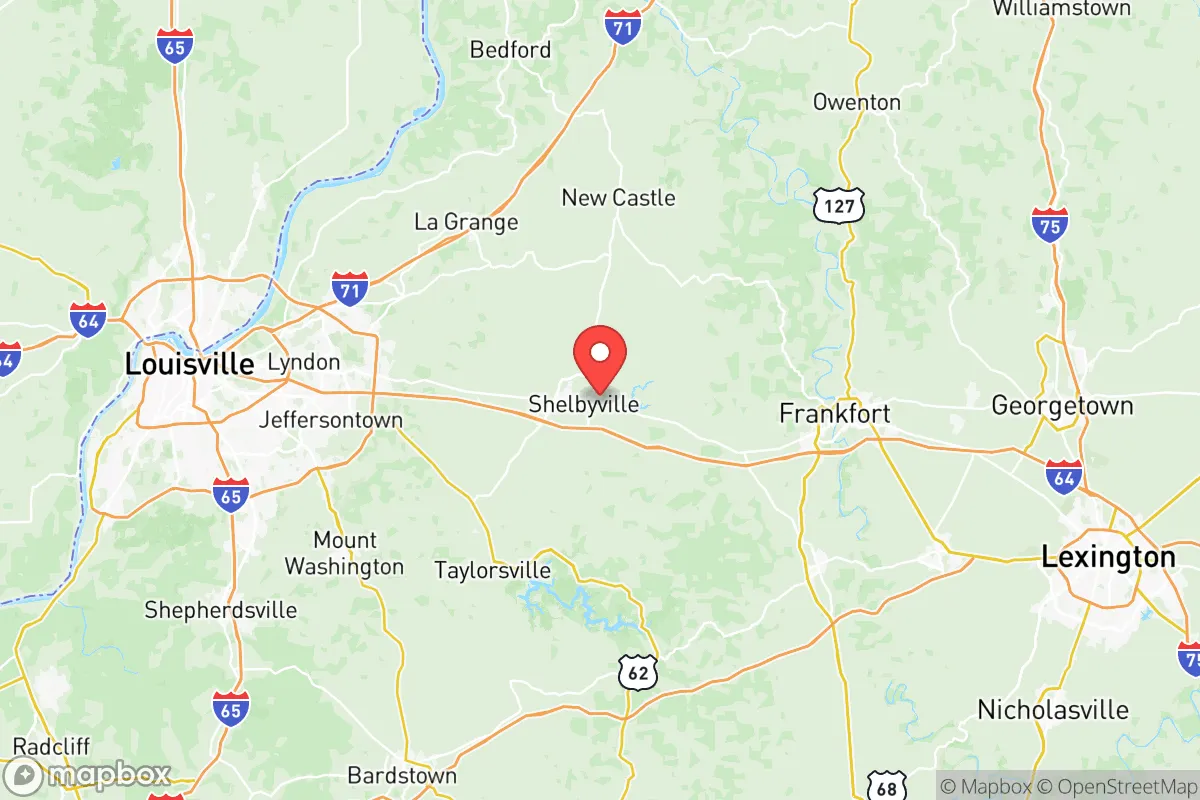
Overall, Shelby County ranks among the top Kentucky counties for personal sovereignty, offering a balance of low taxes, strong self-defense rights, and permissive land-use policies that support self-reliance. Compared to more restrictive areas like Louisville’s Jefferson County or Lexington’s Fayette County, Shelby County provides a lighter regulatory touch without sacrificing access to urban amenities—Shelbyville is 30 minutes from Louisville and 45 minutes from Lexington. For families and individuals who prioritize autonomy in daily life, the county’s combination of state-level protections and local deference to individual choice makes it a compelling relocation option in the Bluegrass region.

* Values derived from national, state, county, city and local statistics and may differ in a specific area. Last updated: 2026-06-12T17:54:26.000Z
Narrative content on this page is AI-generated and may contain mistakes. Verify any details that matter before acting on them.
ReloMaps may earn a commission from affiliate links at no extra cost to you.

