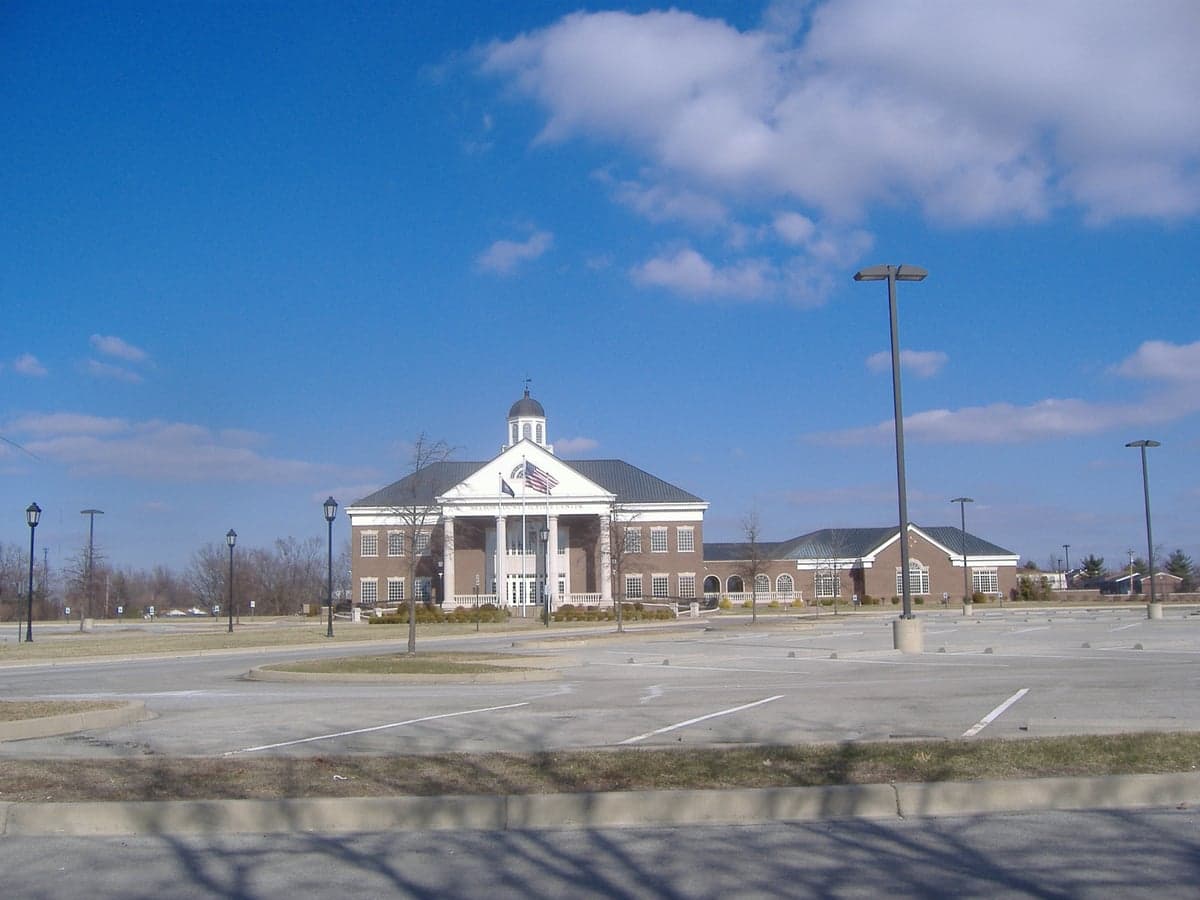
Photo: Wikipedia
Political ClimatePolitical Climate in Nelson County
Showing district-level results — no local-only data available.
Local Political AnalysisPolitical Analysis of Nelson County
Nelson County, Kentucky, is a reliably Republican stronghold with a Cook PVI of R+20, meaning it votes about 20 points more Republican than the national average. This is a noticeably redder tilt than the state of Kentucky as a whole, which sits at R+15. The county has been trending rightward over the past decade, driven by rural voters and a growing exurban population that commutes to Louisville, but the shift hasn't been uniform across all its communities.
How it compares
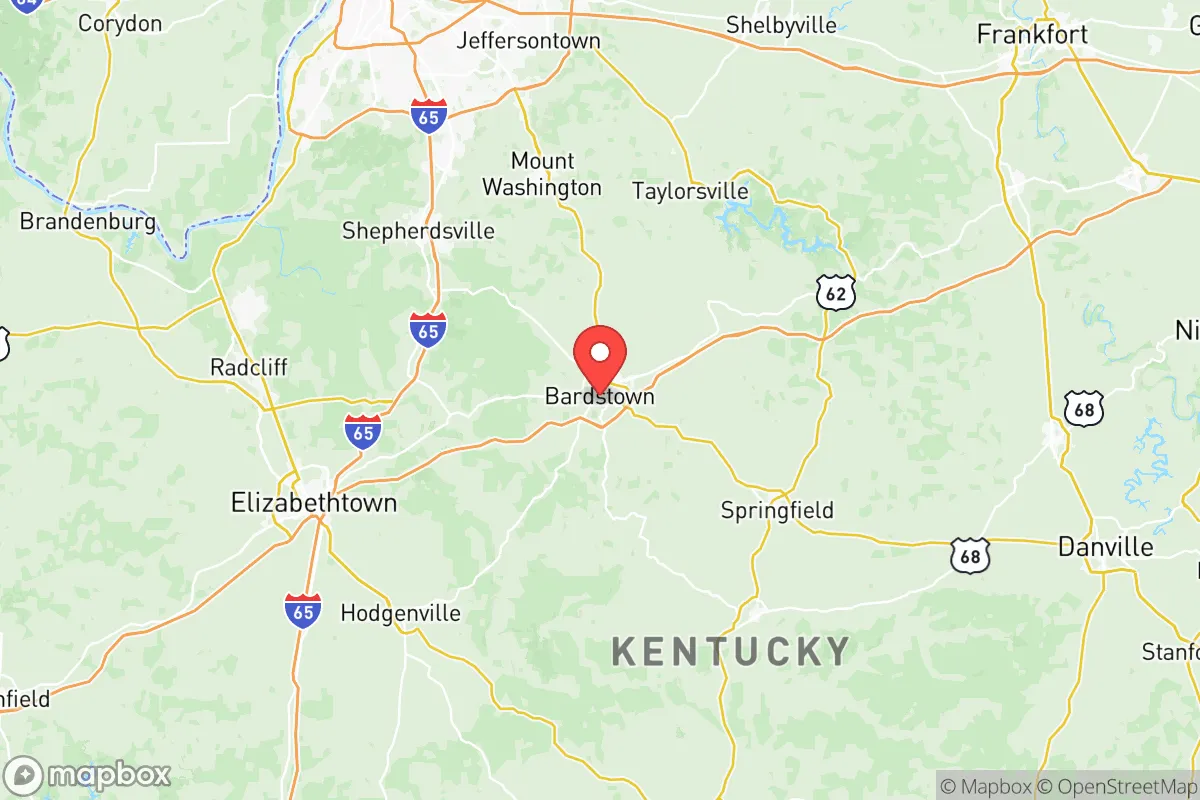
While Kentucky's R+15 rating already makes it a solidly red state, Nelson County's R+20 places it among the more conservative counties in the state's central corridor. The difference is most visible in presidential elections: in 2020, Donald Trump carried Nelson County by roughly 38 points, while he won Kentucky by about 26 points. That 12-point gap between county and state is consistent with the PVI difference. The county's rural character and strong agricultural and manufacturing base—anchored by employers like Heaven Hill Distillery in Bardstown and Dana Incorporated in Bloomfield—reinforce its conservative lean. However, there are notable internal variations. Bardstown, the county seat and largest city (population ~13,000), is the most politically mixed area. Its historic downtown and growing tourism sector have attracted some younger, more moderate residents, and precincts near the city center and around the Bardstown-Bloomfield line have occasionally swung within 5-10 points of the county average. In contrast, New Haven and Boston are deeply red, often voting 70%+ Republican. The Cox's Creek area, straddling the Bullitt County line, is a swing precinct of sorts—it's conservative but less intensely so than the rural south, reflecting its mix of exurban commuters and longtime farm families.
What this means for residents
For conservative residents, the political climate is comfortable and affirming. Local offices—from the county judge-executive to the school board—are held by Republicans, and policy debates tend to center on tax rates, infrastructure, and economic development rather than social issues. The Nelson County Republican Party is active and well-organized, with regular meetings and a strong presence at the county fair and local events. For liberal residents, the reality is more nuanced. They are a clear minority, but not an invisible one. Bardstown provides a relative haven, with a visible Democratic presence in the city council and a handful of progressive-leaning community groups. The Nelson County Democratic Party maintains a modest but persistent operation, focusing on voter registration and local races. In practice, most residents—regardless of affiliation—report that day-to-day life is civil and neighborly. Political signs are common during election season, but heated arguments at the grocery store or over the back fence are rare. The county's strong Catholic and Protestant heritage, combined with a culture of "live and let live," tends to keep political differences from boiling over into personal animosity.
One cultural distinction worth noting is the role of the bourbon industry. Bardstown is known as the "Bourbon Capital of the World," and the industry's economic clout has created a pragmatic, pro-business atmosphere that sometimes blunts ideological edges. Both conservative and liberal residents tend to support policies that protect the distilleries and the tourism they bring, even if they disagree on other issues. Looking ahead, the county's trajectory seems likely to remain red, but the margin could narrow slightly as Bardstown continues to grow and attract a more diverse population. The rural-urban divide within the county will probably widen, with Bardstown becoming a bit more purple while the outlying towns stay deep red. For anyone moving here, the key takeaway is that Nelson County is a place where politics matters, but it doesn't define everything—and where you can find your people, whatever your lean, as long as you're willing to look.

State Political ClimatePolitical Climate in Kentucky
State Political AnalysisPolitical Environment in the State
Kentucky is a deeply Republican state with a Cook PVI of R+15, meaning it votes about 15 points more Republican than the national average in presidential elections. The state has shifted hard right over the past 20 years — in 2000, it was a competitive swing state that went for George W. Bush by just 4 points; by 2024, Donald Trump carried it by over 30 points. The dominant coalition is a mix of rural and small-town conservatives, evangelical Christians, and working-class voters who have abandoned the Democratic Party in droves, particularly in the eastern coalfields and western farm counties. Louisville and Lexington remain Democratic strongholds, but they’re too small to offset the rest of the state.
Urban vs. rural divide
The political map of Kentucky is a textbook case of urban-rural polarization. Louisville (Jefferson County) and Lexington (Fayette County) are the only reliably blue areas, each voting for Joe Biden by about 20 points in 2020. These two metros contain roughly a quarter of the state’s population and drive nearly all Democratic votes. The rest of the state is deep red. Northern Kentucky — the Cincinnati suburbs in Boone, Kenton, and Campbell counties — used to be a swing area but has moved right, with Trump winning Boone County by 18 points in 2024. Bowling Green (Warren County) is a growing conservative hub, home to Western Kentucky University and a large industrial base, voting +30 R. The most dramatic shift has been in eastern Kentucky — counties like Pike, Floyd, and Letcher that voted for Bill Clinton in 1996 now go Republican by 50-60 points. Owensboro (Daviess County) and Paducah (McCracken County) are reliably red, while Frankfort (Franklin County), the state capital, leans slightly Democratic due to state government workers but is trending right.
Policy environment
Kentucky’s policy environment is solidly conservative, shaped by a Republican supermajority in the legislature and a GOP governor (Andy Beshear, a Democrat, is a notable exception — he won in 2019 and 2023 by running as a moderate, but the legislature overrides his vetoes routinely). Taxes: The state has a flat income tax of 4.5% (down from 6% in 2018), with a scheduled phase-down to 4% by 2026. No estate or inheritance tax. Sales tax is 6% on most goods, but groceries and prescription drugs are exempt. Regulatory posture: Kentucky is a right-to-work state (since 2017), and the legislature has passed tort reform capping non-economic damages in medical malpractice cases. Education: School choice is expanding — the 2021 Education Opportunity Account Act created tax-credit scholarships for private school tuition, though it’s been tied up in court. Charter schools are legal but virtually nonexistent. Healthcare: The state expanded Medicaid under the Affordable Care Act in 2014, but the legislature has added work requirements (currently blocked by courts). Abortion is banned with no exceptions for rape or incest, only to save the mother’s life. Election laws: Voter ID is required, early voting is limited (no-excuse absentee voting was expanded during COVID but rolled back), and the state has a Republican secretary of state who has pushed for stricter ballot security.
Recent policy direction
The last five years have seen a rapid conservative shift across multiple fronts. Gun and self-defense law: Kentucky is a constitutional carry state (permitless carry for adults 21+ since 2019), and the legislature passed a "stand your ground" law in 2022. Parental and education rights: The 2022 "Parents’ Bill of Rights" (HB 563) requires schools to notify parents of any changes to a child’s health or well-being, effectively banning transgender students from using bathrooms matching their identity without parental consent. The state also banned teaching "divisive concepts" related to race and sex in public schools (SB 1, 2022). Speech and privacy: No major surveillance expansion, but the state has a broad public records law that’s been weakened by recent exemptions for legislative records. Medical and bodily autonomy: Abortion is effectively banned (trigger law took effect in 2022), and the legislature passed a ban on gender-affirming care for minors in 2023 (SB 150), overriding Governor Beshear’s veto. Property rights: Kentucky is a "Dillon’s Rule" state, meaning local governments have limited authority unless explicitly granted by the state — this has been used to block local gun control and anti-discrimination ordinances. Taxation: The flat tax phase-down is ongoing, and the legislature passed a bill in 2023 to eliminate the state income tax entirely by 2030 if revenue targets are met. Voting and ballot access: The 2021 election reform bill (SB 2) shortened the absentee voting window, required ID for all voters, and banned ballot drop boxes.
Civil unrest & political movements
Kentucky has a history of political activism, but it’s less visible than in coastal states. Protest history: The 2020 Breonna Taylor protests in Louisville were the most significant — they lasted months, resulted in the National Guard being deployed, and led to a single charge (wanton endangerment) against one officer. The city remains a flashpoint, with ongoing debates over police reform and a federal consent decree. Organized movements: On the right, the Kentucky Freedom Coalition and local Tea Party groups are active, pushing for school choice and anti-abortion legislation. On the left, the Kentucky Democratic Party is weak, but grassroots groups like Kentuckians for the Commonwealth advocate for criminal justice reform and environmental justice. Immigration politics: Kentucky is not a border state, but the legislature passed a bill in 2023 requiring local law enforcement to cooperate with ICE (HB 258). There are no sanctuary cities. Election integrity: The 2020 election saw Trump’s "Stop the Steal" movement gain traction in rural counties, but no major fraud was found. The state’s Republican secretary of state, Michael Adams, has been praised by both parties for running clean elections. Visible flashpoints: A new resident would notice the "Blue Lives Matter" flags in rural areas and the occasional "Fuck Trump" bumper sticker in Louisville. The divide is cultural as much as political — Louisville feels like a Midwestern city, while the rest of the state is distinctly Southern.
Projection
Over the next 5-10 years, Kentucky will likely become even more Republican. The state’s population is growing slowly (about 0.5% annually), and the growth is concentrated in the conservative suburbs of Louisville and Lexington, not the liberal urban cores. In-migration is mostly from other red states (Tennessee, Ohio, Indiana) and from Californians seeking lower taxes, which reinforces the rightward trend. The Democratic Party’s only hope is the Louisville and Lexington metros growing fast enough to offset rural losses, but that’s unlikely — the state’s rural counties are losing population, but they vote so overwhelmingly Republican that even a small number of voters there outweighs urban gains. The flat tax phase-down and potential elimination of the income tax will make Kentucky more attractive to conservative relocators, while the abortion ban and anti-LGBTQ laws will deter liberal newcomers. Expect the legislature to continue pushing school choice, further restricting abortion, and possibly passing a permitless carry law for 18-year-olds. Governor Beshear’s popularity (he won re-election in 2023 by 5 points) shows that a moderate Democrat can still win statewide, but the legislature is so gerrymandered that Republicans will hold supermajorities for the foreseeable future.
For a new resident, the bottom line is this: if you’re conservative, you’ll find Kentucky’s politics comfortable and getting more so — low taxes, gun-friendly laws, and a government that prioritizes parental rights and religious liberty. If you’re liberal, you’ll be in a distinct minority outside of Louisville or Lexington, and you’ll face a legislature that actively opposes your views on abortion, LGBTQ rights, and education. The state is stable, with no serious secession or nullification movements, and the political violence seen in other states is rare. The practical takeaway is that Kentucky rewards those who align with its conservative majority and offers a low-cost, low-regulation lifestyle, but it’s not a place where political dissent is likely to change policy anytime soon.
* Values derived from national, state, county, city and local statistics and may differ in a specific area. Last updated: 2026-07-27T10:00:16.000Z
Narrative content on this page is AI-generated and may contain mistakes. Verify any details that matter before acting on them.
ReloMaps may earn a commission from affiliate links at no extra cost to you.

